Skip to content
Search

Latest Stories

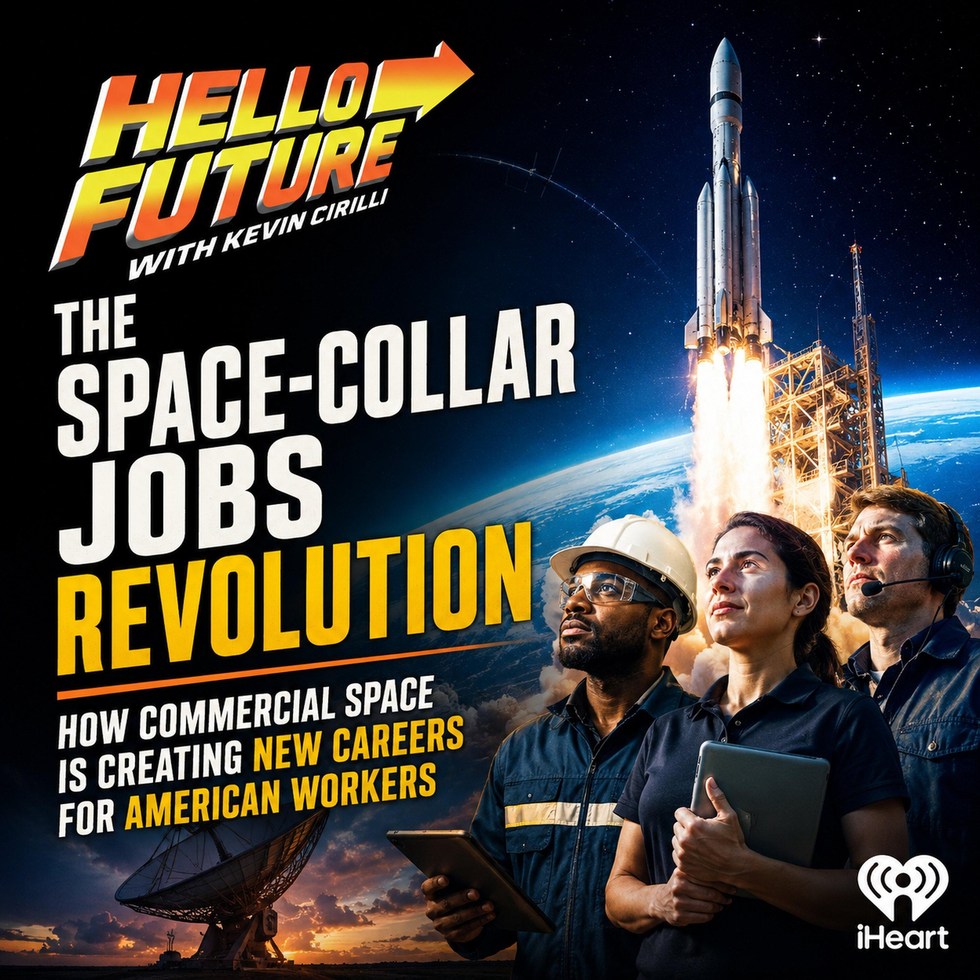
HELLO FUTURE: Space Jobs are Everywhere (You Just Can't See Them Yet)

HELLO FUTURE: Space Jobs are Everywhere (You Just Can't See Them Yet)


Kevin Cirilli sits down with Michael "Ludes" Martindale to talk about one of the most important and least understood challenges facing the future of space: people.

As Education Director at the Space Force Association, Martindale is focused on building the pipeline for the next generation of space talent from high school students to undergraduates and beyond. His mission: make space real, reachable, and relevant long before someone ever considers becoming an astronaut.


In this conversation, Martindale explains how space is no longer an abstract concept reserved for science fiction or elite pilots. Space now touches everyday life from GPS and AI to communications, energy, and national security and the jobs supporting it span welding, cybersecurity, data science, education, policy, and more. Being an astronaut, he says, is just the tip of the iceberg.

Kevin and Ludes explore how experiential learning, hands-on programs, and workforce development can help young people see themselves in the space economy whether they grow up in Silicon Valley, Washington, DC, or rural America. They also discuss how pop culture sparks curiosity, why space-collar jobs are already here, and how todays industrial revolution is opening doors most people dont even realize exist.

This episode is a reminder that the future of space wont be built by a few heroes in orbit it will be built by millions of people on Earth who finally understand that space is already part of their lives.

See omnystudio.com/listener for privacy information.
Speaker 1 (00:08):
Nowadays, all the young kids, the youths of America, they
want to know how to get a job. They want
to know where the future of jobs are. I say,
look up at the stars of night. It's an outer space.
Hello Future.

Speaker 2 (00:20):
It's me keV.

Speaker 1 (00:21):
This is a dispatch from the Digital Frontier. The planet
is Earth. The year is twenty twenty six. My name
is Kevinsrelei. I'm the founder of MTF dot TVs Meet
the Future, one of the homes for the Hello Future podcasts,
which by the way, you can get by downloading the
iHeartMedia app. And I tell the kids, you want a
job these days, go to space. It doesn't necessarily mean
you've got to go up to space and you know,
live on the Moon or live on Mars, which is possible,
but it means working in the space economy, the space
freedom economy, because I believe it's not just enough to
work in the space economy. You gotta work in the
space freedom economy to protect space. And my guest today,
I interviewed him down in Orlando the other week at
the big Space Power conference they have down there, doctor
Michael luds Martindale. He's the Space Education Chair for the
Space Force Association. So he's going to talk to us
all about how leaders in the space industry, in the
Space Force community are working to get kids excited about space.

Speaker 2 (01:25):
Take a listen. So you're tasked with helping to teach
the next generation about space and why they should care
about outer space and national security. Tell me a little
bit about what you do.

Speaker 3 (01:38):
Great, So thanks for having me. I really appreciate it. Ken.
So really, what I do is I build a team
to do what you just explained. So I bring in
folks into this Space Force Association, to the Education Committee
so that they can build programs that provide what we
call workforce development or human capital development programs that target
primarily our youth, high school age, undergraduate students ultimately throughout
the continuum, the education continuum, where we capture them in
when they're young and take them all the way through
their career.

Speaker 2 (02:17):
How did you get the bug to do that?

Speaker 3 (02:20):
Bill Wolf? He and I served together for a long
time in the Air Force as space operators, and he
was one of my students at the Air Force Weapons
School where I was an instructor in the Space division,
and he contacted me shortly after he developed the idea
to start the association. We had coffee. He said, Hey,
I want to do this thing. Education is a big
part of it and I need somebody to help me
out with that. What do you think And I said,
sounds great.

Speaker 2 (02:45):
So as you're talking to me, I'm thinking of who
were the people that got me into space? Bill I
the science guy. Yeah, Buzz light Year, Buzz Lightyear, ter
Infinity and beyond, you know all that, and then obviously
like DC Comics and Marvel and all of these like
Action Here is Interseller, my all time favorite movie. Pop
culture plays like such a huge, huge role, but it's
almost really not even scratching the surface of the possibilities
in what I like to call space collar jobs. Like
everyone right now is started to whare are the jobs?
Were the jobs? And like the jobs in the future
are actually here today. These are space jobs. So what
are some of the tactics that you're deploying in order
to help reach the next generation of explaining the importance
of space domain because it's you know, we're living through
another industrial revolution. You're exactly right, we are living to
a revolutionary period as we get prepare ourselves to take
advantage of this space domain and most of our programs
there's an educational element, but what we don't want to
do with the use is just give them another class, right,
So we've developed programs that are very experiential. So for example,
I don't know if you talk to Sophia Sciba, the
director for the Space Professional Society. So this society that
she developed and runs for the Space Force Association, targets
undergraduate students of any flavor who were just interested or
curious about space, and then provides experiential events to help
inspire them to pursue that that interest and with the
idea of we need people in all walks of life
interested and motivated to either participate in or at least
support the nation's efforts.

Speaker 3 (04:32):
In the space domain.

Speaker 2 (04:34):
It is really cool to see like in the past,
like how episodes of the Magic School Bus I remember
when I was a kid, How they're starting to become real.
I mean science fiction? What was one science fiction is
now real? Just give us an example of what young
kids are being introduced to about space. When I was
a kid, we learned all the names of the planets,
and we thought that was it right. How has it
even changed in the last twenty years. How we're planning
the seed of space exploration in the next generation.

Speaker 3 (05:04):
So some of it is still similar to your experience,
my experience, and I'm a few years older than you are,
through things like astronomy where you can see the beauty
of what's out there, right, So things like that that
have been humans before telescopes were doing that, right. But
now one of the things that really draws young people
in is how you can show the connection of space
to so many things that they do in everyday life.
You know, the things that everyone talks about, global positioning,
things of that nature, but when even if you talk
about artificial intelligence, they're all super interested in that. Well,
we're using artificial intelligence technologies to assist us in the
pursuing the space domain, operating in the space domain, and
so you can tie it to so many different things
and so many different interests space. As the domain is
becoming less abstract, you might not be able to go
there fully on board on if I can get a chance.
But you know, if you can't pay to get a
commercial flight or be young enough and have the right
skill sets and get into an astronaut program, that's okay,
because so many things in your day to day life,
touch space, and you can make it real through those
other things. So it's less abstract.

Speaker 2 (06:16):
And the final question that I want to ask you
is essentially that you know, I'm based in Washington, DC,
and I remember what the buzzword was AI AI artificial intelligence,
and you know, I'm thinking AI that thinks. So in
the past, I'm focused on Quanta and I'm focused on
colonizing Lars. Let's go mind series and solve the national debts.
You know what I'm trying to say. But to make
it less abstract. It is really interesting because when I
was a kid, the only way to get a space job,
in my mind, the only way that I could comprehend
it was to be an astronaut. But I no longer
think that way, and so this next generation needs to
understand not just the next generation, we all really should
make the leap that no, no, no, no no. You
can have a job in Silicon Valley and associate that
with tech. You can have job on Wall Street and
associate that with science. You can have a job in
refining and associate that with energy policy. You can have
a job in the space industry. And by the way,
being an astronaut is only the tip of the iceberg
in terms of the economy and the ecosystem, the universe
relacked better. Analogy that's out there, is that what you're
talking about.

Speaker 3 (07:29):
Yeah, that's exactly what I'm talking about, the fact that
I grew up in rural Michigan around the auto industry. Yeah,
and we took classes in auto mechanics. Folks took classes
in welding because you knew where those were going to
take you. If that's the things that you did, you
could do the same thing. Put a young person through
a welding certification course and inspire them by saying, hey,
you can go get a job with this company that
builds rockets. They need welders. Also, you could help the
AI people develop the welder that could be the welder
that does the on orbit repair or construction of capabilities.
Also the tangible way that you can actually show how
they can touch space without being the astronaut who's you know,
the master's degree in aeronautical engineering, and then you know
they can they can see a path where they can
still touch it. And I think that is a thing
that is a way that it's easier to inspire and folks,
young people in particular to pursue space because they can
see where they can touch it while it's not inaccessible.

Speaker 2 (08:40):
I know people's talk smack on ARMAGEDDA, but anyone who's
listened to the show knows how much I love Armageddon
because anyone who knows someone who's worked in a refinery it.
You watch that movie as a kid and you're like,
oh my gosh, the refinery workers just save the planet
from an astro. What's your favorite side oftime?

Speaker 3 (08:57):
Maybe last question, I gotta go original aliens, Okay, if
it's a genre of sci fi for me that I
really am to.

Speaker 2 (09:05):
Yeah, that's awesome. Thank you so much for it, for
coming on and explaining. I hope you get to talk
more in the future as well.

More For You