Skip to content
Search

Latest Stories

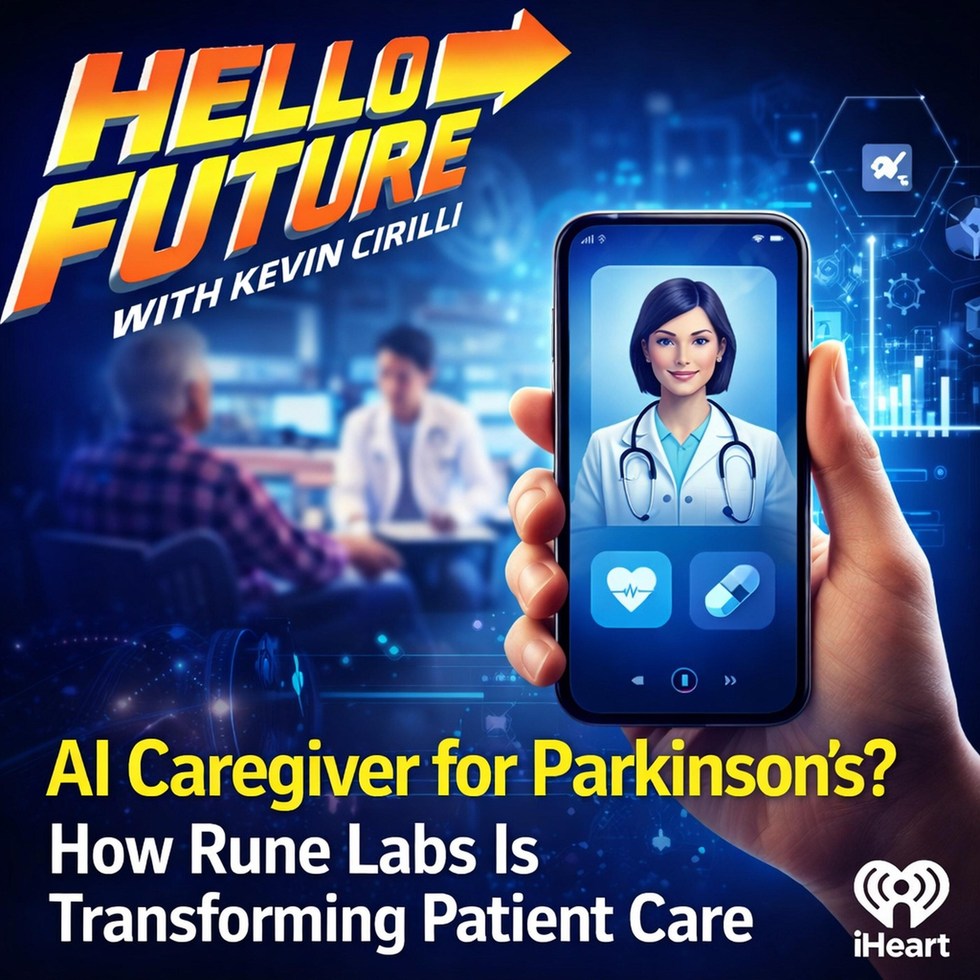
HELLO FUTURE: AI Caregiver for Parkinson’s? How Rune Labs Is Transforming Patient Care

HELLO FUTURE: AI Caregiver for Parkinson’s? How Rune Labs Is Transforming Patient Care


For millions of Americans living with Parkinson’s, the gap between neurology appointments can feel like a void. Symptoms shift, medications need adjusting, and questions pile up with nowhere to turn.
Rune Labs has built an AI caregiver inside its StrivePD app. Powered by FDA-cleared movement-analysis technology and one of the largest real-world Parkinson’s datasets, the tool gives patients a conversational AI they can ask about symptoms, medication timing, and day-to-day disease management anytime.


The system coordinates specialized AI agents — a Medication Assistant, Symptom Expert, and PD Coach — that deliver personalized, evidence-based guidance based on each patient’s own real-time data.


In this episode of Hello Future, Kevin Cirilli talks with Rune Labs’ new CEO about the technology and its potential impact on Parkinson’s care.


We also hear from a Parkinson’s specialist and a patient using the app.

Meet The Future: https://mtf.tv/

See omnystudio.com/listener for privacy information.

Speaker 1 (00:08):
Everybody's talking about telehealth and artificial intelligence and its impact
on how you get treated for diseases and illnesses and
the cures for all of it. That's what we're diving
into today. Hello Future, it's me keV. This is a
dispatch from the Digital Frontier. The year is twenty twenty six.
The planet is Earth. My name is Kevin Serrilli. You
can listen to all of the Hello Future episodes on
your iHeartMedia app. Joining me today is Amy franz In.
She is the CEO of Rune Labs, and they're launching
an AI caregiver inside of their STRIVEPD app that is
essentially going to fill the gap between neurology and symptoms
and the complicated world of medications, all of these questions.
How is AI dealing with all of this, but specifically
focusing on Parkinson's disease, which is so thing my grandmother
had and that's why this story caught my attention. Amy,
Thanks for being here. Tell us a little bit about
how Rune Labs is using artificial intelligence.

Speaker 2 (01:09):
Sure, thanks, Kevin, so glad to be here. Let me
give a little bit of a background on what we
do at Rune Labs. So I can actually put it
into context, and then I'm super excited to share with
you how we're taking what we do and transforming it
into a way that makes it just incredibly useful to
all different parts of the ecosystem. So, Roun Labs is
a digital health company. We've built an app called Strive PD.
We have about twenty thousand users across one hundred and
seventy sites. We have incredible app store ratings and retention rates.
And I think what's really clear and has been clear
since the beginning of the company, is that people living
with Parkinson's disease really get a lot of value from
what we do, which is roughly a continuous monitoring of
motor symptoms and daily active lives of those living with
parkins disease. So the platform itself serves people with Parkinson's disease,
it serves health systems, and it serves pharma companies that
are running clinical trials managing neurology patients and interested in
the continuous monitoring of patients that are on trials. With
our existing platform, we have been collecting a tremendous amount
of understanding on patients with Parkinson's and so what that
means is that we now have this clinical grade understanding
of neuroscience, of course, but also in the context of
this big population of Parkinson's patients. And so the evolution
of the product, which I'm super excited to talk about
today is called Guardian. Guardian is what happens when years
of this clinical grade in neuroscience meets modern AI and
really only we could do it because we have that context.
If you think about you know, the healthcare system was
really built for episodic care. Right you go in, you
see your clinician, and then three to six months later
you're seeing your clinician again. But your disease is changing
every minute of every day. It progresses slow, it progresses fast.
And capturing that in an objective way and then being
able to relay that to your clinician objectively is really
the magic behind Guardian. And so you know, what I
like to say, and what I've actually heard straight from
a patient is that Guardian is different. It has your data,
it understands your patterns, and it's there in the middle
of the night when your doctor isn't to.

Speaker 1 (03:34):
Be blunt with you. So many people have dealt with
AI bots that stink and it's so frustrating. You know,
it's like doing your taxes and the dentist and your
cable provider all wrapped into one, and it's just you
get stuck in a loop. You get so frustrated you
want to throw your phone against the wall. Am I
speaking from experience? I don't know, Bob, you want to
throw your phone against the wall and you're like, what
the heck? Like, I just want this very simple answer,
or worse if you call brass zero pras zero if
to speak to this. I think the average person can
figure out within thirty seconds whether or not the AI
bot is going to help them or they're just trying
to find some type of cheat code hack to get
to talk to a human. I think the test of
success is whether or not the user is thinking to themselves,
I just want to talk to a human, because no
one would think that if they just want us to
talk to a bot. So, as we're in this culture
and this will we talk about a lot on the show.
I mean, talk to me a little bit about that,
not you know, you know, like talk to me human
to human. How do you think about that? As a CEO,
because when I interview CEOs, we try to get past,
you know, some of the talking points of the company
and just like into how are you as a leader
thinking about this moment. We're at the start of the
fifth Industrial Revolution, We're at a shift, you know, baby boomers,
and candidly like, if you're over the age of forty,
you're used to talking to humans and this is like
you're asking people to do not you, but the industry
is asking people to have a really big shift under forties.
We're sort of like, okay, we're kind of used to
this where the COVID generations, we get it, So how
are you thinking of all of that through?

Speaker 2 (05:10):
It's exactly the conversation we should have. You know, of course,
the demographic that we're dealing with with Parkinson's is very
much of an over fifty five demographic, and so you know,
you're right, you're hitting on a group of people that
really want to talk to a human. There's a lot
of concern around data privacy, there's a lot of concern
around you know, like I don't want to talk to
a chatbot. I just want someone to help me. And
I think that the bar is exactly as you said,
like is this better than talking to a human? And
I think that you and I have probably experienced that.
Like I've just found tremendous efficiency in my role as
a CEO by you know, powering up Claude and like
thinking through problems with it. It's like the best chief
of staff I could ever have. And I understand it's limitations,
and I understand where it comes from. And I think,
you know, I'm of an age demographic and just an
experience where like I can really rent my arms around that,
and that's not necessarily true of everyone. And so the
bar to hit is yes, like is this better than
talking to a human? Two things they are. One a
proof point. We launched to a small group of users.
We've got five hundred Strive users that are using Guardian
today and it has become unquestionably habitual for them. We've
seen on average, nineteen conversations per person, which is much
higher than what I was expecting. So meaning, you know,
since launched just two and a half weeks ago to
that group, on average, they've come back nineteen times to
keep asking questions their data, putting their data into context
in just like really clear ways, and you know the
questions they're asking are symptom interpretation and emotional reassurance, and
like we're reading these blogs actually see that people are
getting value because they keep coming back and asking more questions.
And I think that the reason they're doing that is
that this is not to be like buzzy, but this
is truly a gentic ai. It's not a chatbot.

Speaker 1 (07:14):
Wait a bit, wait a bit, Wait a minute agentsic ai.
There's this debate happening in the community right now. Some
folks are saying that we're still years away from that
and that you know, it's just this marketing buzzword. Scientists
and others are saying, like, we've got a ways ways
to go. What do you mean, I want to get specific?

Speaker 2 (07:32):
Yeah, I love it. Okay, So here's how we built it.
Think about it, like, we have these specialized domain agents
that route your incoming message into a specialized pot and
so we have a medication domain it comes from like
you know, the right spot for medication that is very
relevant to the Parkinson's population. We have a symptom expert,
we have a PD coach, we have a data visualization
agent that we built specific to this community, and underlying
all of that is data on Parkinson's patients. Here's an example,
sleep suffers greatly throughout your evolution in this disease. And
so when you sleep with an Apple Watch on and
you look at your sleep score every day you wake up,
it's going to be like your sleep sucked.

Speaker 1 (08:19):
This is why I don't sleep with my Apple Watch
is because literally I'm too competitive and I would get
mad at myself.

Speaker 2 (08:25):
There's a trick actually, you know what I heard is like,
don't look at your score in the morning, look in
the evening so it doesn't screw up your day.

Speaker 1 (08:32):
That's a great pro tip from Amy friends and the
CEO of Room Labs. That is a great pro tip. Yeah,
the information off.

Speaker 2 (08:40):
Until where that came from exactly. But you know that
score is based on the general population, and so it's
just very defeating when you have disease and drug interactions
that make your sleep suffer. What you really want to see,
of course, is like how is this sleep relative to me?
And how is this sleep relative to my peer set
who are also three years into this disease, And that
is I'm going to take the word agentic out of
my vocabulary for now, but that's what I mean when
I say that this guardian layer that we have is
both personalized and just not a general chat.

Speaker 1 (09:22):
It like that. I like the concept of the way
you explained it. It's almost like, and we talk about
this so frequently on Hello Future, it's almost like you've
got a video game and there's multiple players in the
video game that are all doing different things all at once.
And so I like this idea of what you've created
is that you have a team of ais that each
have different functions, that are continuously working twenty four to
seven to give you the most up to date answers
and things for people to get. I guess I would
say I read a lot about AI and I'm curious
for your and your background speaks for itself. Worked at Mackenzie,
You've worked at Nike, you went to Cornell. I mean,
you've really have had such an incredible successful career and
now you're the CEO of Rune Labs. But I would
be really interested to hear how you're thinking about this
idea of trust between a human an AI, and not
just in general or specific to Rune because for me
as a millennial when I was growing up, I mean,
we still talk about it, like, don't if you ever
have a symptoms, then you go online and ask I
have a call to tell you that you're dying, you know,
like it's like the worst thing ever. And then there's
also all of these reports about people being really vulnerable
and using AI as like a therapist or getting really
personal advice. And I'm wondering how if you how you
think about these trends, what you think about these trends
and the impact that it could have, because I mean,
especially you're you're dealing with the elderly in many cases,
So how are you thinking about all that?

Speaker 2 (10:59):
Yeah, and I think you're right, like we're at this
tipping point right now, and it could go as a
as an industry in a lot of different directions. And
I do think that it is behold into companies like Roun.
What we're you know, what I'm leading here that we
take really extra care, especially of this vulnerable population. And
so we did, you know, build a few things in
and then I'll talk to you how I'm thinking about
it in the future. You know, one every agent of
those you know kind of couple that I mentioned operates
within a bounded action space, and so what that means
is that there are only so many actions allowed to
take before there's a trigger that says contact your care
team for emergency guidance. And so you know, because we
are not providing care or medical support or clinical support,
we have just the privilege of being able to say,
like hold on, stop, contact your care team. And so
you know, that's one We spent a lot of time
testing that out and hunting for moments of experience where
it could veer into danger zones medical advice, and we
feel super confident that we're on the right side of
that line. I think the other thing is just like
calibrating your language to be supportive and not alarming and
not overreaching. It's something that will continue to be iterative,
you know. I think the pros greatly outweigh the cons
to be able to have this tool that a lot
of our users are using just for journaling, like you know,
giving thoughts and hearing them back and feeling more supported
and feeling more like they're not doing anything wrong. Just
such a positive experience that I do see it kind
of as a blueprint for how AI could reshape, you know,
disease management, especially on the supportive side that we're on.

Speaker 1 (12:40):
It's fascinating disease management and AI, I mean, and it
is the future. I mean, and in many ways, as
I mentioned under forties, this is we're native to this
in many ways, whereas you're transitioning a demographic over to this.
So in the future it will just be more and
more commonplace. As a business person, then the ROI of
what's happening right now, there's it would appear there would
be a lot of upside because more and more people
are going to get used to this as time continues.

Speaker 2 (13:09):
Correct, absolutely, yeah, more and more people are going to
get used to it. And I think you know, we've
already seen with the sixty five and over population a
really strong adoption of this, and it you know, sometimes
it starts small and timid, but then with the just
how natural language these AI systems are, and you know,
most of our users are talking into it, you know,
voice to text and then you know back in audio
you can just really quickly get into a conversation and
then it becomes you know, keeping those safety rails in
place to make sure you know that you are not
talking to a human. But it's very cool to see
and for us to watch in the in the feedback
data that we're getting.

Speaker 1 (13:46):
It is fascinating because I just had an aha moment.
I call it a meet the Future moment because I'm
sure Oprah probably trademark AHA moment. I'm just kidding. I'm
not trying to get in a beef with Oprah. I
love Oprah, but yeah, yeah, exactly, by the way, like
she's a brilliant interviewer. But to Meet the Future moment,
which was actually AI is a lot easier to use
than the Internet when you think about it, because it
takes the searching out of it. So I would imagine
that transitioning the elderly onto AI. It's just like, Oh,
all I have to do is ask a question. I
don't have to decide what I'm going to click or
where to go and all that. It takes all the guesswork.
Oh and you don't even have to type it, you
can just speak it. So Amy, friends, And what's next
for you? I mean like you are quickly emerging to
be one of the go to national global executives when
it comes to health and technology and your background again,
I think it speaks for itself. How are you thinking
about this career move and what's your hope as the
CEO of this company Ruined Labs? And do you have
a personal connection to Parkinson's, not that you know, my
grandmother passed away of it. It's a horrible, horrible, horrible,
horrible illness. I want to thank you for all you're
doing for Parkinson's, because it is a horrible thing. Yeah,
we'll give you the last word.

Speaker 2 (15:02):
Yeah, last words. So you know, when I started learning
more about what root Lamps was doing, I just got
incredibly excited about what it means in a really big
way for the future of both care management and drug discovery,
where I think, you know, I don't come from a
background in science or medicine, and so the past ten
years of my career have been bringing a bit of
an outsider perspective, like with a business lens on and
a scale lens on of how do you actually put
all of this incredible science into the hands of the
end users who are the doctors, the patients, and the
pharma companies. And to do that you need to make
it really simple and embedded into the workflow. And I
think that's what we are so excited about at RUN
with all of the AI benefits we get internally in
terms of how we're able to grow the company, but
then also externally in terms of how folks are able
to use what we have, putting it into the existing
really tricky workflows. Is the work at hand, so that
clinicians can actually see this and use it in their
own systems, and drug developers the FDA can actually benefit
from it. And that's where I get really really excited
about the value that I can bring into this industry.
You know, the world's our oyster right now, Like there's
just so much going on and there's so much impact
to be had, and we are chipping away at it
with RUNE, and I think we're you know, great things
are ahead for us.

More For You