Skip to content
Search

Latest Stories

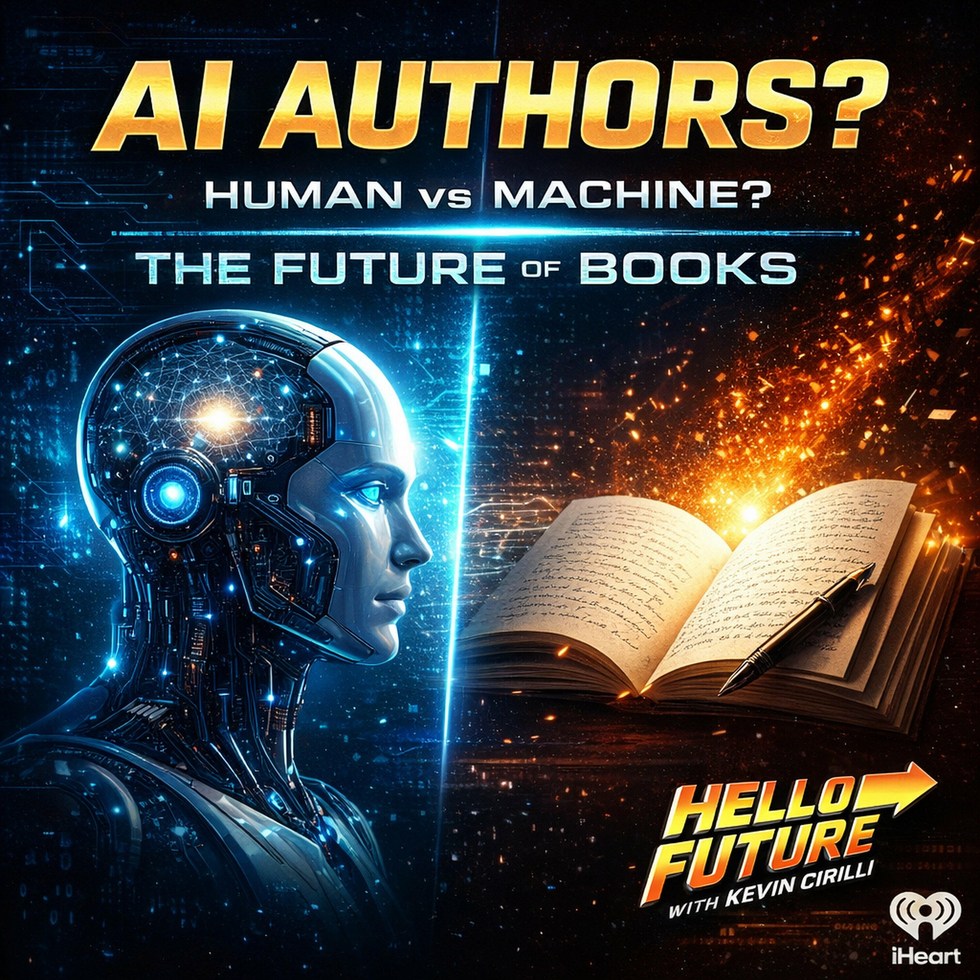
HELLO FUTURE: AI Writing Revolution: Are Algorithmic Authors Replacing Human Storytelling?

HELLO FUTURE: AI Writing Revolution: Are Algorithmic Authors Replacing Human Storytelling?


The Algorithmic Author—Is Your Next Favorite Book a Bot?

What if you could prompt a protagonist into existence as easily as ordering takeout? In this lively episode of Hello Future, Kevin Cirilli dives headfirst into the weird, wild, and wonderfully messy world of AI-written books. Kevin interviews Tim Boucher, who is writing books with AI.


AI didn’t just show up—it kicked writer’s block to the curb. The blank page? Practically extinct.

Algorithms now crank through research, world-building, and plot scaffolding at lightning speed—freeing humans to focus on heartbreak, humor, and the raw emotional spark no machine can manufacture.

This isn’t “Man vs. Machine.” It’s the rise of the Hybrid Author: silicon builds the structure, you bring the soul.

And as digital shelves flood with content, one question lingers: does “100% Human-Written” become the next luxury label in storytelling?

Plug in. The future of fiction is being written—one prompt at a time.

Meet The Future: https://mtf.tv/

See omnystudio.com/listener for privacy information.
Speaker 1 (00:07):
You know, before I was prepping for this show, I
was in a bookstore, a large conglomerate bookstore chain, having
my coffee, looking through news about the future, and I'm
thinking to myself, how is artificial intelligence going to literally
rewrite how authors, how artists, how all of these creative
economies interact with themselves and with the technology. We've dabbled
on that in the music industry. Here on this program today,
we're going to do it with the book industry. Hello Future,
It's me keV. This is a dispatch from the digital frontier.
The planet is Earth, the year is twenty twenty six,
and my guest today is Tim Bouche. He's an author.
He's really been on the front lines of this. You
and technology have written about one hundred and twenty books
in like a very short period of time because you've
been harnessing artificial intelligence. I'm not here to say whether
I think that's right or wrong. I'm just fascinated by
this trend and how and your take because you were
really an early adopter in embracing and owning the fact
that you're using AI. First of all, how did you
get into that lane? And let's go from there.

Speaker 2 (01:11):
Yeah, well, I've been working in technology for about about
ten years, working for platforms and doing like operations and
policy and content moderation and things like this. So I've
got just in the habit of always kind of trying
out whatever the new wave of technology is to kind
of see how it works and how it's going to
impact different things, you know, for social media or you know,
different contexts. So that's really just been a habit of mine.
And I have kind of ongoing work that I've done
world building, like sort of fantasy sci fi universes that
when I go and do those experiments, I just kind
of plug in my own details of these worlds that
I built and use that as the base and then
kind of take that from there and see what I
can do with a new thing. And I guess it
really started probably three and a half four years ago
when the AI tools started getting better. They started reaching
the point where there was like I don't want to
say perfectly production ready quality outputs, but get getting closer
and closer. And I kind of liked that early wave
because it was still kind of low quality. You know,
you got kind of like low budget results sometimes that
were incorrect or not what you expected, but in a
kind of a cool way. So I've always trying to
kind of try to incorporate that into my work of
like what is the state of the art, you know,
and is that good quality? Is that medium quality? Is
that bad quality? Because I've already seen like people looking
back at you know, how the original Dolly from Open
Ai produced things, and people are kind of already nostalgic
for that wave of stuff. So I've done that with books.
I did one hundred and twenty five books in a year,
and I did the same thing at the end of
last year, kind of the same approach with suno AI,
which is a music creation thing, and I did forty
full length albums in a month, just to see like
what is the process, what is the workflow, what is
the quality that you can get? And is it good enough?
Is it interesting? Is it threatening to human creatives? Or
is it something that's going to open up new pathways?

Speaker 1 (03:07):
Okay, So even like two weeks ago on the New
York Times there's an article headlined the new fabio is Claude.
The romance industry, always at the vanguard of technological change,
is rapidly adapting to AI. Not everyone is on board.
So I mean, folks, you don't have to be a
rocket scientist or a technologist to understand the dynamics. Some
people are arguing this is great, This is an efficiency
thing for the book industry. It allows for more creation,
more content, more products. Other folks say, hey, wait a minute,
we got to protect the authors. It's just a bunch
of AI slop. Tim When you're writing the books with AI,
it's incredible your output because you know, that's a lot
of folks think that AI is going to help boost
production and output. But is more, always more? Is writing
one hundred and twenty five books in a year as
good as writing that one best seller that you put
yourself away in.

Speaker 2 (03:58):
And I mean, if I could write that one best seller,
you know I I would happily do that, Like, just
give me the template and all. I'm happy to do that.
But you know, I think that the thing that's interesting
to me about the technology is all of these questions
is the fact that it's not nailed down, is the
fact that it's controversial, and that there are all these
pluses and minuses about it. You know, I don't fall
into either camp. I fall into both camps, you know,
Like I think there are things about it that are
really bad and kind of abhorrent about how it works
or the results that you get. And then there are
things about it that are just like too fascinating for
me to turn away from as an artist, you know,
Like I've looked a lot at art history, especially over
the last let's say, like two hundred and fifty years
since kind of like just before Impressionism, and it's always
been the same thing. Like every time there's a new
technological thing that comes along, it changes how the arts work,
It changes what is exception, it changes what you know,
what is the vanguard, what is interesting, And every time
there's a new vanguard, it's like people don't like it,
you know, they say like, oh, this shouldn't be in
our in our academy exhibit, or this shouldn't be in
our traditional method of you know, presenting things or whatever.
And it's happened again and again, you know, with photography,
with digital art, and so I don't see this as
being any different than any of any of those stages.
And for me as an artist, I would much rather
be someone who has like deeply, deeply engaged with the
technology and firsthand seeing what's good and bad about it
instead of being somebody sitting on the sidelines and just
being It gets to this I don't know, and I
don't want to know.

Speaker 1 (05:31):
It gets to this question of can artists use technology?
I mean, and what is a paint brush but a
form of technology? I tend to lean way more on
the side of embrace the technology, use inject art into technology.
I think that's a positive. It kind of feels like
if a painter were to say that a camera were
a bad thing, and we consider.

Speaker 2 (05:52):
Fill right, and that happened throughout history.

Speaker 1 (05:54):
Yeah, yeah, And so I love that existential question. I
think for me and even with me, music right, I mean,
and everyone has these conversations with themselves with music. You know,
if I ask my parents, you know, Frank Sinatra as
a musician, but Frank Sinatra at one point was a
pop artist, and you know, but they wouldn't consider the
you know, the kids, the gen zs these days, who
are who are releasing whatever songs they're they're releasing on
the TikTok or whatever. But uh, I do find it
interesting and and so I what I love about what
you said is that you're world building. You know, I
folks who are listening to this program. I haven't really
spoken about it much, but I'm developing a play on
the West Coast and it's been taking me more than
two years. It's it's called The Man in the Red Hat.
It's fictional, but it's definitely inspired by my time as
a journalist. And what I love about theater is that that,
to me, represents the original immersive experience and you're you've
got people in a room. It's communal. And what I'm
excited about, and I'd love your thoughts on this, tim
is how technology might be deployed creatively in the future
for storytelling to continue to bring about community. And you're
starting to see it with Cosm, which is a company
that does immersive sports viewing with immersive screens. You're seeing
it with the Sphere in Las Vegas, when we embrace
the technology instead of an intuitively resisting it. This is
why I'm very curious for your thoughts. Where do you
think this is all headed in the next decade and
beyond for specifically the book industry.

Speaker 2 (07:29):
Well, I mean I first of all, I worked in
professional theater for five or six years, so that resonates
with me on a lot of levels. Of this kind
of immersive thing, but also like thinking about real people
in a real space, you know. But before coming back
to that thought, I was reading a book recently. It
was about like relationships and stuff. I found myself while
reading that book wishing that I could like enter the
details of what's going on in my life and then
have the book get kind of like rewritten on the
fly to focus and what's my thing. So I think
that's kind of where I expect in general, the direction
will go. Is that is that the ability to really
personalize and customize whatever your experience is for you. But
while you do that and make it for you, that
could become alienating, you know, like because you're something becomes
so customized to you, it could risk that, you know,
you no longer have a communal experience of music because
you know, I made in my last year, I made
like eight hundred and twenty songs in a month, you know,
but I'm the only person that's ever listened to all
of those songs, you know, and like, so it's there's
something there.

Speaker 1 (08:34):
It could be isolated.

Speaker 2 (08:35):
Yeah, and we're seeing this with kids.

Speaker 1 (08:37):
In the screen time. I mean, when you when you
just live your life online, and I want to come
back to something for the self help market, for the
self help industry, it actually could create new communities in
terms if what you're if what you're engaging with in
the self help book is actually then directing you into
that face to face person to person that I just
had to meet the future moment, folks, where the self
help industry, Bouchet as our guest, who is really out
front in terms of embracing artificial intelligence to write books
and to be an author? The self help industry is
one thing. What about like the mystery thriller, because you
could just choose your own adventure when I was a
kid back in the old NAELM thirty six. Okay, but
when I was a kid, it would be you know,
I remember those books where it would be choose your
own adventure. I love those books. You know, if this
character does this, or you know, go turn to this page,
or if this character does acer to that page. I
would imagine that with artificial intelligence to choose your own adventure,
storytelling capabilities must you must think about that.

Speaker 2 (09:38):
Right, I Mean that's a little bit what my books are.
So like my books, they all take place on the
same kind of like multiverse. But from book to book
the details change, you know, like sometimes even within a
book because of the way that AI works, like the
a I would forget the name of a character, or
would forget the gender of a character, or it wouldn't
invent different random stuff. But then within hallucination, it's of AI.
But I try to incorporate that as a as a feature,
not a bug, you know. But then from each book,
when you hit a certain point that there's another book
that already exists about that topic, you know, there's a
link out to that, and it becomes kind of like
a chooser own adventure, or I think of it as
like an open world, you know, like in video games
where there's kind of like all these different side quests
you can go on and you just choose what you
want to do. There's not even necessarily a central organizing story,
you know, this just like that's what's there. You explore,
you check out stuff. So I think it's it's going
to be the same AI influenced media, you know. And
like what I've done is like every time I thought
of a new topic to kind of flesh out in
my world building, I would just go I would often
start with like, Okay, I go into the LM and
I say, like, here are x y Z details about
my world. Let's do an Encyclopedia entry that kind of
like grounds the narrative about you know, these details, and
then just see what it comes up with. And then
from there. A lot of times I would take and
I would have it do kind of like very short
narrative slices like slice of life vignettes kind of that
take place within that context. And like I said, between
book to book, like the details change. And I think
that's part of what's interesting about it these technologies for
now is because they're so inconsistent and because they're so hallucinatory,
there's something kind of magic about that. If you accept
that that that could be a feature. You know, like
in literature, we have this concept of the unreliable narrator,
which has existed for thousands of years. You know, it's
like someone who's telling you a story that you can't
really necessarily believe everything they say, but from what they're
saying you can kind of like tease out something. So
that's kind of how I.

Speaker 1 (11:38):
Yeah, it's called cable news, keep going.

Speaker 2 (11:42):
Yeah, it exists everywhere.

Speaker 1 (11:43):
It does exist everywhere I also think of the user experience,
like the user experience that I'm chasing when I pick
up a book and read it is calmness, is escapism,
is taking my mind off of things. I inherently understand
as a human being that my eyes scanning the pages
of a story will lead to hopefully a rewiring of
my brain for the positive. And I remember when like
e readers came out, people openly had conversations, Oh, do
you prefer the print holding the book or the or
the tablet. I actually prefer actually holding a book, but
you know some people don't. Obviously I can read on
the tablet now, but I still like the idea of
holding a page. Plus, if you take it to the
pool and it drops, you're not out a couple hundred bucks.
But I wonder if, with the advent of artificial intelligence,
as it becomes more evolved, if the user experience in
a book is not like the The only influence that
we've seen thus far is really twofold one is the
intellectual property, world building capabilities, and development, which I love
what you're saying about, like a psyclopedia. Encyclopedia that was it.
But then secondly, it's just the sheer number of output
increase that you can create. So I'm curious about even that,
like how you are thinking through all of that in
the next twenty thirty forty years. Yeah.

Speaker 2 (13:11):
Well, I did think a lot early on about like,
is there a way that within a text, you know,
whether it's an electronic text or a printed text, that
we could easily and clearly differentiate who is the speaker,
who is the source? You know, like in a play,
a written play, we can attribute things to a narrator
or characters. But when we have texts that are hybrid,
where it's like a human writer plus AI, Like, what
would be an easy or effective way to delineate when
the AI is speaking as the writer and when the
human is and kind of the dance between the two.
I never found a simple way to execute it.

Speaker 1 (13:46):
Yeah, well, because I don't think the technology is there yet.
And what's so fascinating about theater or any script for
that matter, is that the playwright or the screenplay writer is,
by design just create the parameters for world building in
the future, and so a director is charged with creating
that vision. But I think what's fascinating about that industry
is I kind of like the idea of different directors
being able to interpret a story with their own experiences
like that is what inherently makes storytelling communal. Even when
you go see a movie that's a remake, you don't
necessarily want to see the same movie. I like when
there's different twists put on it, or different periods of
time interpret one story very differently than you know another
period of time has done. And I think the audience
likes that, and there's limits, and it's it inherently makes
it more artistic. So I think that's really interesting that
you're saying that. Where did you do theater?

Speaker 2 (14:44):
Mostly in Baltimore, a little in Montreal, a little in
Cape cod but Baltimore and Washington, mostly Washington, DC, mostly.

Speaker 1 (14:51):
What theaters in DC.

Speaker 2 (14:53):
I worked a little bit at the Shakespeare Theater in
Dalla Hispanic Theater in Baltimore, a lot at the every
Man Theater Center Stage, and then a bunch of Montreal
at Centaur and what Seagulls Center and some of the places.

Speaker 1 (15:07):
Very cool. All right, Well, listen, if people want to
check out your books, where should they go?

Speaker 2 (15:11):
They could go to Lostbooks. Dot ca A is the
kind of the headquarters of my little publishing thing, and
then from there you can click through and it will
take you to the ebooks are where most of the
AI stuff is amazing.

Speaker 1 (15:25):
Well, thank you so much Tim Bouchet for showing up
to Hello Future. Thank you and have a great tomorrow today,
thanks you too,

More For You