Skip to content
Search

Latest Stories

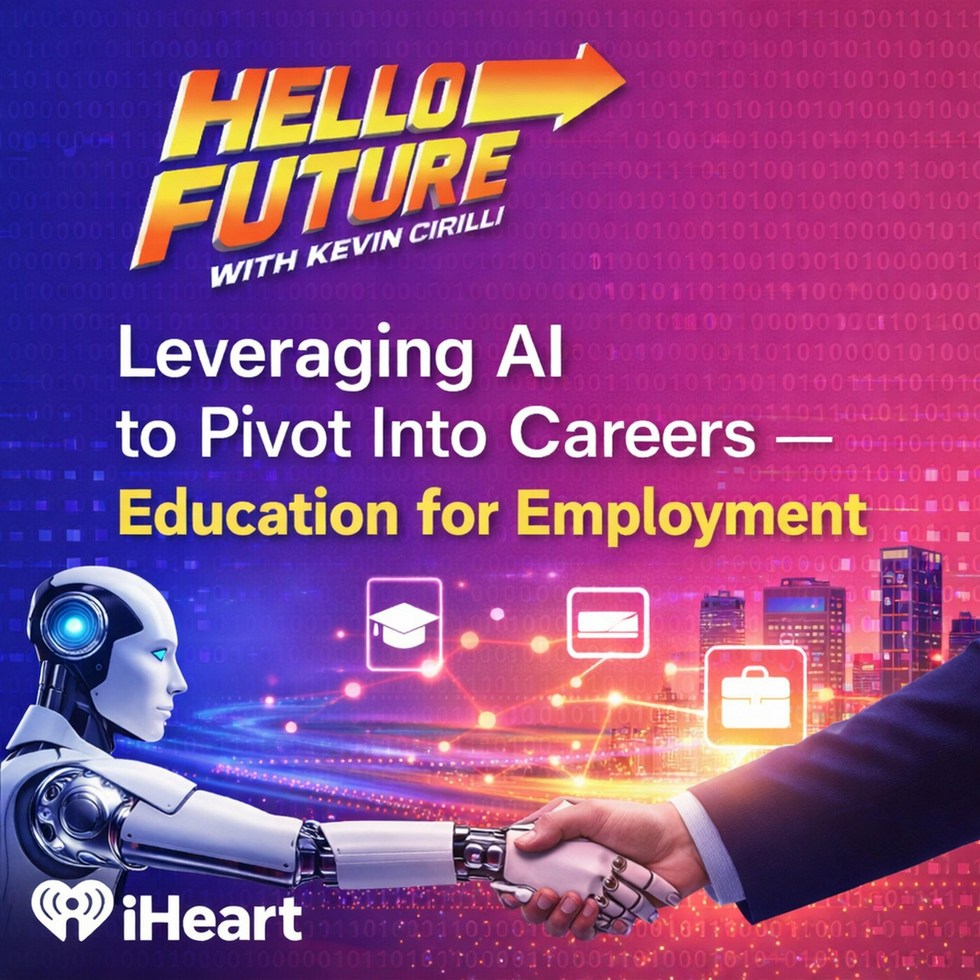
HELLO FUTURE: Episode 2: Leveraging AI to Pivot Into Careers — Education for Employment

HELLO FUTURE: Episode 2: Leveraging AI to Pivot Into Careers — Education for Employment


AI isn’t just disrupting classrooms — it’s rewriting career pathways.

In this episode, Kevin Cirilli spoke late last year with Michael Hansen, CEO of Cengage Group, about the rise of “Education for Employment” and how adults are using AI to reskill, pivot, and compete in a rapidly shifting labor market. With more than 3.5 million people already trained through Cengage Work programs — and hundreds of thousands enrolling each year in allied health, cybersecurity, and high-demand fields — the future of work is becoming modular, digital, and skills-first.


Hansen shares lessons from transforming a legacy print publisher into a modern edtech portfolio company — and why affordability, accessibility, and speed now define workforce education. We discuss how AI tools are accelerating upskilling, how employers are reevaluating degrees versus demonstrated competencies, and why lifelong learning is no longer optional.

If the first industrial revolution reshaped factories, AI is reshaping human capital. The question isn’t whether workers will adapt — it’s whether institutions can move fast enough to keep up.

Meet The Future: https://mtf.tv/

See omnystudio.com/listener for privacy information.

Speaker 1 (00:08):
Listeners of this program know that I believe we are
at the start of the Second Industrial Revolution, and that
the change that is happening not just from the rise
of artificial intelligence, but the inevitability of quantum computing, the
harnessing of potentially fusion energy technology, and outer space exploration
is catapulting our human civilization and society into the unknown,
and I am very optimistic about it. At the same time,
any time you navigate through these impressive, impressive transformations of society,
we have to make sure that people are able to
have work, that people are also able to maintain jobs
and to rise the ranks if they want to pursue
rising through the middle class system and hopefully earning more
than their previous generations. So today we're going to look
at that Hello Future, it's Media Campbals in the dispatch
from the Digital Front. Here. The year is twenty twenty six,
the planet is still planet Earth, and I'm thrilled to
welcome back to the program the CEO of Send Gauge Group,
which has this awesome education for Employment program. They are
now more than seventy percent digital and they're focused on
providing education or employment helping individuals improve their lives, who
are eating tangible education outcomes. Michael A. Hanson, the CEO
of Sundage. Michael, thank you so much for coming back.
Last time we were talking about students and how young
people are learning and the transfer knowledge. But now I
want to focus on people who are already in the workforce,
people who are already having to maybe they are working
at a refinery, or maybe they are working in the
medical per field. AI. People are very nervous, this very
real sense of economic anxiety that AI is going to
replace them or dismantle their industry. But you have a
lot to say about this because you actually think AI
can help to quickly reinvent someone's career, provided that they
are able to learn these skills earlier.

Speaker 2 (02:04):
On Absolutely, Kevin, and thanks for having me. I would
say two things. One is when you get for the
first time in the workforce. And let's use our example.
Both you and I went to college at some point
and then we went out and like would try to
get a job, right, and we were lucky to get
one at some point.

Speaker 1 (02:21):
Right.

Speaker 2 (02:21):
Millions and million students face this every year. Now. They
are today very ill prepared, many of them because the
education system is not connected to the workplace. The education
system is here, and hire it to get you a degree.
But whether that degree gets you a job, your professor
doesn't really care all that much about. They want to
make sure that you get the degree. So the first
thing we have to do is to bring the real
world jobs into the classroom. And we could do this now,
We could do this better than ever with AI. The
second thing is what you are saying, like, when you
are in the real world and you have a job, right,
that doesn't mean that your opportunities end. In fact, your
opportunities start. But with the advance of technology as fast
as it is quantum computing AI, you need to reinvent yourself,
not like me every three or four years, or like you,
maybe every two or three years, but like possibly every
six to eight months. And therefore you need to learn skills.
And the beauty of the current situation that many large
employers have understood that and instead of saying I'm going
to fire a bunch of people because they don't have
the right skills and hire other people, which is very
costly and very time consuming, they are now jumping on
the bandwagon saying I can actually teach the people while
they're in a job while they're making money, and I
can still teach them the relevant skills, and that's called
reskilling and upskilling in fancy ways.

Speaker 1 (03:46):
Well see, I think that's really interesting, especially because I
get what you're saying about the reindention, and that really
speaks to me. You know, listeners of this program know
that in a previous chapter of my career, I was
very much seen and portrayed as a political journalist. That
never really resonated with me because I have so many
different interests and I've always considered myself a future a
sci fi geek at heart, and so I think one
of the things, especially as it relates to right now,
is that the middle class in our country feels so
incredibly nervous that they're going to be put out of
a job. But what you're saying, I think I just
had to meet the future moment I like to call it.
What you're saying is that the companies that will survive
and the employees who will thrive are the leaders of
the companies who understand inherently that quants some artificial intelligence.
We just have to get used to surfing this wave
of industrial transformation. And part of that means retraining your
workforce constantly. So what is an example. Give us a
case study of an industry where this has proven to
work incredibly well for both the most importantly the employee
and then also for the company.

Speaker 2 (04:57):
So I'll give you. I'll give you the example. I
was say two things as a preface. One is we're
at the beginning of this. This is not you know,
this is now leading companies are going into this, but
it's not like a mass phenomenon. That's number one. And
number two. I think one thing I would add to
what you're saying is we need dignity in work.

Speaker 1 (05:18):
Amen, We're not just work. Pause pause right there, Just
so like let's build that underline it. There is dignity
and work. And I just that really resonated with me.
Michael Hanson, CEO of Engaged Group. I mean there has
to be because you don't have purpose without dignity, and
you can't have dignity without self respect and mutual respect.
So I really really respect and appreciate that comment.

Speaker 2 (05:41):
Kick on it here and here is and here is
where the beauty of this moment lies. What artificial intelligence
can do, promises to do, or quantum computing is get
rid of a lot of menial tasks that need to
be done. But what it cannot get rid of is
the ingenuity of the human mind and the care of
the human spirit. So a lot of jobs will become
or are already in high demand. Think about healthcare, any
job that requires human to human interaction, huge amount of
opportunity there, and a lot of the stuff that you
have to deal with now, like you know, insurance reimbursement
and like paperwork, filing, et cetera, will increasingly be substituted.
So I believe we have a huge opportunity to bring
dignity back and you know, just to hard back to
the olden days when somebody was working at Ford Motor
Company on the assembly line. They were dignified. It was
dignified work. They were they were happy, there were the
breadwinners in the family. They came home, and we got
to go to that and back not into like into
assembly line work, but really making sure that people can
put their best abilities forward and not deal with the
mundane stuff that we all at times have to deal with.

Speaker 1 (06:53):
So I think it's it must become important. And I
want to use the energy sector as a potential example,
because like right now, for example, a lot of energy
companies are looking at creating data centers and whatnot, and
data centers and infrastructure for transforming America at other parts
of the world into upgrading our power systems and our
energy structures to be able to run on artificial intelligence,
because no community wants to be left behind in five years,
ten years. Even candidly, right now, I want to make
sure that the hospital that I'm going to, or more importantly,
my loved ones are going to, that they have access
to artificial intelligence data servers for the best quality of
care for medicine. So you're going to need engineers to
help with that transition. And if you're an engineer who's
in their forties or in their fifties, you're not going
to go back to school to get an AI degree.
But Ken, I guess my question is could artificial intelligence
retrain an employee to who has a great understanding of
working in the industry to be able to move within
the market, to be able to do more training, and
can AI even solve that problem faster.

Speaker 2 (08:00):
The best AI solutions so far that I've seen, Kevin,
and that we all have seen, are an integral part
of the workflow that's already happening. That engineer that you're
talking about, he or she works on a particular problem
every day, and then AI augments accelerate some of that.
I don't believe in the AI will take away the
job of that engineer, but I will pivot on this
one as well. You know, also, who's going to be
thriving electricians? Okay, we need millions of electricians in this
country to build all these data seenters. Right now, if
you tell some middle class dude like me right say like, hey,
you know your son is becoming an electrician, probably I
get a lot of stairs at the cocktail party. Like really,
it's like we have such stigma attached to it, right
Whereas I think those types of jobs electricians, h rag technicians,
et cetera, coupled with AI and with an ability to
be more efficient in that job are in many respect
jobs that should have the same dignity, the same esteem,
and not the stigma that is in touch with them. Now.

Speaker 1 (09:01):
I mean it just snaps all around, brother, Michael Hanson.
I mean, while I come from, no one's rolling your
eyes where I grow up. If you want to be
an electrician, they're saying that's a good job. That's a
great job, I mean, and quite frankly, I've seen the
same reports that I'm sure you have. There are some
electricians right now who are making like several hundred thousand
dollars annually. These are great jobs, These are American jobs.
These are the jobs that are building the future. And
shame on higher education as a whole. And you know,
maybe not not asking you to get political. I'm not
a political person, but shame on high our education institutions
that have demonized this line of work, that have demonized
what it means to actually roll up your sleeves to
do hands on work and appreciate it. And quite frankly,
it is crazy to me, absolutely crazy to me that
the people running these higher education institutions who have slapped
on billions of dollars of debt to millennials, to gen
z on the promise that you'll be able to get
a good, decent paying job and not have to work hard.
That's criminal to me. That is criminal to me. And
it is not a too big to fail argument. And
I mean that in every sense of the word. What
you're saying is that coupled and harnessing in the power
of the innovation of artificial intelligence. Jobs like refinery workers,
jobs like electricians, jobs like mechanics. These are good paid jobs.
I love it. What would that book like if you're
merging AI with these more hands on jobs like electricians?

Speaker 2 (10:31):
What you cited a number of really great hands on jobs,
and it's exactly but we've talked about for dignified jobs
that people have, and then there's a whole list in
healthcare that is also there, phlebotomist, farm techs, etc. They
all are thriving jobs with good incomes and good dignity
in the work that they're doing. And I couldn't agree
more with you. This stigmatization of like you know, if
you don't have a college degree, do you know how
many high school regeates in the United States end up
with a college degree at the end? Twenty five percent
of them? So what happened? What happened? And that hasn't
changed over the last twenty years, by the way, So
what happens to the other seventy five percent? What happens
to those people? So are we arrogant enough to think that, oh,
we'll just leave them figure out like be an oba
driver or whatever. Instead of elevating those and not saying
you're a failure because you didn't go college. No, quite
the opposite. You have an opportunity to a path to
the middle class that is exciting, that is dignified, and
that gets you an income that is actually better than
the previous generation.

Speaker 1 (11:34):
Yeah. But where does this come from for you personally,
Because this is obviously something you're very pissy charms about.

Speaker 2 (11:38):
It comes from my childhood. So full disclosure. I was
born and raised in Germany and came here with two
suitcases to JFK and New York. No freaking idea what
I was doing, no idea what my plan was. I
just saw a television series. I was twenty four, and
I came here, and you know, and I kind of
figured it out. And I'm internally grateful of whatever, being
grateful to now my adopted home. I become an American
citizens for twenty five years now, et cetera. But the
one thing that I will never ever forget about Germany,
Austria and Switzerland. These are the only three developed countries
in the world where youth unemployment for twenty years was
lower than average unemployment. The only countries in the world
why they brought the education system and the workplace together
at an early stage, meaning when you're in middle school
in Germany, you're in law. Likely fifty percent of the
student's work. They work two days a week, they work
in a shop, they work in a factory, they work somewhere,
and they actually learn why on Earth they're learning the
stuff that they're learning in middle and high school.

Speaker 1 (12:39):
It's a great point Michael Hansen's CEO of to engage
in our society right now. We put so much emphasis
on extracurricular activities, which are important. And I'm not trying
to say don't play soccer and don't try out for
the school play. It's important, you know, you want to
let kids play. There's a lot of science behind and
making sure kids are are doing all that. But I
always had a part time job. Even when I was
doing that, I remember being like mom and dad, why
do I have to go scoop ice cream? Or why
do I have to go wash dishes at the local
retirement community. Because it taught me. I mean, that's why
it taught me. And there's dignity and work, and there's
dignity and understanding that and you learn so much and
I always tell young people who a mentor. I'm like,
when you get paid for work, great, but there might
be a period of time where you're actually working and
not getting a paycheck unfortunately. But if you want to
get experience or you want to start your own business,
it's called pre revenue and so you got to keep working.

Speaker 2 (13:38):
I'm glad that your parents thought about it the same way.
I have Free Sun's generation gen Z and they all
are telling me. I mean they worked early on in
their lives and they all told me, like, you know,
the benefit of actually working is not just you understand
the work environment, but you also understand why you're learning.
And that is highly motivational for them. And that has
really panned out, and I think it's panning out now.
Is that getting into the workforce. Jobs one figured out
he wants to be in construction. He wanted obvious to
be in construct He didn't want to sit in the
school and just have like academic, you know whatever, French poetry.
That was a nice thing, like you know, and that's
a fine.

Speaker 1 (14:12):
That's great. Michael Hanson, thank you so much, CEO of
sam Gage Group. I really appreciate this. Really fascinating the
meet the future moment that I just had was was
really the merging of AI with these hands on jobs.
All right, my friend Michael Hanson, thank you so much
for showing up to meet the future. Have it great
tomorrow today.

Speaker 2 (14:29):
Thanks for having

More For You