Skip to content
Search

Latest Stories

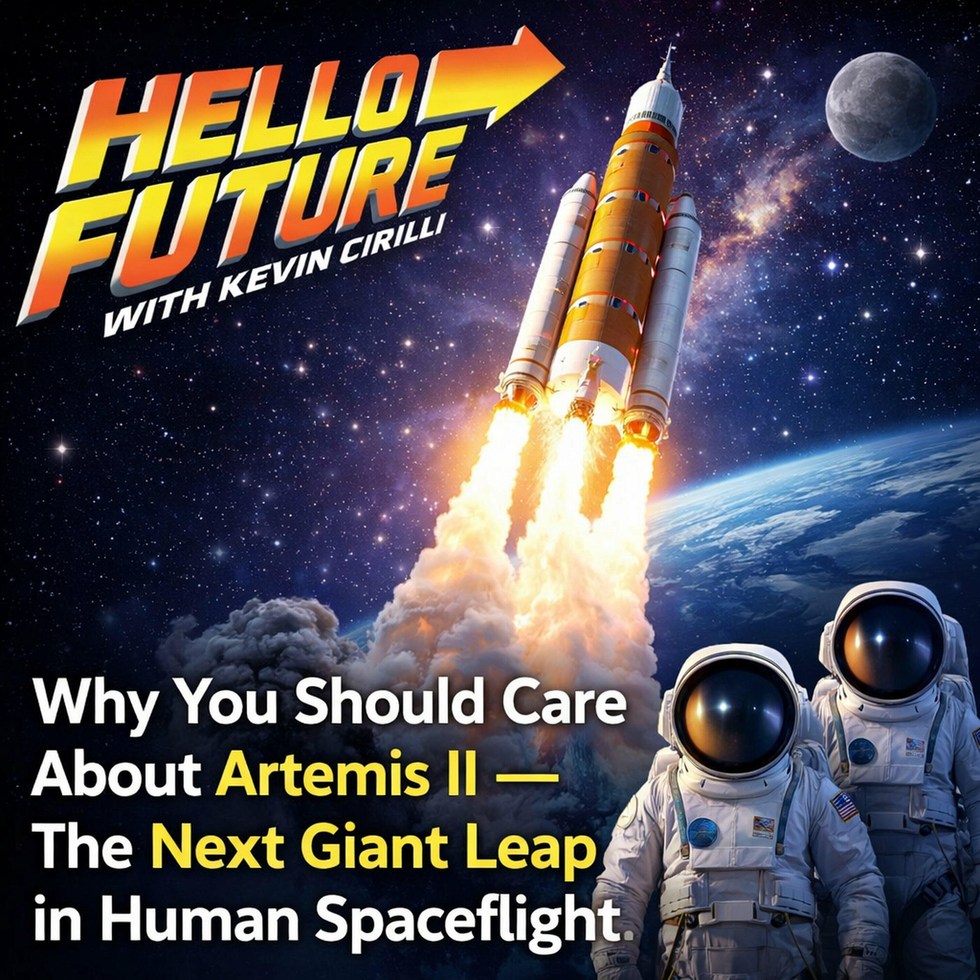
HELLO FUTURE: Why You Should Care About Artemis II — The Next Giant Leap in Human Spaceflight

HELLO FUTURE: Why You Should Care About Artemis II — The Next Giant Leap in Human Spaceflight


The Artemis program isn’t just NASA’s return to the Moon — it’s the foundation for humanity’s multi-planetary future.

In this episode of HELLO FUTURE, Kevin Cirilli sits down with Rich Cooper of the Space Foundation to break down Artemis II, the first crewed mission of the Artemis era. Slated to send four astronauts around the Moon aboard NASA’s Orion spacecraft atop the powerful Space Launch System rocket, Artemis II represents the most significant step in human space exploration since Apollo 17 more than 50 years ago.


Cirilli and Cooper explore why this mission matters far beyond headlines: how it tests critical deep-space systems in the harsh radiation and thermal environment of cislunar space, paves the way for a sustained lunar presence, and accelerates the technologies needed for eventual Mars missions. They discuss the international partnerships powering Artemis, the growing role of commercial space companies, the strategic importance of cislunar space, and what successful execution of Artemis II will mean for America’s leadership in space, scientific discovery, and inspiring the next generation of explorers.

From lunar gateways and resource utilization to national security implications in orbit, this conversation reveals why Artemis II is a pivotal moment that will shape humanity’s expansion into the solar system.

If Apollo showed us we could go to the Moon, Artemis II is proof that we’re going back to stay — and that the future of human spaceflight is closer than it has ever been.

Find all of the latest HELLO FUTURE episodes at mtf.tv.

Kevin Cirilli, former chief Washington correspondent for Bloomberg TV and Radio, founded mtf.tv. His work has appeared on Bloomberg News, Yahoo Finance, Fox Business Network, CBS News, CNN, Fox News, C-SPAN, and more.

Meet The Future: https://mtf.tv/

See omnystudio.com/listener for privacy information.
Speaker 1 (00:02):
Artemist two has really captured the imagination, not just the Americans,
but all around the world as the United States prepares
to return to the Moon, hopefully in a few years,
putting astronauts back on the Moon.

Speaker 2 (00:15):
Hello Future, It's me keV. This is a dispatch from
the Digital Frontier. The planet is Earth. The year is
twenty twenty six. My name is Kevin Surreally, and today
I'm talking to the vice President of Strategic Communications for
the Space Foundation, Rich Cooper. He's a frequent guest on
the Hello Future program. You can check out all of
the latest Hello Future episodes on MTF dot tv and
all of the other Meet the Future content. Rich. I mean,
my phone's been blowing up. I'm sure yours husband two
just about everyone so excited about Artemist two and everything
that it represents. But your organization, the Space Foundation, really
focuses on the economics behind it. I mean, really, the
Artemists two mission is like a Lego block, for lack
of a better analogy, of all of these different supply
chains coming together. Talk to us about the business behind
Artemis two and how it's a great example of the
space industry as a whole.

Speaker 3 (01:10):
One of the great things that you see about Artemis
is that the different parties and come together. And those
are countries as well as companies large and small, some
that are well known and unknown, but all of these
pieces have come together to deliver what has been a
moment that at least I know for me, I was
around for the early years of Apollo. I was very little,
but I didn't get my moon moment. And we now
have a shared moon moment for the world. And you've
got a crew that has been absolutely amazing and spectacular
in sharing that mission and the challenges and the triumphs
and everything along the way. One of the things that's
been great about this is it's giving all of these
different companies the opportunity to showcase what they did. That's
unique when you bring all of these pieces together. As
someone described it to me last week when I was
at Kennedy Space Center, this is a menum. They put
all the legos together. Okay, when you've got a structure
that's three hundred and twenty three, uh, forget how many
feet tall, with you know, eighty eight you know, million
pounds of thrust all of that, that's a lot of legos.
It's an incredible potential when you see the collaboration that
comes together. This has been a long time coming because
we've been talking about Moon missions for decades. But now
we've executed it, and now I will say the pressure
is on for everybody that, Okay, what are you going
to do to follow it up? Jared Isaacman has already
talked about what some of that, what some of that
is going to look like. We're going to hear some
about that at the upcoming Space Symposium. Yeah, but we
play but the playbook that he's laying out is giving
more opportunities for more companies and more countries and more
capacity than what started before this mission even launched. I
think when you see those pictures that have come out,
they have touched everybody in a different way. We've all
been along for the ride, and there's more ride to come.

Speaker 2 (03:04):
I think what I love about this is is everything.
I love all of it. But there's like forty seven
states according to NASA that have worked on the Artemis
two mission. I'm like, who are the three that got
shut off? But in addition to that, dozens, if not
hundreds of companies that played a part in Artemis two.
And it's such a great supply chain story. And you know,
I think what feels different at least from this time.
I mean, I'm a millennial. I wasn't around for you know,
Neil Armstrong and all of those incredible iconic imagery. But
I've been hearing from people who were, and it really
did inspire a lot of people to think big again,
to demand new ideas. What this feels like for me
is I always say, and I'm not joking when I
say it, I want to go to space. I want
to be used as a medical experiment, for lack of
a better word, I want for space research. And it
feels like I'm not crazy to say that. And when
you're watching all of these things happening, it feels like
America is leading the way in building a supply chain
between here and the Moon and that future generations can
extend further into our solar system. Am I out on
the reservation? How do I sound?

Speaker 3 (04:17):
I'm saying yes, and and more on just that and
this is where and again let's let's let's take this
back one step. When everybody who was watching the moon landing,
they were watching it on TV, okay, and there were
only three or four major networks that were covering it.
As this mission has unfolded, we've all been watching a
courtesy of our phones and the fact that the crew
even took their iPhones along and they've shared the imagery
along the way and the stories. Look, we have all
been along for the ride of our lives, and we've
had four crew members who, as different as they are,
share a commonality with all of us as it relates
to to being married, having kids, going school, suffering losses,
suffering joys, having plumbing problems and all that we had
all of that going on. This has been a very
human story that has really I think touched people in
the way that it has, and it's allowing persons like
yourself to be able to say, hey, I want to
be a part of that. That is not an unreasonable
request or vision to have because the inspiration that comes
from exploration, there's no measure to that. That is a
ripple that has no end because you don't know when
someone who was inspired by that moment is going to
step on to the stage of life and say I
was inspired by Artemis two to do this. That is
a long term dividend that comes from this mission and
everyone that follows let.

Speaker 2 (05:50):
Me ask you one final question, and I want to
hear how you answer it, because I've been asked a
bunch in the past couple of days about this, and
I've got my own soapbox that I go on. But
for folks who say, and I'm not one of these
people who say this, by the way, but for folks
who say, why should we be returning to the Moon
with all of the problems here on planet Earth? What
says rich Cooper of the Space Noundation, I would.

Speaker 3 (06:16):
Say to them to take a deep breath and step
back and take a look at how they're connected to space.
And this is a realization that I think a lot
of people don't understand the dividends that have come from
the Apollo era, the Shuttle era, the International Station era,
from medical research to manufacturing, to communications to again, you
name it. It is because people don't have the realization
of what space is doing in their lives. They think
it doesn't apply to them. If you take space out
of the daily equation for the life of anybody in
this planet, it's a really bad day. Economically, things are
going to stop. Security wise, things are going to be
dramatically at risk again. Operation and from an infrastructure standpoint,
we're going back to the teenth century, possibly the nineteenth century,
maybe even further behind. Because space is intrinsic into all
of those systems, whether people realize it or not, that
dependence is only going to increase, and that is where
the entire space community has to do a better job
of helping people realize the benefits that space bring to
their lives. We are feeding more people on this planet
because of space. We are treating disease better because of space.
We are communicating with people faster because of space. We
are securing financial transactions better because of space, and so
much more. We have to do a better job of
making sure people understand the why of what we're doing,
but the what and the how and all of that
that delivers for them because space is for everyone and
their benefits for all.

Speaker 2 (07:54):
I mean, it's just so well said, folks. He's one
of my favorite people that I've met. He was one
of the first believers and meet the future at MTF
dot TV, and I can't thank him enough because he
made it rich. I'm appall and smoke here. I mean,
you were really one of the first people who said,
if you want to do this, you can do it,
and a lot of people thought I was crazy and
still think I'm a little crazy. Maybe a little crazy
is good. Appreciate you Rich and yeah this art is
too well. Remember folks. You can get all of the
latest episodes of Hello Future on the iHeartMedia app and
also over at my website at MTF dot tv, MTF
Course Stands or Meet the Future. Have a great tomorrow
Today

More For You