Skip to content
Search

Latest Stories

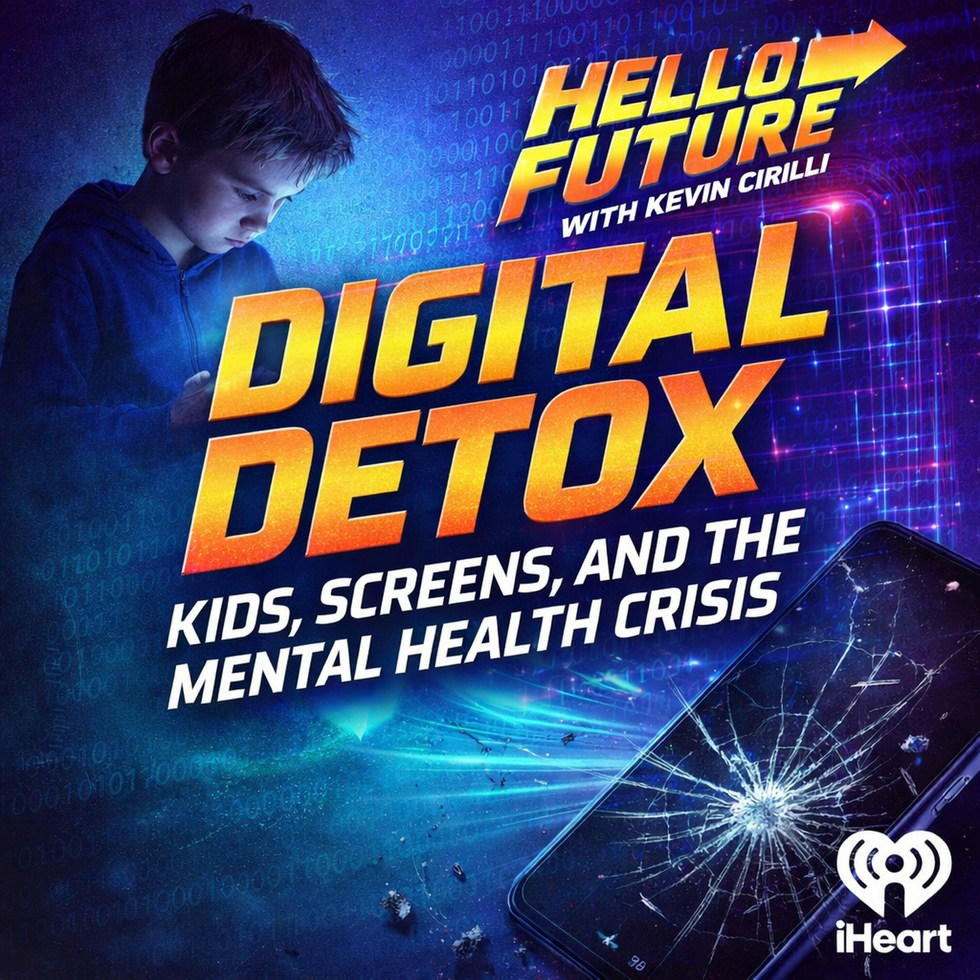
HELLO FUTURE: Digital Detox: Kids, Screens, and the Mental Health Crisis

HELLO FUTURE: Digital Detox: Kids, Screens, and the Mental Health Crisis


How much screen time is too much — and what is it doing to kids?

In this episode of HELLO FUTURE, Kevin Cirilli speaks with Jennifer Kelman, a licensed clinical social worker and mental health expert with more than 30 years of experience working with teens and families.


The conversation comes as new data raises serious questions about the relationship between screen time and youth mental health. According to the CDC, teens who spend four or more hours a day on screens are twice as likely to report symptoms of anxiety and depression compared with those who spend less time online.

Cirilli and Kelman explore why the modern digital environment can amplify stress and isolation for young people — and how the constant feedback loop of social media, notifications, and online comparison can worsen anxiety.

They also discuss what a “digital detox” actually looks like in practice, why simply banning screens often backfires, and how parents can start healthier conversations with their kids about technology without making devices the enemy.

As technology continues to shape how young people grow up, this episode asks a simple but urgent question: how can families build a healthier relationship with the digital world?

Listen to learn practical strategies for navigating screens, social media, and mental health in the age of constant connectivity.

Meet The Future: https://mtf.tv/

See omnystudio.com/listener for privacy information.
Speaker 1 (00:07):
Kids these days, it's like they're all addicted to social media.
They're like zombies walking around with their heads in the phone,
and you know they're making the TikTok dances. I don't
even know. I don't even understand it. Hello Future, It's
me keV. This is a dispatch from the Digital Frontier.
The planet is Earth. The year is twenty twenty six.
My name is Kevin SIRRELLI. Today we're talking all about
young people and social media, and it's been in the
news a lot lately with that meta and the Instagram
trial and the social media companies, with Mark Zuckerberg testifying,
and it's really grabbed my attention. I was on c
SPAN the other week talking about it. And you can
subscribe to all of the latest episodes of Hello Future
on your iHeartMedia app, or subscribe to our newsletter on
MTF dot TV. My guest today is a licensed clinical
social worker and just answer mental health experts. She's got
thirty plus years specializing in mental health, and we're going
to talk all with Jennifer Kellman about kids and their
the anxiety, screen, feedback loop, everything. Jennifer, I really appreciate
you coming on and for all of the work.

Speaker 2 (01:13):
That you're doing on these issues.

Speaker 1 (01:15):
I mean, I'm sure you've been really busy these last
couple of years.

Speaker 3 (01:18):
Extremely busy. And I want to thank you for dating me.
When you said that I've been in this profession for
thirty something years. You just gave some information away in advance.
But what it also does at the same time is
it lets everybody know that I've been seeing this kind
of impact for a long time and the detrimental effects
that device use has on our children. And like you
started by saying, you see kids walking around glued to
their phone, their eyes around their screens all day, but
we need to stop and think about what they're feeling,
how disconnected they are from everything and everyone around them,
and what type of benefits do they get from having
devices or what things are troubling them by being so
addicted to their phones, And what can we do with
families and parents to prevent depression and anxiety.

Speaker 1 (02:11):
Well, I think one of the questions I have for
you is when should a kid get a development?

Speaker 3 (02:14):
Such a great question, so there is not a one
size fits all. What I do mean by that is
I do believe that it should be delayed. Is there
a magic number around that. I don't know, because that's
an individual family decision based on who and how you
know your child to be. If you know that your
child is out there playing sports, engaged with other people,
maybe they could get a phone earlier for safety reasons
to stay in touch. But if you knew that your
child was prone to an anxiety and limited connection with
people around them, you might want to delay that longer. So,
although I'm not answering with a specific number of an age,
I am giving you some guidance of know your child
and know when they can handle respect abilities.

Speaker 1 (03:01):
I actually don't think it's the parent's fault. It used
to be in the olden days where a kid would
go to the movie theater, they can't get into see
a rated R movie unless they sneak in.

Speaker 2 (03:12):
So we live in a society.

Speaker 1 (03:14):
Where there are certain regulations for certain forms of media.
Your child, if they're walking around with the device, has
an ability to log onto literally anything, whether you can
see them or not. And so I guess what guardrails
do you think need to be in place. People associate
the age sixteen with driving and twenty one with alcohol,
eighteen with being an adult. We don't have a number
for where we associate with technology use. So do you
think we need one in our culture?

Speaker 3 (03:44):
There actually is one, and it's around thirteen, like you mentioned,
and I actually think that's a little young. Now. Granted,
there could be some flexibility around it based on is
your child coming home from school where the parents are
working and they need that type of access. Yes, but
in terms of free rain, I think it should be
later than thirteen. Let's not look at it as fault,
but let's look at it more as a collective responsibility
that we have as parents and society at large. The
analogy I like to make is these phones have an
addictive quality algorithms in TikTok or Snapchat or any type
of social media platform, they're designed to bring your children
back into it. Even as adults. We can be prone
to doom scrolling if we know that, and it has
the same impact on a child's brain as drugs do.
There are feel good chemicals that are released while they're scrolling.
We don't hand our children drugs, so why do we
just give them free rein You.

Speaker 1 (04:45):
Also wouldn't let your kid go into a casino, and
I got nothing against casinos.

Speaker 2 (04:49):
I mean candidly.

Speaker 1 (04:50):
You wouldn't let your kid walk into a casino. You
wouldn't let your kid walk into a bar by themselves.
My fear is that we're going to look back on
this wild West that we're moving through, that we've been
living through. I'm thirty six. I mean I was the first.
I mean, but I'm a part of a generation that
really was first with social media, and we're going to
look back and be like, remember when they let people
smoke on airplanes. I remember when back in the olden
days when people would drive cars with their windows up
and the parents would be sitting there having a cigarette.
I also have nothing against cigars and cigarettes. I'm just saying,
you know, the put down the window. You know what
I'm saying. So I fear that, like we and I
get what you're saying about assigning blame. And I'm an
optimist because I do think these young people the potential
for knowledge transfer for combating mental illness with technology is
the upside is infinite. Okay, especially when you start talking
about like quantum computing and whatnot. It used to take
civilization in thirty years to transfer knowledge as a collective society.

Speaker 2 (05:50):
Now the turnover is one year.

Speaker 1 (05:52):
I mean, that's remarkable at how fast it is to
be living through the Fifth Industrial Revolution, the start of
the fifth Industrial Revolution. But the consequences of that, it's
how do we navigate the weather of our times? So
what are some things parents can do to navigate the
weather of their child's phone addiction in order to make
sure that they're not anxious, depressed, or worse.

Speaker 3 (06:17):
I think that we all benefit from the social media
that's out there. There's nothing wrong with it until there's
something wrong with it. So my first idea is that
we delay giving it to our child. Again, I don't
know what that magic number is. Know your child, know
whether they need it for access to you, or if
they're going to become addicted to it, if they are
going to lose out on all other connections. Something I
also like to say is there is healing in connection.
But when we are tied to our phones and our
children are tied to their phones, that is not true
genuine human interaction that builds that feeling of connection. If
you don't have that, that is when our children or
adults are prone to feeling disconnected, anxious, and depressed. So
delay giving them that drug.

Speaker 1 (07:10):
I mean, let Jennifer Kellman, License, clinical social worker, Just Answer,
mental health expert, thirty plus years of experienced. Let's say
they're on the drug. You can't just take it. I
mean you got to go through like a digital detox.
And if they're a teenager and the hormones are raging
and the what are some skills that people can have,
the parents can have to navigate through that process.

Speaker 3 (07:30):
Well, I'm twin teenagers and so I'm going through it
right now.

Speaker 2 (07:34):
So God love you.

Speaker 3 (07:36):
First, my first is delay. But if you're saying, if
we are in the thick of it, those first couple
of days are not going to be pleasant, are not
going to be fun. But what we have found, and
I have found this in my work with clients on
just Answer or in my private practice, similar to any addiction,
after a couple of days, those teenagers actually do report
feeling better, a lift in their mood, a less of
an anxious experience, and less of a need to continue scrolling.
So do I say we need to go cold Turkey?
We might again, knowing who your child is, some child,
you could say, you know what, We're going to limit
you and you're only allowed on it from four to
six PM, get all your scrolling, all your contacts, are
your connections done during that time. One child might be
able to handle that, another might not, and so you
might need a full removal of it.

Speaker 1 (08:35):
I think both the powers it be for decades, and
I really identify it like the last twenty years to
get here, because it's not like we didn't know artificial
intelligence was coming. It's not like we don't know the
quantum computing is coming. Because to blame just the parents,
which is what I frequently hear, now.

Speaker 2 (08:53):
Well, it's the parent's fault. It's the parent's fault. I
don't know.

Speaker 1 (08:56):
I'm more of an optimist than that, And I think
most parents really want to do the right thing. Most
parents don't want to raise addicts or phone addicts. They
don't and so if you can't. Most parents know where
their children are at all times, but you can't necessarily
blame them for not knowing where their child is on
their device or another kid's device or a school device
twenty four hours a day. I think there needs to
guard rails. Your data is harrowing. Four and ten teens
now spend eight hours daily on screens. Four and ten
teens spend more than eight hours daily on screens, and
according to the CDC, teens with four plus hours of
daily screen time are twice as likely to experience anxiety
and depression compared to those with less exposure twenty seven
point one percent who have teens with four plus hours
of daily screen time get anxiety twenty five point nine percent,
according to the CDC. I say this because what's great
about this data, which is shocking but confirms everything we
all know, is that to your point, which you just
stated so bluntly and simply, less screen time, less anxiety,
less screen time, less depression. Obviously I'm not a doctor,
you're the doctor. But there's a correlation between less screen
time and feeling better.

Speaker 3 (10:17):
Correct, there is, I have seen that firsthand. But what's
also there's almost like a disbelief of denial about it
that the data could be there. You just read some
very scary data a lot of times, and speaking as
a parent, we could say, well, my child isn't prone
to depression and anxiety, and they're going to weather this,
to use your word earlier, they're going to weather this better.
And so again, no blame. Parents are overwhelmed with how
much their children are being overwhelmed. They're being bombarded, They're
being pressured at school. If their child isn't on the latest,
greatest device, they're being shamed. So it's coming at families, children,
parents from all anger. The big giant corporations. Schools will
say well, you can't have your cell phone while you're
walking around, But then they think nothing about teaching on
a device for eight hours a day and their child
needs to be on the computer. And then you get
an email sent from a teacher, Hey, your child was
found on YouTube during the classroom. You're aspect now I
want to expect you're asking them to have it.

Speaker 2 (11:25):
It's like you're asking them to sit with a toy
and not play with it.

Speaker 3 (11:29):
Correct.

Speaker 1 (11:29):
It's it's absolutely and I don't blame teachers either, I
really don't. I want to end this conversation with being
really optimistic because what I'm hopeful for is that the
classroom of the future will encourage to use technology in
order to create in a way that is amazing, that
harnesses independence, that harnesses innovation, that harnesses opportunity and individuality.
And so what bright spots are you, Jennifer Kellman seeing,
and what makes you hopeful about the direction that summer
headed in that maybe more of us can follow.

Speaker 3 (12:06):
Well, I'm hopeful because I've done it in my house
and so I know that it can be done. It's
not easy, and certainly there's pushback from my kids, but
I delayed giving them a phone, and their social media
is limited. But I want to leave everyone with this
idea that I said earlier, that there is healing in connection,
and I mean true, genuine interaction, face to face, live
human interaction. So if we remember them, if we keep
that in the back of our mind, then it might
be easier to delay, reduce, and restrict device use depending
upon what is needed, based on the need of that child.
We don't want to end up with the depression and
anxiety and then say, oh, no, we should have done
something prevent it beforehand. Talk with your child, have them
connect with you, their peers, their teachers, and let's have
a collective responsibility as a community, as a human community,
that we want functional and high functioning adults, which comes
through human connection.

Speaker 2 (13:14):
Quit trying to raise influencers. You know what I'm saying.

Speaker 1 (13:18):
I mean, I see this a lot, whereas you see
you know, it used to be, Oh, if they're a
star athlete.

Speaker 2 (13:25):
I mean, they got enough pressure on them.

Speaker 1 (13:26):
You got some parents who are trying to push them
to be star athletes and push them to be, you know,
the next Tom Brady lebron Jay, I mean, and then
you've got some where are pushing them, oh, be the
next you know, great singer, and now it's like they're
pushing them to be to go viral. You should push
people to want to be able to manage their success,
to be business owners, to be entrepreneurs, because that is
what the most successful influencers and content creators are.

Speaker 3 (13:54):
I love what you just said. And the other question
that everyone can dig deep is what happens when the
likes don't come or the likes stop? So you are
handing over your mental health and your feelings about yourself
to likes or shares, and really have to ask yourself,
is that how you want to be in the world.
To give over your mental health to some algorithm or
a like or some connections to device.

Speaker 1 (14:28):
It is very, very foolish, and it will lead you nowhere.
I'm gonna have to leave it there. Jennifer Collmen, this
has been very therapeutic for me.

Speaker 2 (14:35):
I feel like I just feel like I should like,
did I just have a therapy session? What just happened?
Where could people learn more about you?

Speaker 3 (14:44):
Thanks? First of all, thanks for to laugh, Thanks for
having me, and I'm so appreciative that everybody who has listened.
You can find me a just answer I handle. There's
therapist Jen or you can find me at Jennifer Kellman
dot com.

Speaker 2 (14:58):
All right, Jennifer Colman, have a great tomorrow today. Thanks
so much for showing up to meet the future. Thank
you so much.

More For You