Skip to content
Search

Latest Stories

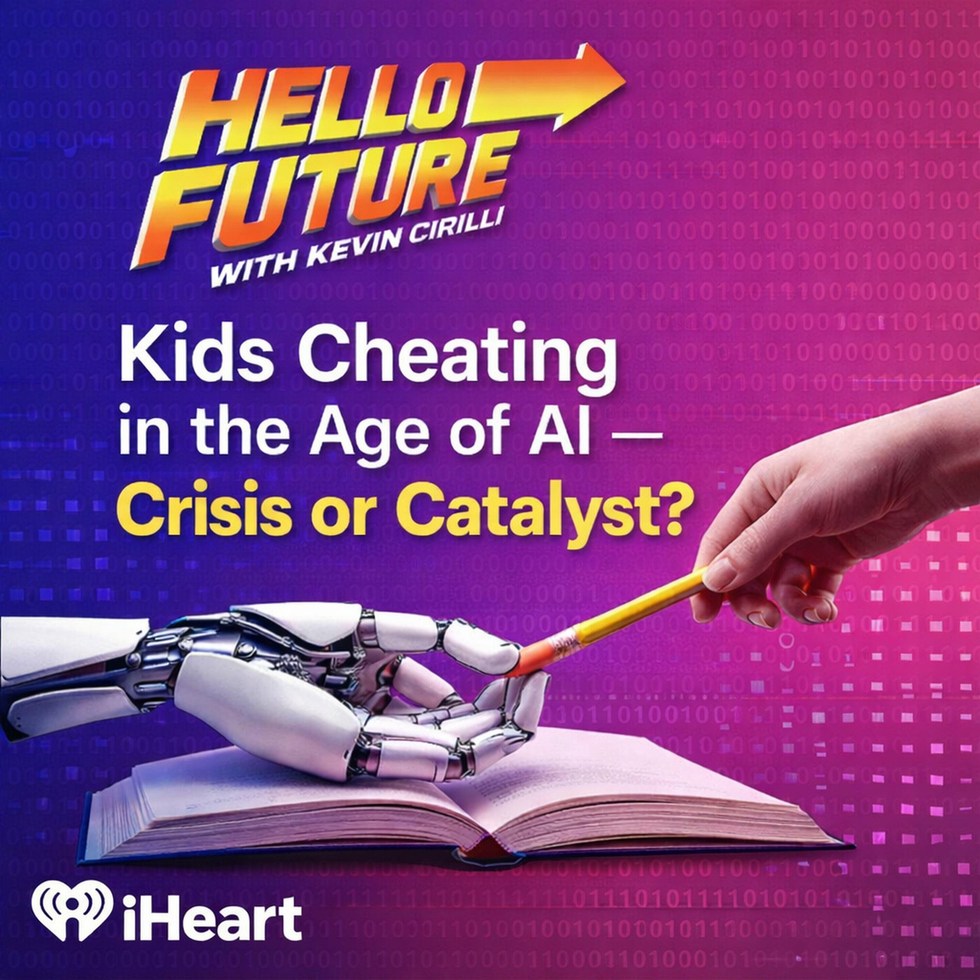
HELLO FUTURE: Episode 1: Kids Cheating in the Age of AI — Crisis or Catalyst?

HELLO FUTURE: Episode 1: Kids Cheating in the Age of AI — Crisis or Catalyst?


Artificial intelligence has entered the classroom — and students are using it. But is this the death of academic integrity… or the beginning of a new learning model?

Kevin Cirilli sat down late last year with Michael Hansen, CEO of Cengage Group, one of the world’s largest edtech companies serving more than 12 million digital learners, to unpack what’s really happening in schools and universities right now. As generative AI tools blur the line between assistance and dishonesty, educators face a fundamental question: are we policing students for using the tools of the future — or redesigning education around them?


Hansen, who led Cengage through bankruptcy and into a 70% digital transformation, explains how AI is reshaping testing, credentialing, and the very definition of knowledge. From AI-powered student assistants to subscription-based course models that challenge affordability, this conversation goes beyond headlines to explore the structural reinvention of education.

In a world where machines can write essays, what does human mastery look like? And are we measuring the right skills for the economy students are actually entering?

Meet The Future: https://mtf.tv/

See omnystudio.com/listener for privacy information.
Speaker 1 (00:08):
Education and the rise of artificial intelligence has really taken
a dramatic hold in students classrooms. Will artificial intelligence for
place teachers? Do students need to even learn anymore? How
is the transfer of knowledge even impacting the way that
we all study and engage and learn. Hello Future, It's
me Ken, and this is the dispatch from the Digital Frontier.
The year is twenty twenty six, the planet is still
Planet Earth. And my guest today is Michael E.

Speaker 2 (00:38):
Hansen.

Speaker 1 (00:39):
He is the chief executive officer of sen Gage Group
and he has been a director of Senngage Group for
more than a decade and during his tenor, Michael has
successfully guided the company through a reorganization and help pave
the way for the company's new transformation from a struggling
hire at print publisher to now a portfolio ed tech company. Michael,
you're the textbook guy. You are the guy who is
building the textbooks of the future. So first of all,
thanks for coming on, Hello Future. I remember when I
was a kid, we would have, you know, the grocery
store brown bags, and we would cut them in our
math book or our history book and they would be
the book cover. And Mylene, we come a long way.
Are we going to have textbooks in ten years or
our kid's going to be learning in textbooks in ten years?

Speaker 2 (01:28):
Devin, thanks for having me. The short answer is, I
don't hope. So except for I will say we might
still have textbooks in kindergarten and first and second grade
because it's actually a pretty cool way of getting to
learn and you know, getting familiar with reading, et cetera.
But I do think beyond that, I hope we are
fully on digital learning platforms. And this is really what
we're thriving forward sengage.

Speaker 1 (01:58):
So what if we're not going to if we're not
going to have textbooks, what are we going to have?
What will your high school or middle schooler or your
college student, what will they be learning from if they're
not picking up their textbooks?

Speaker 2 (02:10):
Well, the good news is millions are already there, millions
of learners. They are about eighteen million hier ate students
in the United States and about by our bioer estimate,
about ten million of them already learning on online learning platforms.
And what does that mean? They have the content that
they need for the course Introduction to Psychology. You and
I have both taken that course, right, You have the
content there, you know the pedagogy, and you're learning step
by step in that pedagogy. But now you have all
the tools at your disposal, and with AI, it's going
to be a major leap forward to actually learn in
your own style because I can guarantee you one thing, Kevin,
you're learning different than I'm learning guaranteed right, how now
we can figure it out right, you might be more
of a visual learner, I might be more of an
auditory learner. We can really adjust it to your learning
style and that is super exciting and we are at
the early early stages of that.

Speaker 1 (03:03):
So it's to choose your own adventure. Yes, absolutely. I
think what I find interesting about this is because there's
been a lot of conversation recently about young people not reading,
and there's been some horrible studies about whether or not
literacy rates amongst the next generation, particularly amongst Gen Zers,
whether or not they're reading and literacy in our country.
And then there's this other conversation happening about the knowledge transfer.
And Michael Hanson is the CEO of this company that
really is studying this transfer of knowledge. So back hundreds
of years ago, when the printing press was first invented.
People understood that you could read, and that transferring knowledge
through literacy and through literature and through various different printed
products was the key to knowledge and the key to
transferring knowledge. Nowadays, when I go on YouTube and I
watch a YouTube video, or I'm listening to my voice
messages for my colleagues, I'm listening to it on four
x because I'm like, talk faster, because my brain is
conditioned to trying to receive and process information on a
faster speed. And so, as you are looking at the
future of the transfer of knowledge, particularly for students, how
is this next generation Gen Z and even younger? How
are humans evolving in the sense of how they are
retaining and receiving information because they don't necessarily have to
read a seven hundred page book.

Speaker 2 (04:28):
Right, So I would start with we as the older generation,
and I'm all, I have a next generation from you.
But we shouldn't be so damn arrogant and say like, oh,
they have to learn the way we learn, right, We
should first of all really understand that there are evolutions
in the words of learning, and there are actually different
types of flood and the beauty. So you said it, right,
Gutenberg when he invented the printing press. That was a
marvelous piece of technology that was deployed into education because
all of a sudden you had a way of teaching
a certain course, and it it was a better way.
It was systematically taught in the same way. That's what
books did. Beautiful. The only problem is the last innovation
was one hundred years ago. Now we're at the cusp
of the next innovation. And the next innovation is learning
platforms and coupled with AI. So what I can do
now to make it very practical? Right, you want to
read four times faster, that's easy, But I can do
you even better. I can say you don't have to
read this stuff anymore. You can watch a video about it,
or we can do a simulation. Right. You never understood
I never understood in chemistry how on earth that molecule
was actually working and coming together and whatever. Now you
can actually simulate it. And now I go to do
you want even better? And this is where I really
want to drive this company is I want you to
understand why on earth you're learning. When I said in
the psychology course, I had no idea why I was
learning this, right, it was like, yeah, okay, the professor
wanted me and I wanted to get a good grade.
That was it, right, But now I can bring the
real world into it. And you say, like, you know,
if you were a mid level manager in company, you
want to understand psychology because that's what's going to motivate
your team. That's what to going to get the results
that you want. So there is a huge amount of
opportunity here to bring the real world into the education
system because one of the problems is the education system
exists in its own little bubble and that's not good
enough anymore.

Speaker 1 (06:19):
You know, that's such an interesting point. And I love
this idea of simulations. I had the privilege to put
on these high tech lasses I like to call them,
you know where. I got to see a simulation, particularly
of a wildfire display, and I got it. I mean,
the second you put on those goggles, you feel like
you're on a field trip in the Safari or you
feel like you're in the International Space Station staring down
at a simulation of the globe and you're seeing the
fire and what happens that the wind is going at
this mile per hour and how it will impact and
go in this direction versus if the rain comes and
you can literally visualize it in your simulation. I love
the idea of kids being able to or young people
or young professionals being able to learn through visualization and
through simulation. I think that's incredible. Do you predict in
the future that you're instead of having textbooks, we're going
to have I don't know, We're maybe companies like you.
Instead of selling textbooks, you'll be selling simulation for a
pair of glasses and kids are putting on VR AR
glasses and learning their knowledge that way.

Speaker 2 (07:28):
We're doing it now, Kevin, We're doing it now. So
I next next time you go to Phoenix. We have
a collaboration with Arizona State University. Michael Chrome, the president
is a is a good friend of mine. We have
a collaboration where you have virtual lab at the SU campus.
You go in and we teach you biology with the
alien zoo. So you go and you're in the alien zoo.
It's it's actually a room and you know, well, we
are getting to portable devices in you know, in two
or three months. But what you have is an ability
to actually pick up an animal and actually dissect the
animal in a virtual world and this is the leading edge,
but we have it today, so it's not futuristic.

Speaker 1 (08:11):
Michael Hansen talking to us about the future of textbooks,
the future of education, and just the knowledge transfer. I mean,
it's so incredibly important. I think every parent in America
right now is trying to figure out are they cheating,
are they cheating or are they learning? And that'll be
my final question for you for this. If you're a parent,
what advice do you give to parents about whether or
not their kid is cheating using AI or using it
to navigate through their homework.

Speaker 2 (08:37):
So, Kevin, I don't want to speak for you, but
every kid, every kid is tempted to cheat, right, I mean,
particularly if you think if you think that particular course
is not that relevant to me, like whatever, I just
want to get through. I want to get an A
or B or whatever and then I'm fine. So cheating
has been around forever, forever, right. The problem is now
it's on freaking steroids because the students are going to
any one of large language models, most preferably chat GPT,
and say give me the answer. And this is why
we introduced a different large language model. So we license
chet GPT technology and we now build it on the
course objectives, and we're giving you one hundred and fifty twice.
But we'll not give you the answer because the answer
is something that will stop you from learning. It will
make you dumber, You will forget about it in a minute. Yeah,
you've passed the test, but you'll forget about it in
a minute. But will make it so exciting for you
that you want to learn. And if you failed in
a particular attempt, we'll give you more attempts, and then
we'll go back in your history and say, you know what, Kevin,
maybe you're missing something in algebra. Although we are talking
about physics here, maybe you're missing something algebra. Let's go
back there.

Speaker 1 (09:44):
For me, like philosophically speaking, intent behind action really matters
to me. So I never want to demonize a young
person or a child for trying to be more time
efficient and trying to make better use of their time.
I mean, we didn't tell the word calculator actually used
to be a human profession, and so once technology was created,
the function of a calculator jumped from being a human
job to a piece of technology. And so I think
for me, it's tough to tell little Johnny or Little
Sarah that they can't use something to make their lives
easier provided that they understand how the skills that they need.
So I agree with you one thousand percent. Michael Hanson,
CEO of Sengage Group, one of the leaders in education
software and digital textbooks and the future of education, please
come back on. Thank you so much for showing up
to meet the future.

Speaker 2 (10:47):
Thanks for having me

More For You