Skip to content
Search

Latest Stories

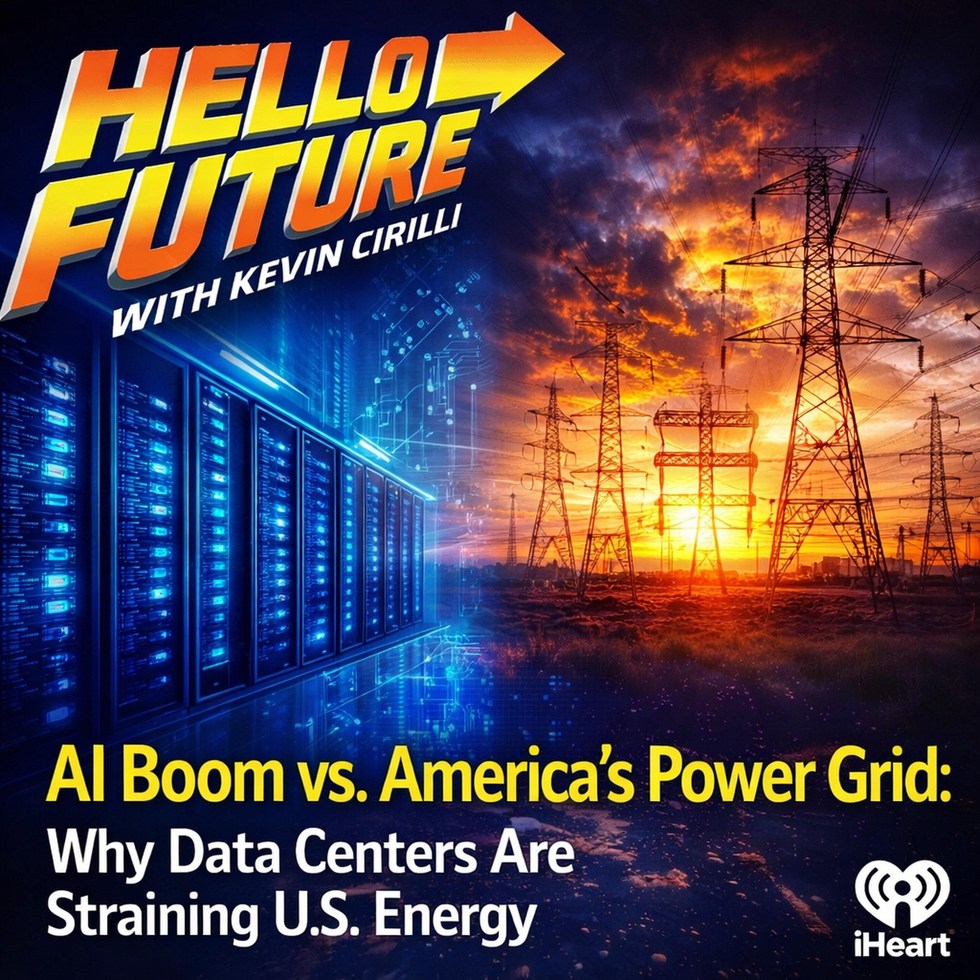
HELLO FUTURE: AI Boom vs. America’s Power Grid: Why Data Centers Are Straining U.S. Energy

HELLO FUTURE: AI Boom vs. America’s Power Grid: Why Data Centers Are Straining U.S. Energy


On this episode of HELLO FUTURE, Kevin Cirilli explores the hidden crisis behind the AI boom: America’s power grid isn’t ready. Kevin interviews Terry Ploetz, co-founder of Next Century Power.

As hyperscalers race to build massive data centers, the demand for reliable energy is exposing serious vulnerabilities—from grid strain in key hubs like Virginia to overlooked cyber risks tied to fiber infrastructure. Kevin breaks down how energy, connectivity, and national security are now deeply intertwined, why the U.S. risks falling behind in AI, cyber, and space competition, and what new models—like behind-the-meter power, community energy agreements, and domestic resource recycling—could help stabilize the grid while delivering real benefits to local communities.


The bottom line: the future of AI won’t be won by code alone—it will be powered, quite literally, by who controls the energy.

Meet The Future: https://mtf.tv/

See omnystudio.com/listener for privacy information.

Speaker 1 (00:07):
Okay, by now, you know that the artificial intelligence boom
is well underway, but you also probably know that we
are going to need a lot of electricity in order
to power the future. Hello Future, it's me keV. This
is a dispatch from the Digital Frontier. The planet is Earth.
The year is twenty twenty six. My name is Kevin Sirelli.
You can download all of the latest Tello Future episodes
on the iHeartMedia app. My guest today is someone who
has been at the forefront of making sure that America
can power the future. His name is Terry Plettz. He
is the co founder of Next Century Power and he's
gonna help explain all of this us. So, Terry, thank
you so much for being here. Really really appreciate it.
First and foremost, how did you get involved in this?
And are we going to have enough energy on our
grid to make sure or that we don't lose the
geopolitical race for artificial intelligence to build the future infrastructure
of our country.

Speaker 2 (01:07):
Yeah. First, absolutely, and thank you Kevin for having me.
I can't thank you enough. So, No, the grid is
not going to have enough power and its current rate
is not sustainable. That's the short and ugly answer. The
good news is we have a tremendous alternative and if
we pivot now, we can save the grid, if you will,
and that pivot is to take all data centers off
the grid. There is an inordinate amount of natural gas
that's available in North America that, to be fair, any
utility or non utility can tap into, and that natural
gas can feed, you know, quite a bit of technology,
most notably gas turbines. The difficulty is nobody saw this coming.
The demand for the utility companies and the demand the
turbine makers was unknown three years ago, to be fair,
and so that's where we got started. When this started
to happen, we started to investigate a little bit of
what was going to happen and the economic impact of
the data center boom. So it's really hard to conceptualize,
but seven trillion dollars is being injected in the whole
process from now until twenty thirty four. All of the
available loose hanging fruit, if you will, has already been
tied up. And so now you have utility companies saying
but as soon as they can do anything as twenty
thirty two or twenty thirty five, and the data centers
can't allow that, so they're looking at every possible way
to move forward, and all that is a continued strain.
What's happened is the national average has risen as seventeen
and a half sets, and it's on its way to
twenty cents.

Speaker 1 (02:43):
Okay, so this is where I want to I'm so
glad you're bringing this up, because I think that this
is really what people are concerned about, and I don't
blame them at all for being concerned about it. I'm
concerned about it. I think where I struggle is with
the lack of depth that experts, quite frankly, and the
media that people have in terms of actually talking about this.
And why I'm really excited to talk with you today
is because of this particular issue. I don't want my
electric bill to grow up, but I also don't want
to live somewhere that doesn't have access to artificial intelligence.
If my hospital in an emergency doesn't have access to
artificial intelligence because of a power grid, that's bad. If
my banks aren't able to make the banking system run
the way that we all need it to run, that's bad.
So I think what is getting lost in this conversation
is how reliant we are on artificial intelligence to give
us a way of life that we as Americans are
really grateful for. And so I just don't think you
would say to Thomas Edison, oh you're going to put
all of the candle makers out of business, or oh hey,
Thomas Edison, thanks so much for giving us electricity. You
are stuffing us with an electric bill. No, you say
thank you so much, Thomas Edison, because I would not
want to live in a country it doesn't have electricity.
So I say all of that because I want to
ask you point blank, how should we be thinking about
the relationship that we have as Americans with the electricity
bill and this revolutionary thing happening with artificial intelligence.

Speaker 2 (04:16):
Yeah, so first let's start with that in regards to AI,
and I just want to make a quick and blanket statement,
which I'd love to have another call on with you
for your listeners. But the reality is the boom is
happening because they can't keep up with the demand. When
open AI Oracle open a data center, they have that
sold for all the effort and work they're going to
do for a margin that's close to twenty thirty percent
for the next five years. Any business would want to
sign up for that and get as much much as
they can. But the reality is your fortune ten companies
have pushed forward. The fortune fifties are in there, and
now the rest of the world want's in. So when
you think about enterprise solutions, we can't meet the demand
of all the businesses that want to take advantage of
just AI. And then you have another thing happening intertwined
in the complexity of the race to AI, and that's
the race to AGI. And for folks like me, I
love yeah, and so that represents a cure to cancer
or global farming or clean water for the first time
in our humanity. So those things I think are worth
every sacrifice. So let's a say the race to AI
is one of the most significant human evolutions that we
definitely need to support, and there is no reason for
any consternation against it. I wish we are humanity, but
is a little further, and we did it as a
group effort, but we still have lines and borders and
we compete. So that's how we get there that I
can't stop. In regards to all of that said, there
is an alternative to get there that's less painful. For
the American consumer. And so what's happened is on the
East coast of America, their average kilowatt hour or what
they pay on their utility bills, risen to twenty four
and a half cents. The national average is seventeen and
a half. In the Midwest it's fourteen and a half,
and then out west it's much lower. The only problem
is out west in Arizona and Texas, those folks have
water bills, and then and we all have water bills,
but we don't only pay attention to them in the
Midwest or East Coast because they're pretty small. But now
they're tripled and getting ready to be quadrupled to be
ticked off. Yeah, so that's painful. But what's happened is
Virginia has the most data centers in the Union. Pennsylvania
has the second most, and PJAM had to put a
report out last year last summer that said, to help
upgrade the current grid and meet demand of data centers,
we are going to need an eight hundred percent increase
in our price. And so let's say you had a
two hundred dollar utility bill in New Jersey, you now
have a six hundred dollar bill. Add that to our
current economic stretch. Is why I think this topic is
sold polarizing. It is unfair to those residents that don't
get a direct benefit from what just happened in their backyard. Now,
I don't blame PGM, and I do not blame the hyperscalers.
We actually need the race to AI. It's an asset.
Focusing on that part of the future for where we're
headed is absolutely an asset. What's to blame? What if
everybody wants to go back to the core of the problem,
that is how we set up the grid in the
first place. We didn't allow them to stockpile a ton
of resources for certain moments like this. We didn't allow
them to invest in innovation to further the cause. Instead,
we push them to buy American and use the lowest
bidder on any plants. And so the only way they
could survive was to amortize these power plants thirty or
forty years on the backs of their rate payers. Well,
the useful life of a power plant is twenty five years.
So what's happening right now is we have seventy percent
of all of our power plants are over twenty five
five years old, and we have distribution lines that we're
using that are over fifty years old. Worse though, is
we have laws in regards to how we seek utilities
that are over one hundred years old. Nobody has stopped
to pay attention to look at it and say should
we do this? So if anybody wonders, there is no
federal ruling that controls all of them to help them grow.
What we have is three thousand utility companies in North America,
all doing the best they can, interdependently, and each area
has their own way of monitoring and standardizing. So you
have MISO and PGM, and Indiana you have an Indiana
Utility Regulatory Commission. Pennsylvania is so frustrated with the grid
and how things are working that they are a deregulated state,
so they don't even abide by the rules anymore, and
they are full on tracking and taking advantage of the
Marcella shale. So as you look at our.

Speaker 1 (08:54):
Current, which I have to say, I think is very smart.

Speaker 2 (08:57):
Oh it's wildly intelligent.

Speaker 1 (08:59):
Everything you're saying. And I really look forward to a
longer conversation with you. You know, Meet the Future, which
folks can subscribe to at MTF dot TV. We did
an event with former Energy Secretary Dan Burriette just a
couple of weeks ago about the future of energy, and
he was Energy Secretary from like twenty sixteen to twenty twenty.
And it really is fascinating to hear just how there's
such opportunity in this space and yet the conversation in
Washington is just so reductive. And this is not a
political show by any stretch of the imagination, nor do
I want it to be. But when I'm hearing you
talk about outdated structures and just how old everything is,
I'm like, it would create jobs to transform. They're great.
Like I just to me to the average person, I
don't have a PhD. But she's very simple and it's
not rocket sciences, you know. And I also hear when
I'm listening to you a real sense of real and
not blaming people. If you're looking at a water bill
in Arizona and it's tripled, yeah, you're going to be
ticked off, and you're going to go to your politician
and be like, what the heck happened? Or you're gonna
call your water company and be like, what the heck happened?
But I feel like we're just having this conversation stuck
in the nineteen nineties and not projecting like where we
need to go for the future. And it's really interesting
to hear you kind of paint this picture of all
of this because you're being very real, which I appreciate,
which is this is a really tough problem, but there's
massive opportunity, but no one really seems to be taking
a big swing and trying to create the opportunity.

Speaker 2 (10:39):
I appreciate that. That's where we are, and that's the
problem in America. Can't sustain it. And I'll just say
this outright. We are going to be facing rolling blackouts
and if you think about other countries that go through that,
we really don't pay attention or know what that disruption is.
But when you talked about your hospitals earlier, very difficult
for them to run on generators for a very long
length of time. As we're as we're set now, Grid
one had a great run and it is time for
Grid too. And that's where we that's where we decided
to create this company. We saw a massive media or
heading for Earth and we started to get the lifeboats
out and the and so the reality is that.

Speaker 1 (11:17):
Is a for folks listening because we do talk about
meteor striking earth. That was a metaphor. Thanks Kevin, there's
a great metaphor though, Terry, I really liked it.

Speaker 2 (11:26):
I appreciate you. So what we need to do is,
like I said, take the AI race as an asset.
These companies are so well funded they can do many things.
And one of the things they can do is and
they and they are doing it now. They're buying their
own equipment for power plants. Some of them have already
built their own power plants. But the reality is there
are enough behind the meter solutions where we could take
and behind the meter want to be really clear to
the listeners. That means it is not part of u
utility bill. So if a data center was erected right
next to your house, but it's behind the meter, it
would not affect your utility rate whatsoever, because your utility
company would not be involved. So we build micro grids
to put the data centers on, and then we supply
the power to them directly. But what's really wonderful is
they require to be on all the time. Those computers
can't be off for more than five seconds, and so
to ensure that latency, you have to overbuild a power plan. Now,
the reality of the redundancy kicking in is close to
six to ten percent, and a worst case scenario that's
ninety percent of power to be available for something else. Well,
we offer a one point three gigawatt base load plan.
It's enough to power to cover the city of Atlanta,
but in a six hundred and fifty acre little parcel,
if you will. So it's a lot of power in
a small area. One gig goes to the hyperscaler and
then the rest of the power is for redundancy. So
you have roughly let's say two hundred and twenty five megawatts,
which is enough to a small city like South Bend
or Hole Boken. It's a lot of.

Speaker 1 (13:04):
Power, right, Yeah, that's a lot of power.

Speaker 2 (13:06):
But you can give that back at cost to the
local utility company and pull out your e comm one
on one. If there's a new surplus, then the demand
price should go down correct. And that's the idea that
the data centers can provide power to the existing grid,
which is pretty remarkable concept, and that's exactly how we
get there. We take the data centers off the grid,
we get them all on their own own power, if
you will. We free up the utility companies and we
actually add power in the process, and by adding comme
on the process, you allow them to then reinvest in
themselves and move forward. The other part that's really fun
for your technical listeners. These power plants and microgrids that
we set up are air gaped. There's a bunch of
wonderful software companies and utilities that use the blockchain, so
we can send the gas pressure and volume from our
nodes and sensors and the pipes through the blockchain so
that other nearby neighboring pipelines are aware. And that's just
a standard of safety and intelligent protocols, not just for
the sales and capacity. So that's smart, but as far
as the control room goes, you'd have to physically be
there to affect its output. And the idea is if
we have one hundred to one thousand air gap facilities,
that makes us really defensible in the long term. And
so I'll leave it there for any questions you have.
But the reality is the water pollution. A lot of
them are looking to dry cooling. Now it's a new
concept and it's amazing closed looped is maybe seventy five
thousand gallons of water a day. We can put silencers
and noise barriers on our turbines to reduce the noise
to a sixty five decibels. Sixty five decibels is equivalent
to a conversation three feet apart from someone. We definitely
have some really wonderful innovation that we do at Nextorchy
Power that's unique and we capture the carbon produce that,
manufacture that and sell it for two D material. So
the environmental, the noise, the air, the water, we can
check the box. The grid reliability, we can check the box.
Developer funded infrastructure. We don't need any government aid or
tax incentives. In facts, as a power company we actually
pay taxes, not incentives like a utility company. So the
benefits are lengthy. But lastly, what's you really unique, and
it's a lot of new legislation, is hey, data center,
if you come here, can you help us out a
little bit because you are kind of a pain in
the butt. So we have a community Benefit Agreement which
is a legal binding document between enterprise and municipality, and
all of our sites that are one point three gig
in size return fifty million dollars to that community for
them to do what they want. And so in some
towns it could mean no more property tax or no
more utility bills, and so there is tremendous value. But
the biggest thing that is a relevant knock is these
data centers take up a lot of space and they
don't have a lot of jobs. After a construction, there's
twenty people there. Our methods unique because we do the
carbon capture and we sell the carbon nanotubes, nano fibers,
and graphene in the two day material world, and that
does create hundreds of jobs. It does.

Speaker 1 (16:29):
It's a way into the future. It's job creation, and
it's blue collar jobs as well.

Speaker 2 (16:34):
Higher paying yeah, seventy higher paying power at the base. Yeah,
so this which is a good job.

Speaker 1 (16:39):
I love that.

Speaker 2 (16:39):
I mean, yep, it would be the nineteen seventies again
in regards to manufacturing for America.

Speaker 1 (16:44):
Amazing. We're gonna leave there. Terry Pletsko, founder of Next
Century Power, really appreciate this.

Speaker 2 (16:49):
Thank you so much. Thank you, Kevin

More For You