Skip to content
Search

Latest Stories

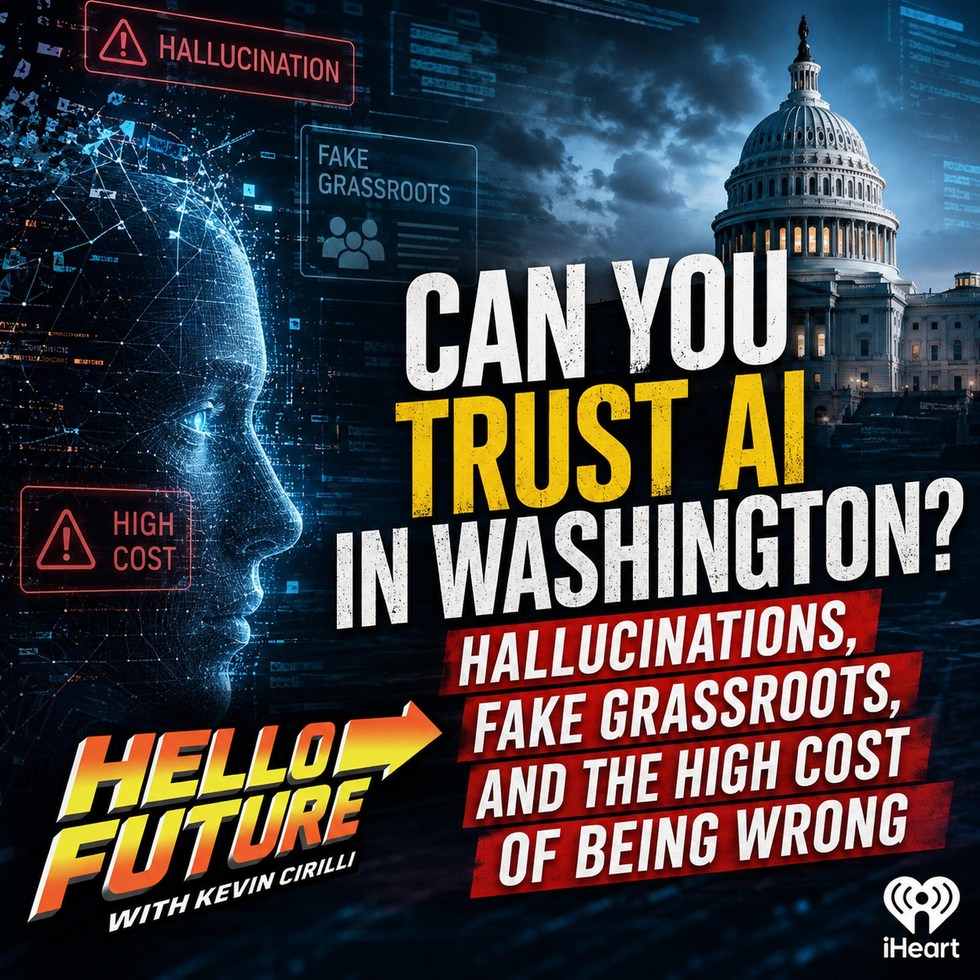
HELLO FUTURE: Is America Prepared for Quantum Computing?

HELLO FUTURE: Is America Prepared for Quantum Computing?


Quantum computers promise breakthroughs in medicine, materials science, and encryption-breaking power that could render today’s cybersecurity obsolete overnight. In this episode of Hello Future, Kevin Cirilli talks with Leslie Beavers, former Acting DoD Chief Information Officer, about whether the United States is truly ready for the quantum era. We’ll discuss the race between quantum development and “post-quantum” cryptography, the risks to classified systems and critical infrastructure, and what concrete steps government and industry must take now to stay secure.

Meet The Future: https://mtf.tv/


See omnystudio.com/listener for privacy information.
Speaker 1 (00:08):
Everybody's talking about quantum computing, quibbets, ones, zeros and super
computing and AGI and all of this quantum computing stuff. AGI,
by the way, is not the same as quantum computing.
But everyone in Silicon Valley and Wall Street, it's like
they're all conflating all of this stuff, and I don't know.
I want to understand it more. Hello Future, it's me keV.
This is a dispatch from the Digital Frontier. My name
is Kevin Surilli, and the planet is Earth. The year
is twenty twenty six, and my guest returning to the program.
General Leslie Beaver's the former Acting Department of War Chief
Information Officer. She's been on before talking about America's under
a cyber invasion, a sustained cyber invasion, and I figured
who better to have back on the show to talk
about America's preparedness for quantum computing. All right, First things first,
what the heck is quantum computing.

Speaker 2 (01:01):
It's a really really really fast computer that solves really
really really gnarrowly math problems.

Speaker 1 (01:09):
And they can do it in like the blink of
an eye. Correct, Yes, when are we going to get
quantum computing?

Speaker 2 (01:15):
Well, that's a journey. At the moment we have, we've
transitioned from the physical the physics problem of quantum. There's
more than one way to figure out how to manipulate
the cubits which give you the ability to do your
massive calculations quickly. The trick is going to be to
scale it. And so right now what we're seeing is
partnering between quantum processing and high power compute processing together
and starting to apply it to the scientific problem sets
like materials development. You can start to get into drugs
and you know, figuring out molecular constructs for drugs and
sophisticated financial models. Things like that. At some point will
be industrializing and then at some point will be breaking
code encryption, which.

Speaker 1 (02:08):
Is what is right. So before we get into that,
I want to back it up a little bit because
that I think gives me a lot of optimism. Again,
America invented quantum computing, and that's awesome, just like we
invented artificial intelligence. This should be a matter from my
perspective of national pride, that we continue America's innovation to
move humanity forward. I think with quantum what really, especially
anyone who's I mean, every American has been impacted by cancer,
or Parkinson's disease, or Alzheimer's dementia, a host of different illnesses,
and so the ability for preventative medicine and preventative health
care treatment that quantum might be able to quite literally
find cures in a blink of an eye because of
its ability to go so fast. That's awesome. And you
mentioned critical rare earth materials just from a space exploration standpoint,
to be able to actually map the universe and different
galaxies and identify which planet to be able to harness
and where we are in space. I mean, these are profound,
profound implications that sound like science fiction. It's actually happening
in our lifetime. And I believe that we're living through
the fifth the start of the fifth Industrial Revolution. Some
people say the fourth, I say, why not give us
another one? But you mentioned financial markets, and I think
that's where quantum computing there is an issue, because if
quantum computing can break encryption, once we scale this and
the genies out of the bottle. Okay, we saw it
first with social media. Now we're seeing it with artificial
intelligence with disinformation. But once the genie of quantum computing
is scaled and folks have the ability to break in
and solve encryption. Yeah, I hope my bank is secure
and that we are quantum resistant. So are we? Is
America ready for that? Leslie?

Speaker 2 (04:07):
Yeah, so we will be. I'm confident kind of much
like Y two K, But there is a lot of
work to be done. There's an estimate of a range
that sometime between twenty thirty and twenty forty, the utility
of the quantum computers and the quantum computing we'll get
to the point where you can break the high level encryption,
which is the these really tough math problems. So the
solution to defending against quantum computers is to come up
with an even tougher math problem. And those algorithms have
been written. We now must put in place the way
to distribute the keys and to use those algorithms to
protect our networks. So why this is important is because
if you think about it, encryption is used every day
when we go online and do shopping, our secure bank transactions,
our digital originals, including our national security, and if you
can break that encryption, then our trust or our ability
to do digital signatures to do our online banking is
at risk. So within the financial services if quantum let's
say twenty thirty five is when it gets to the
point that the technology has matured enough that they can
that you can break our current RSA encryption and the
adversaries are collecting information now. So any information that is
considered sensitive that you need to keep secure for more
than eight nine years from now is at risk because
they're doing the harvest now, decrypt later activity.

Speaker 1 (05:53):
That's what I want to scream from people to people
is because when I heard that, it was really wild.
So why you should care about your data being stolen?
Because I always hear this in the cultural zeitgeist. Well,
everyone's stealing everything, it doesn't really matter. But why it
matters is because they're they're taking that data and then
they're gonna use that as their trojan horse to get
in and break quantum computing because they're stealing all of
these algorithms and whatnot. So they're harnessing basically all of
our playbooks to keep our financial data secure, which is wild.
I am optimistic. It sounds like you are optimistic as
well that America will be able to be quantum secure.
But the final question I want to ask you is
what are you most excited about with regards to quantum computing,
and because again you're not going to like have a
quantum computer on your desktop in five years. These are
like massive systems that are akin to yeah exactly, that
are akin to data centers and warehouses, and think of
hospitals harness them, and cities and governments and obviously military implications.
But what are you most excited for about quantum going
mainstream in the next I would argue decade.

Speaker 2 (07:08):
I'm most excited for the opportunities within the scientific breakthroughs
where we can come up with new materials and new drugs.
And then at the end of the day, I would
hope that we could almost completely eradicate genetic diseases things
like that we would be able to identify and then
make cures for them. Who knows what's in the realm
of the possible, but that's one of the areas that
I am optimistic that scientifically quantum will be a game
changer for our nation.

Speaker 1 (07:44):
Amen, and the application of it is just going to
be awesome. Leslie Beavers, thank you so much for showing
up to meet the future and for explaining to us
what quantum computing is and why we can all breathe
a little bit easier that okay, hopefully we don't get hacks.

Speaker 2 (08:00):
We keep our foot on the gas.

Speaker 1 (08:01):
And yes he's impressing. Thank you, have a great to
have a great take. M.

More For You