Skip to content
Search

Latest Stories

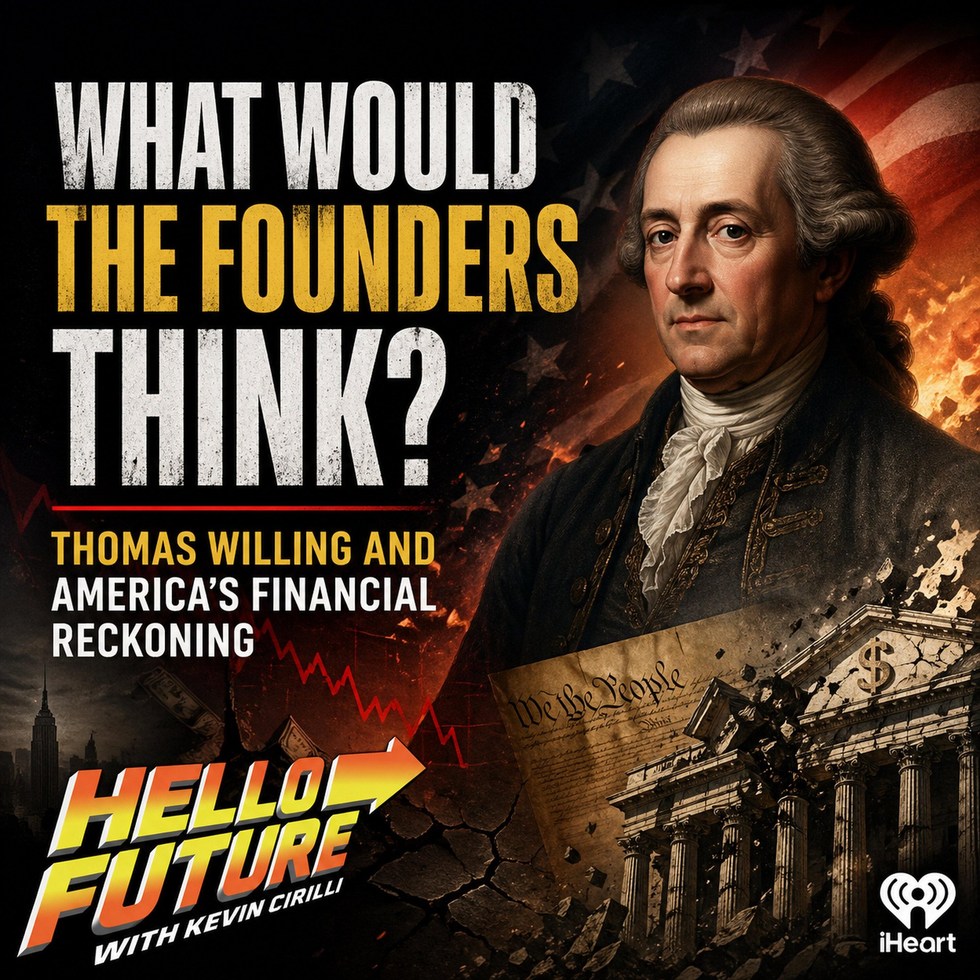
HELLO FUTURE: What Would the Founders Think? Thomas Willing and America’s Financial Reckoning

HELLO FUTURE: What Would the Founders Think? Thomas Willing and America’s Financial Reckoning


What if Thomas Willing — America’s forgotten first central banker and the man who helped design the financial system that powered the Republic — suddenly appeared in 2026? He’d stare at our $36 trillion national debt, the immense power of the modern Federal Reserve, explosive private credit markets, AI-powered fintech, and a new financial aristocracy far wealthier and more influential than anything from his era… and he’d have some very strong opinions. In this mind-bending episode of Hello Future, I sit down with Richard Vague, author of The Banker Who Made America, to explore the hidden origins of American finance through the life of Thomas Willing — the merchant prince who voted against independence yet bankrolled the Revolution and shaped our earliest banks.

We ask the provocative question: If the Founders and Willing time-traveled to today, would they be amazed by the scale of prosperity we’ve unlocked… or alarmed at how far we’ve strayed from their vision of commerce, sound money, and balanced power? From the birth of America’s financial aristocracy to today’s debt supercycle, central bank dominance, widening inequality, and the disruptive force of fintech and innovation, we connect the dots between our financial past and the critical choices shaping our economic future.


This isn’t just history — it’s a high-stakes conversation about whether we’re still living in the financial republic the Founders built, or if we’ve entered an entirely new era that demands fresh thinking. If you’ve ever wondered how the money system really works — and what it means for America’s next chapter — this episode is for you.

Meet The Future: https://mtf.tv/

See omnystudio.com/listener for privacy information.
Speaker 1 (00:08):
You know, there's so much talk about the markets and
the economy and the future of money and cryptocurrency, and
I don't know, it's enough to make your head spin. Affordability,
the cost of groceries. Hello Future, It's me keV. This
is a dispatch from the Digital Frontier. The planet is Earth.
The year is twenty twenty six. My name is Kevin Surreally.
Remember you can listen to all of the latest episodes
of Hello Future on your iHeartMedia app and wherever you
get your podcasts, and log onto MTF dot tv to
get the latest episodes and the latest news on the
future in your inbox today. Today we're talking about affordability
and the future of money. But in order to understand this,
in order to really grapple with where the US dollar
US currency, US economic bedrock of our democratic at lowercase
D inst we have to understand the founders. We have
to understand where we were oriented toward. We have to
understand respect and appreciate history, not just the founding fathers,
but who was actually financing them, who is advising them economically?
Who is the Elon Musk, the Jamie Diamond of seventeen
seventy six and the guests that I have today knows
all about it. If you haven't gotten his book. And
I don't say this about all the books of the authors.
You've heard me interview a lot of authors. I don't
say this about all of them, but I just started it.
It's called The Banker Who Made America Thomas Willing and
the Rise of the American Financial Aristocracy. The author's name
is Richard Vague, and he's a Philadelphian, so I like him.
And he's from Pennsylvania. He's a Pennsylvania guy, so we
claim him. You guys know, I grew up outside of Philly, Delco.
Another Providence, God bless. If you read the blurbs on
the back of his books, I think it shows you
the type of thinker that he is and why he's
such a natural fit for this show. Former United States
Senator Pat Toomey, Republican, current United States Senator Chris Coons,
a Democrat, Pulitzer Prize winning author of The Lords of Finance,
Leah quad Hamed Our Scott Stevenson, PhD, President and Chief
Executive Officer of the Museum of the American Revolution. I mean,
this isn't some sixth grader's history report, folks, this is
like the real thing. Richard Vague, how did your career
lead you to writing this book on Thomas Willing and
the banker who made America? Because you've had a fascinating
career to get to where you are.

Speaker 2 (02:36):
Well, first of all, it's such a privilege to be
with you. Thank you so much for having me on
this show. Yeah, I have a career banker, and I
think the landmark event for all of us perhaps is
the eight Crisis, and I was in the middle of
my banking careers that happened, so understanding that crisis led
me to try to understand the history of banking. The
leverage ratios of banks mattered so immensely in that particular crisis.
And I've been doing working at that for about fifteen years,
and that has led me ultimately to the beginnings the
first bank in American history and the first bank president
and lo and behold, it's the Bank of North America,
chartered in seventeen eighty one specifically to help finance the war.
And the president's a guy named Thomas Willing, who this
book is about.

Speaker 1 (03:28):
So I find it fascinating because just set this stage
and I heard you speak a friend's house to a
couple of weeks ago in Washington, And for those who
don't know, I mean he's being incredibly, incredibly humble. Richard
is a venture capitalist. He served as the Secretary of
Banking and Securities of Pennsylvania from twenty twenty until twenty
twenty three. He started as a Republican, Now he's a Democrat.
He's really, I think, embodies where the spirit politically of
the country is in many ways, particularly on economics. So
I say that because Thomas Willing, how would you describe
him here? I'm gonna be blunt. He was a rich
dude who hung out with a bunch of rich people,
and he actually was against the revolution, which I was
fascinated by. And then he came around and he then
navigated people like George Washington and the founding fathers to
help them on the business side of this war.

Speaker 2 (04:28):
Right, Yeah, I mean he was the largest merchant trader
in his company was the largest merchant trading firm in
the country, and it had connections all across the globe,
including places like the Caribbean, France, and the Netherlands. And
those were smuggling connections, by the way, because you weren't
supposed to trade with anybody but written in its Caribbean possessions.
But luckily for the revolution, he had those connections. And
in the earliest months, when it looked like the US
was going to run out of gunpowder and the revolution
was going to end almost before it began, Thomas Willing
to procure through his global connections, the gunpowder that enabled
us to sustain the revolution.

Speaker 1 (05:13):
So I look at that, and all I keep thinking
of is Elon musk and Ukraine, and I think of
Russia invading Ukraine, and I think of the lessons that
we can learn from the former president of the Bank
of North America and then the First Bank of the
United States, which was essentially America's first central bank, which
gave way to the Federal Reserve. And I think of
all of the questions that we are having currently about
the future of financing in our country, about the national debt,
about America's involvement in geopolitics around the world and funding
wars and conflicts, and what lessons can we learn from
Thomas Willing as someone yourself who has been in these circles,
but also just you know, as you think about that,
what can we learn from him.

Speaker 2 (05:59):
Well, one of the fascinating things about this is that
the early part of the war had been financed by
a continental currency. We all know this because it quickly
became worthless, and the expression not worth the continental came
into being during the revolution. So they were in a
quandary as to how to continue to finance the war,
and they chartered this very bank that Willing helped found
and then ran as president. But one of the things
they had learned, and this is really important, is they
did not have to win the American Revolution. All they
had to do was not lose.

Speaker 1 (06:39):
This is fascinating because I didn't know this, and I'm
going to interrupt you intentionally. They knew that we didn't
have to win the revolution, which goes against everything I
learned in elementary school and then Schoolhouse Rock Live. That's
a big idea that they weren't necessarily fighting to win,
but that they were fighting not to lose. Unpack that for.

Speaker 2 (06:58):
Me well, and by the way, that it's a very
important truth for things like the Ukraine War and the
Vietnam War and even Iran. You know, we're in a
situation all Iran has to do is not lose, and
in order to not lose all they have to do
is continue procuring financing. Uh well, and you know in
that they'll probably be able to do that through China
and other locations. But in the case of the American Revolution,
we had all we had to do was finance it.
And that's where Thomas Willing came in. He was pivotal
to financing it through the bank. But he also led
the thinking that enabled the America to stop spending so
much on the war. So for the first few years
of the war, we were spending twenty million dollars a
year in then current dollars. By the time you get
to seventeen eighty, they reduced that to eight million. By
the time you get to seventeen eighty one, they've pulled
it back to three million. That's the year of Yorktown.

Speaker 3 (07:58):
Wow, they are.

Speaker 2 (07:59):
Fighting this war. Were on the cheap because of that understanding.
And when they chartered the bank, Alexander Hamilton himself says,
there's no way we can lose our independence now now
that we have this bank. But and this goes to
something you were talking about earlier. One of the things
Willing did, and he's the only person in history that's
been able to do this. He turned down the United
States for a loan. Wow, right in the middle of
the war. He not only turned the United States down
for the loan, he actually made the United States repay
alone early.

Speaker 4 (08:30):
Wow.

Speaker 2 (08:31):
And that's part of the financial discipline that caused us
to start fighting this war in a more economic way,
and by the way, we still want.

Speaker 1 (08:39):
Which I find fascinating. I mean just to think, like
literally how cheap it was for the American Revolution, especially
at the end, because we knew, because of Thomas Willings
pressuring and guidance and financial wisdom, that we just had
to have enough money to keep the lights on in
order to make the British aristocracy think to themselves, you
know what, I'd rather just get out of this mess.

Speaker 2 (09:05):
And exactly right, it was costing the British three and
a half times more money per year than it was
costing the Americans.

Speaker 1 (09:13):
If I could bowl that sweet at underline, I just
had to meet the future moment I call it.

Speaker 4 (09:17):
I mean, it was costing the British three and a
half more times the amount of money to fight the
revolution than it was for us. That's incredible.

Speaker 3 (09:29):
We were fiscally responsible all the way back in seventeen
seventy six, flash forward to the future. My god, what
would Thomas Willing say, Richard vague about the state of
our economics today?

Speaker 2 (09:45):
I think he might not be going for a trillion
and a half dollar military budget for one thing.

Speaker 4 (09:51):
What about the national debt?

Speaker 1 (09:53):
What would his assessment be of the fiscal footing, the
financial footing of America's books for lack of a better word,
and the bookkeeping that are lawmakers, by the way, in
both parties, for how we're set up for the future,
how we're not set up for the future.

Speaker 2 (10:09):
Well, he was conservative down to his toenails, and he
turned the government down for a loan early on. He
made the government repay alone early and then he turned
down the United States government for another loan. So he
did it twice. So I think we know where Thomas
Willing would have stood on that issue.

Speaker 1 (10:28):
And so what I also find fascinating is that this
is someone whose opinions changed, and he was very much
He had the ear of some incredibly influential people, including
many of the founding fathers. Talk to me just about
how influential he was to these these characters of history,
these these historical figures in America's history and just how
powerful he was, because I think you know my understanding
of history and what you mythbust is just how powerful
the sky was. This business entrepreneur was in many ways.
It could be argued some of these historical figures worked
for him.

Speaker 2 (11:10):
One of the most amazing things is a letter written
by President John Adams in eighteen thirteen after he's retired
to Richard Rush, who's Benjamin Rush's son, but Richard is
working at the Treasury. He writes a letter and he says,
George Washington and Alexander Hamilton were governed by Willing. And
it's an astonishing statement and it speaks to the power
that Willing had. And it was Willing and in his
coterie of fellow merchants, his son in law William Bingham,
and others, but he was powerful. And others at that
time wrote that he was feared because folks felt like,
if you did not vote Thomas Willing's way on things
like the ratification of the Constitution or the Jay Treaty,
he wouldn't approve your loan. Wow. And whether that was
true or not, the very threat that it might be
true made his political influence profound.

Speaker 1 (12:06):
So the fact that that exists in our history as
a nation and as our consciousness as a nation says,
what about today and the figures I'm thinking not even
just of the current you know, twenty twenty six and
the figures who are advising on both sides of the aisle,
by the way, the politicians, but also throughout history, you know,
the Vanderbilts, some of these iconic American families and whatnot.
It is quite interesting to know that that existed even
before we were born as a country.

Speaker 2 (12:33):
Absolutely follow the money and you know, or perhaps we
should say money talks. You know, it was the Philadelphia,
the coastal Elgue versus really the heartland or the middling
and lower sorts that were in the interior of the country.
That's a paradigm that exists politically in seventeen seventy six,
and I think it's very similar to the paradigm we
have today.

Speaker 1 (12:58):
So how do we get out of the certain situations?
I mean, do you think that there's things that he
did better than our current system allows, or things that
we've gotten away from that they did better? Like what
did your research in your writing about him? You must
have had a couple of moments where you were thinking
to yourself, I wish that we did that today versus
what they did back then.

Speaker 2 (13:20):
One of the things that characterizes Willing. He's the wealthiest
man in America. He's the president of the First Bank
and then the first Central Bank. He's extremely influential, but
he's gracious and John Adams early on when he first
meets him, called him the most agreeable man. And at
a time when the vitriol between the Federalists and the
anti federalists led by Jefferson is at its height, he
was still inviting Jefferson over for dinner and out to
the balls. He was an individual who extended the gracious
and of friendship even at the most difficult political moments
in early American.

Speaker 1 (13:59):
In hisstruy, like, what you're saying is we need more
of that.

Speaker 2 (14:02):
I believe we need a lot more of that. I mean,
just because you disagree with someone doesn't mean you shouldn't
treat them with respect and kindness.

Speaker 1 (14:11):
Well set, sir, I mean, really really well said. I
just find it so fascinating. I mean, how did you
go about just taking a step back now from the
book The Banker who Made America Thomas Willing and the
Rise of the American Financial Aristocracy by Richard Veig, who's
my guest today. You've written about debt and before, and
you've written about the financial systems before and whatnot. But
what was your process like for this? And how did
you go about tackling this? I mean it's a heavy read.
I mean it's it's very much If you like Hamilton
and the book that Hamilton's based on and a lot
of those historical books, you'll love this. But how did
you go about researching this and the process behind it?
And yeah, what's your process like?

Speaker 2 (14:51):
Well, Thomas Willing confesses a couple of things to those
around him. He says he doesn't like to write on
in anything but business, and he doesn't like to write
on politics. So there's a lot of correspondence, but it's
all basically business correspondents. So you don't have what you
have for an Atoms or for Hamilton, which is, you know,
reams and reams of their deep personal thoughts. You get
none of that with Willie. You know, he's business oriented,
he's discreet, he doesn't like to write about anything salacious.
So it was difficult from a researcher and I think,
by the way, that's one of the reasons he's not
as well known as he as he should be, is
we don't have a lot of this juicy stuff that
he's written to go dig into. So we had to
get at it through the numbers. We had to reconstruct
a lot of the financial data of the United States
and of these banks and of the Revolution. We got
through it through indirectly. I probably read two hundred books
and probably fifty to one hundred articles and dissertations to
get at this man. It took some time.

Speaker 1 (16:03):
That's fascinating. What do you have your says on next
and what's your future like?

Speaker 2 (16:07):
Well, the next book for us is going to be
a book about the origin of the Bank of England,
which is really the next step. You know, the America's
founders were envious of the power that was brought to
the English in sixteen ninety four when they chartered that bank,
which was chartered by the Way to help fund their
wars against King Louis the fourteen that's the beginning of
the modern age. That's the first moment in history where
there's the mass creation of denovo money, of money out
of thin air, you know, once. That's one of the greatest,
in my opinion, one of civilization's most notable achievements. That
leads to everything that we've got going on today, and
things that happened back in the late sixteen hundreds, I
got to tell you, are very nearly as sophisticated as
all the finance we read about today. So I really
want to cover that beginning, which I consider to be
kind of the foundation of the modern era.

Speaker 1 (17:05):
Well, Richard Big, the book is called The Banker You
Meet America. Thank you so much for showing up to
meet the future and helping us understand, really, America is
what it was like to finance the American revolutionary work.
Thank you, sir, Thank you

More For You