Welcome to SPACE <GO>. Your no-fluff briefing on the space economy. This week the space economy kicked into high gear: SpaceX locked in a mid-June pricing target for what could be the largest IPO in history, Blue Origin signaled it may finally open the door to outside capital, and NASA dropped the final RFP for a dedicated Mars communications orbiter. At the same time, the Pentagon’s Golden Dome missile defense program pushed back on trillion-dollar cost estimates while standing up a new industry ecosystem hub to accelerate tech adoption.
Let's SPACE <GO>.
FORTUNE HEADLINE: SpaceX heads into a record-shattering IPO with the ‘deepest moat that exists today’ as investors vow to ‘never bet against Elon.'
SPACEX ACCELERATES IPO: TARGETS JUNE 11 PRICING ON NASDAQ. SpaceX is speeding up its long-awaited public debut. The company now aims to price shares as early as June 11, with a Nasdaq listing on June 12 under the ticker SPCX, according to sources familiar with the matter. The prospectus could drop as soon as next week, with the roadshow kicking off June 4 — faster than the late-June target that had been floated earlier. A quicker-than-expected SEC review helped accelerate the timeline.
THE NUMBERS: SpaceX is eyeing a ~$1.75 trillion valuation and a potential $75 billion raise in what would be the largest IPO in history. This comes after its February merger with xAI and reflects explosive growth in Starlink, Starship, and national security contracts.
WHY IT MATTERS: This isn’t just a SpaceX moment — it’s a sector-defining catalyst. A successful debut this size will flood the entire space ecosystem with fresh capital, attention, and validation. Expect it to lift valuations across launch, satellite, data centers, defense space, and infrastructure plays.
BOTTOM LINE: The space economy just hit the gas pedal. From orbital compute to lunar industry to missile defense, the public markets are about to price in the orbital future at scale.
Source: Reuters
BLUE ORIGIN EYES OUTSIDE INVESTMENT FOR THE FIRST TIME: Jeff Bezos’ Blue Origin is reportedly considering raising external capital for the first time in its 25-year history. CEO Dave Limp discussed the possibility during a recent all-hands meeting, tying it directly to plans to significantly ramp up New Glenn launch cadence.
The company has been funded almost exclusively by Bezos selling roughly $1 billion a year of Amazon stock since 2000. That model is now under pressure as Blue Origin scales manufacturing, builds out Florida launch infrastructure, and competes head-to-head with SpaceX for talent ahead of SpaceX’s blockbuster IPO.
WHY IT MATTERS: This is a pivotal moment for Blue Origin. Moving beyond pure self-funding signals the company is preparing for hyper-growth — and potentially an eventual IPO (Limp reportedly did not rule it out). It also underscores how capital-intensive and competitive the heavy-lift launch sector has become. With SpaceX racing toward a $2+ trillion valuation, Blue Origin needs both more money and more momentum to stay in the game.
Source: GeekWire
NASA DROPS FINAL RFP FOR MARS TELECOM ORBITER — $700M, DUE JUNE 15. NASA released the final Request for Proposals for the Mars Telecommunications Network (MTN) on May 14. Proposals are due June 15, with a contract award targeted for October 1, 2026. The orbiter must be ready to support Mars missions by the end of 2028.
Funded by last year’s $700 million budget reconciliation allocation, MTN will serve as a dedicated relay for communications, navigation, and data relay as NASA’s aging Mars orbiters reach end-of-life. It will support both current robotic missions and future human exploration.
THE NUMBERS
- Budget: $700 million (fixed by Congress)
- Timeline: Contract by Oct 2026 → Operational by end of 2028
- Science payload: Up to 20 kg (55 × 55 × 45 cm, 60 W) — a late addition to the RFP
- Eligibility: Restricted to the eight companies that received FY2024/2025 funding for Mars Sample Return commercial studies and proposed a dedicated Mars telecom orbiter in those studies (Blue Origin, Rocket Lab, SpaceX, Lockheed Martin, Northrop Grumman, L3Harris, Quantum Space, Whittinghill Aerospace). NASA has not disclosed which companies met the telecom requirement.
WHY IT MATTERS: This is the first dedicated commercial Mars communications infrastructure. Blue Origin and Rocket Lab have been the most vocal advocates, with Blue Origin pitching a Blue Ring-derived vehicle capable of carrying up to 500 kg of science instruments. The restricted competition protects the congressional intent to reward companies that already invested in Mars architecture studies — while still delivering critical relay capability faster than a traditional NASA-led build.
BOTTOM LINE: Mars is getting its own high-bandwidth backbone, built by commercial industry under tight congressional guardrails. This isn’t just another science mission — it’s foundational infrastructure for sustained robotic and human presence on the Red Planet. The companies that win this will own a key piece of the Mars economy for the next decade.
Source: SpaceNews
GOLDEN DOME MISSILE DEFENSE: COST DEBATE INTENSIFIES AS PENTAGON BUILDS INDUSTRIAL BASE: The Pentagon’s Golden Dome program, the Trump administration’s initiative to create an integrated ground-, air-, and space-based shield against ballistic, cruise, and hypersonic missiles targeting the U.S. homeland, is advancing on parallel tracks of technology development and cost scrutiny.
The White House and Pentagon have described the program’s target cost at approximately $175–185 billion. In contrast, a May 2026 Congressional Budget Office analysis estimated the 20-year cost at roughly $1.2 trillion, with acquisition costs exceeding $1 trillion. The CBO attributed the bulk of expenses to a large constellation of space-based interceptors, which it projected would account for about 70% of acquisition spending, plus average annual operations and support costs above $8 billion.
Gen. Michael Guetlein, director of Golden Dome, pushed back on the CBO figure during May 14 remarks, stating that the estimate relied on outdated technical and operational assumptions and that his office had not been consulted due to classification constraints. He emphasized that the program’s core challenge is affordability and scalable production rather than technical feasibility, and that space-based interceptors would only proceed if they can be manufactured and deployed economically at scale.
INDUSTRIAL BASE MOVES: In April, the program established an “Ecosystem Hub” as a centralized entry point for traditional defense contractors, non-traditional vendors, and academia. The hub vets proposed technologies for cyber vulnerabilities and supply-chain risks before facilitating government data access and potential funding. Guetlein has held meetings with more than 400 companies as part of efforts to expand the industrial base and accelerate innovation.
The Space Force has already awarded 20 Other Transaction Authority agreements to 12 companies to develop prototypes for space-based interceptors. The program is targeting initial operational capability by summer 2028.
BOTTOM LINE: Golden Dome represents one of the largest potential defense-industrial investments in decades, with significant implications for the space manufacturing, launch, sensor, and battle-management sectors. The tension between ambitious architecture goals and cost-control imperatives will shape contract awards, production scaling, and congressional oversight in the months ahead.
Sources: Air & Space Forces Magazine; SpaceNews; CBO Report







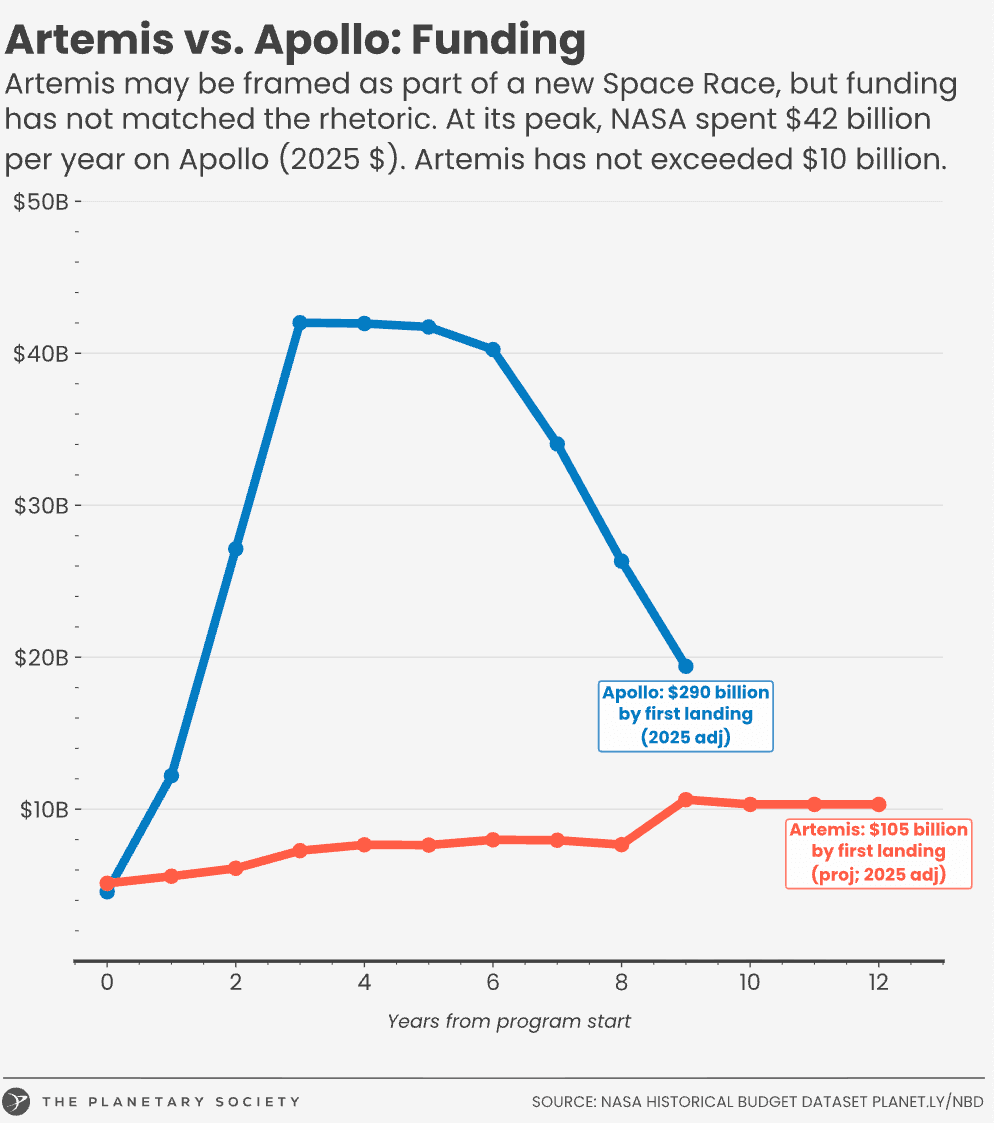 Source: The Planetary Society