Skip to content
Search

Latest Stories

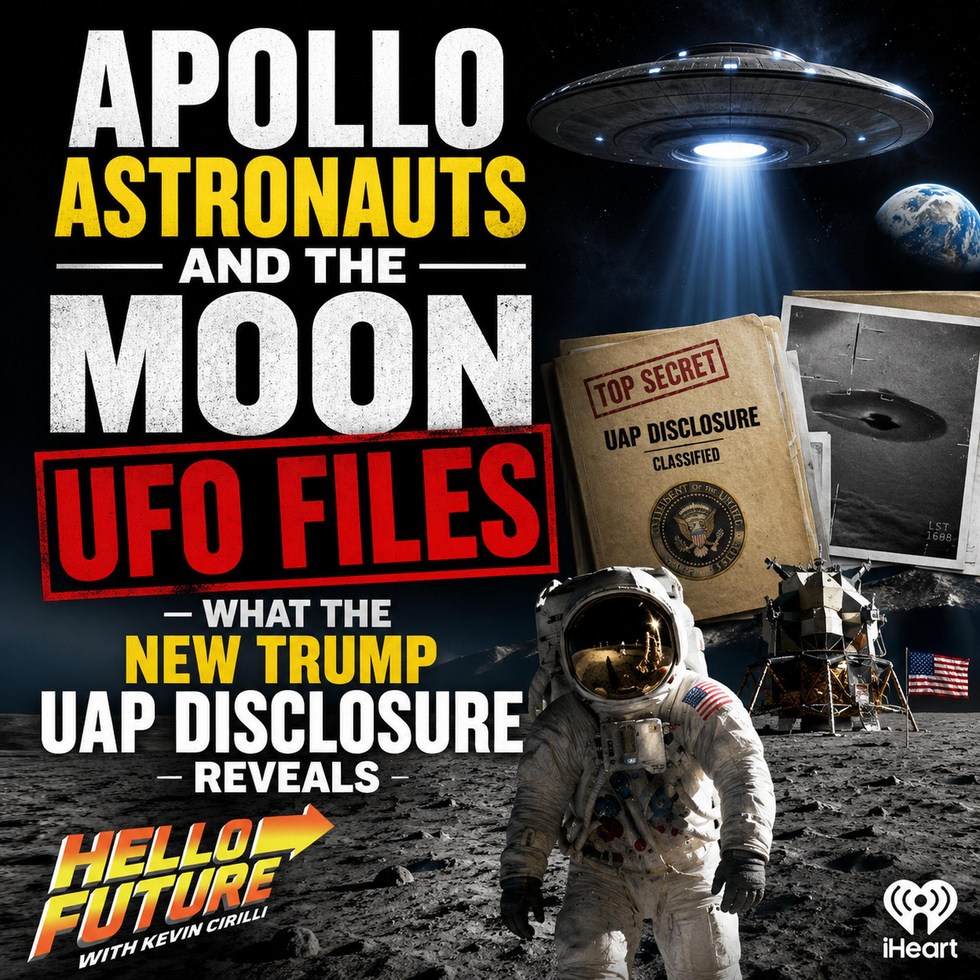
HELLO FUTURE: Apollo Astronauts and the Moon UFO Files — What the New Trump UAP Disclosure Reveals

HELLO FUTURE: Apollo Astronauts and the Moon UFO Files — What the New Trump UAP Disclosure Reveals


In this episode of HELLO FUTURE, host Kevin Cirilli speaks with Dr. Peter Skafish, co-founder and Director of Research at the Sol Foundation — a leading independent research and policy institute dedicated to the serious scientific, academic, and policy study of Unidentified Anomalous Phenomena (UAP) and their implications for science, government, and society.

With the Trump administration’s recent declassification of Pentagon UAP files, new photos and transcripts from NASA’s Apollo 12 through Apollo 17 missions have come to light — showing astronauts on the Moon reporting strange flashing lights, bright objects, and unexplained phenomena, including one crew member describing the sky lighting up “like the Fourth of July.”


Skafish breaks down what these historic sightings actually show, why they matter now more than ever, and how the Sol Foundation is helping bring rigorous, cross-disciplinary research and policy recommendations to the UAP conversation. The discussion explores the broader implications for humanity’s understanding of our place in the universe and what a transparent, “whole of society” approach to these phenomena could mean for the future.

Meet The Future: https://mtf.tv/

See omnystudio.com/listener for privacy information.

Speaker 1 (00:07):
It's now been a few days since the Trump administration
releasing the first batch of uap UFO files from well
a really long time. The President Donald Trump saying the
public deserves to figure out for themselves what the government knows.
So what did we actually learn? The dust has started
to settle. We've seen a lot of reaction. There's you know,
conspiracy theorists lighting up the internet. But what does it
actually mean? What should you care about? Are there now aliens?
Is the US government saying that aliens exist? And what
do we know?

Speaker 2 (00:44):
So?

Speaker 1 (00:45):
I Hello Future, It's me keV. This is a dispatch
from the Digital Frontier the planet Desert. The year is
twenty twenty six. My name is Kevin SURRELLI you can
get all of the latest Hello Future episodes however you
podcast and also on your iHeartMedia app. You know. When
this when the files were released, I reached out to
my buddy Andrew and I said, I got to talk
to Peter Skayfish because he, of course is the head
of the Soul Foundation. Doctor Peter Skafish as socio cultural
anthropologist who is one of the nation's leading experts on UAPs,
and he's studied at the University of California, Berkeley. He
studied all over the world, and he's not one of
those conspiracy theorists, folks. He's actually a scientist. And this
think tank really is all about trying to figure out
what higher education, the public private partnerships need in order
to navigate this. He's been on the show before, so
search for him in your iHeartMedia app or however you
podcast and you can learn more about their work. But
today I want to talk about Peter what we learned.
So first of all, how big of a deal is
this that the governments released this and what do we
now know that we didn't know before.

Speaker 2 (01:56):
Well, this is a big deal. And first, thanks for
having me back of the show. It's great always to
be in a conversation with you. But no, this is
a big deal. And anyone who's just kind of following
the UAP subject or who doesn't really know much about it,
let me say this is a big deal because it takes,
as far as we know, presidential authority to really move
the DoD the intelligence community, and we've never had it before,
and I don't think we have it here at the
Department of Energy to release significant UAP records Okay, this
is the way the classification secrecy works on the UAPUFO
issue is pretty extreme and no one else can really
make this happen besides the president. So that led a
number of agencies it looks like to cop up some records.
These are by far not the most significant UAP records
the federal government has. This is like skimming the surface.
But having done a cursory review today, as our organization,
the Sole Foundation, was preparing communityations outreach doing interviews, I
noticed some pretty significant things in there, and we'll go
into what those are, but I want to say that
these are these are records that, without a doubt, in
some cases concern what I like to call anthropogenic vehicles
or technologies.

Speaker 1 (03:16):
So what does that mean.

Speaker 2 (03:17):
Well, it means vehicles and other technologies not designed, manufactured,
operated by human beings. So yeah, you could say aliens.
But you know, we're trying to keep trying trying to
keep We're trying to keep it a little more dignified here.

Speaker 1 (03:31):
Okay, you scientists are always trying to come up with
these new words, and I'm like, okay, it's aliens. Okay,
we're talking about aliens. You're my alien advisor, by the way,
is my alien advisor.

Speaker 2 (03:43):
What we don't want to do is presume we understand
much about them, Okay, that would be to kind of
leap out of the frame of what we could accomplish
in this conversation. So I'm just saying it's these things
are of non human origin, and that's what some of
those documents concern.

Speaker 3 (03:59):
So that's prett exciting.

Speaker 2 (04:00):
One of the things in there is a transcript of
discussion among the crew of the Power seventeen mission.

Speaker 1 (04:10):
That's what's getting all of the buzz. So for folks
who have I've read that, and I just before you
tell us why it's significant. But the Apollo seventeen mission,
just to kind of give folks some background on it,
this was the eleventh and final crude mission of NASA's
Apollo program. It was the sixth and most recent time
the humans stepped foot on the Moon, and so obviously
with Artemis happening in America wanting to return to the Moon,
this is fascinating and it's the transcript of this is
really really riveting because the headlines that have just been
going all throughout the world I'm reading from USA today,
did Apollo seventeen astronauts witness UFO on Moon. What's in
the disclosure? Why did this particular transcript jump out at you?

Speaker 2 (05:04):
You know, there are always a lot of questions about
whether NASA astronauts, especially the Pollo astronauts, saw, you know,
truly unexplainable things that look technological in space. And you know,
we don't know for sure that that's what these guys
are discussing, but that may be a case here, and
it's significant that that was thrown in and what they're
describing does support the research of a colleague of ours
who's on self Foundation's advisory board, doctor Batrice ville Royes,
Swedish astronomer, who has done astonishing astronomical research. She's examined
old astronomical plates from the nineteen fifties, they're from the
pre Sputnik era, and she's shown that there are what
are called transient objects in near Earth orbit, meaning things
that disappear when you look at other plates, other images
taken at the.

Speaker 3 (05:53):
Time of the night sky.

Speaker 2 (05:54):
And it's very clear from her analysis that these are
not errors of the photography either, not multifications on the plates.
They are objects that are in orbit of the Europe
that shouldn't be there. So okay, we have Apollo astronauts
reporting the same thing that that's an interesting correlation or
usually supportive piece of evidence.

Speaker 1 (06:16):
But it's kind of frustrating at the same time as
an American because the Apollo seventeen mission and the transcript
basically says that they were witnessing some type of flashing
lights and it lit up the sky like the fourth
of July end quote. Yeah, according to one of the astronauts.
But this was all the way back decades ago.

Speaker 2 (06:35):
Well, look, you know, people have been seeing uap that
seemed to be technologies or vehicles since the nineteenth century
even before. But let's just say that of the type
we're familiar with.

Speaker 1 (06:47):
Definitely, what's frustrating, I guess to me as an American
and as a space enthusiast who is an advocate for transparency,
is that this happened all the way back in nineteen
seventy two. And if the government had actually been open
and transparent back in nineteen seventy two, and it looks
like the fourth of July was actually reported at the time,
think of the excitement that that could have generated in
the public opinion, that that could have persuayed for folks
to actually want to fund NASA. That's a fund space
exploration to take more seriously, if that was in the zeitgeist,
if I grew up as a kid thinking that, wow,
they don't know everything they saw on that mission, that
would change culturally how we think about it.

Speaker 3 (07:30):
Yeah. Absolutely, well it may be doing that now.

Speaker 2 (07:33):
But I mean, look, you know you should be frustrated,
and people who followed you ap subject, especially you know,
people who you know aren't that young, have been frustrated
for decades, right, I mean, this is this is from
you know, really with this release, evidence is even better.
You know that the best assessment we have of the
evidence is this has been a classified matter since nineteen
forty seven, like you know, with the birth of the CIA,
the Air Force we founded in nineteen seven. You know,
that's that's as people in federal government say, who come
out of military or the intelligence community, you know, nineteen
forty seven is year one of the National Security State,
and it appears to have been, you know, really become
an extremely classified matter that in that year. So this
is a really old problem in the US. Why weren't
they willing to talk about it? In the nineteen seventies.
Why weren't they doing this in the nineteen eighties. I
think we're going to find that out in the next
five or ten years. I do think that there was
a lot of concern that people aren't ready to know
about this, and frankly, they may not still be ready
to know about this. It really depends on what the
truth is about the intentions the makers and operators of
UAP vehicles.

Speaker 3 (08:44):
You know, we know very little about that.

Speaker 1 (08:46):
Peter Skayfish is my guest. He's with the Sole Foundation,
which is one of the leading think tanks, nonpartisan, really
trusted by higher education, by the public, private sector. On
I want to say aliens, but UAPs and extraterrestrial all
of the topics and transparency around the issue. What were
some of the other bombshells as you've perduced some of
the files.

Speaker 2 (09:07):
Now, well, let's be careful because you know, we don't
know what they mean. We don't know the significance of
these documents, and we need to verify their provenance. In
some cases, I'm sure we need to understand their context,
you know, as an academic, but also somebody who was
responsible for helping lead a public conversation. I'm just going
to say caution first. Now that said, there is a
record in there. It's got some reactions, but it's also
pretty clean. Believe it's a Department of an Offense or
a Navy memo which appears to concern a possible retrieval
and transport of a crashed UAP vehicle on Navy ship.
I don't know if it's an aircraft carrier. I believe
so in the mid nineteen eighties. And that's a pretty
stunning document. If the intention was to put that in
there because someone knew that was a retrieval of UAP vehicle,
that that's a bombshell. Now we don't know, and I'm
just doing this for memory because we're very busy over
here right now. That record states that it's addressed to
the Secretary of Defense, and it states that the transport
of something of material as something in materials is underway,
and that whatever the thing is is being held somewhere
of a tit beneath deck in the skiff environment of
the ship. Most of the crew is unaware of what's there,
and it's being kept away from the power source and
the main part of the electrical grid at the ship
so as not to have some kind of negative effect
on it from radiation or some of their effect. You know,
it could be that that is record of the recovery
of you know, a Soviet submersible or you know, some
kind of crash Soviet helicopter or something. I mean, we
don't know. It implies that something radioactive was on board,
and the fact that it was included in this document
release suggests that someone thought who chose the document, that
it did concern what we call a maritime retrieval of
UAP vehicle, and of which there apparently have been many.

Speaker 1 (11:15):
What's it going to take for us as a society
to actually treat this with the care and the rigor
and the academia mindset so to speak. I mean, even
with this, it's just like an unleashing of clickbait, and
that's how it feels. It doesn't feel like there's a
trusted voice.

Speaker 2 (11:37):
In this st Now you're correct, Kevin, we don't have
enough trusted voices. We don't have what I like to call,
and like I like to try to be in my
public work, a responsible narrator, saying that to criticize anyone,
you know, including people who live for clicks and sometimes
do stuff that looks pretty sensation all and a little silly,
to put it generously. This is understandable because this was
for so long such a marginal and ridicule topic that
the only kind of media space for it for the
most part still, you know, for really kind of long
form coverage or in depth coverage it. You know, it
tends to be a little bit kooky.

Speaker 1 (12:21):
Alternatives media, Yeah, exactly.

Speaker 2 (12:23):
You know, there are very few media professionals like yourselves
who you yourself, who you know you've developed pretty serious
curiosity about this, and curiosity that is leading you to inquire. Right,
most people are stock get curiosity and they kind of
think this is a curiosity.

Speaker 3 (12:39):
This is not.

Speaker 2 (12:40):
I'm pretty sure this is going to be like the
twenty first century issue. You know, it's going to make
climate change and even AI possibly look small.

Speaker 1 (12:49):
Well, the reason I know, we got to end it here.
And I can't thank you enough for coming on to
help explain these issues for me, you know, and I
was talking with Andrew about this when I say I
don't think of ET the movie. I think of us
on Planet Earth like to me, the octopuses in the ocean,
you know, and I see these images, they're like an
alien species to me because I don't think about them.
I don't understand them. Micro Algae, you know, at the
depths of the ocean, I don't know what that is.
So to me, though, outer space and our let's just
not even say outer space, our solar system, just our
solar system is in many ways in ocean. And I
think it would be very naive to think that no
form of micro bacteria life exists off of planet Earth.
So then when you think of just the magnitude of
how big this is the universe is, it's just very naive.
And so I don't think of it as an action
movie the discovery of this. I think of it like science.

Speaker 3 (13:58):
You should think of it like science.

Speaker 2 (14:00):
There's no situation in human history or human experience that
offers a perfect analogy for this. You've got to work
with a lot of different analogies.

Speaker 3 (14:10):
You know.

Speaker 2 (14:11):
Also think of it like the situation of initial contact
events at the beginning of European colonialism. Right, people's encountering people,
and both sets of people's being incredulous when they encounter
the others, like it's a shock to find out for
the Spanish and the Portuguese that there are people in
this new world, just as it's a shock indigenous people
of the Americas to discover the Europeans, and neither party
is quite sure of whether the other is human. In
the same way, there's a lot of confusion about that
in these colonial encounters, and that goes on for a
couple of centuries. So it's also a bit like that
we have historical precedents by which we can understand this
a bit. You know, there's a point at which all
the analogies break down and we're faced with a tremendous enigma,
which is like, Okay, who and what are the makers
of these things? I mean, are they biological and still?
Have they transcended evolution? Could they be hybrids of machine
and organism? Are they something else entirely that we haven't anticipated?
And I have my own hypotheses guiding my research on that,
because I study people who encounter this. We should all
just take a moment to wonder about that, and to
wonder at possibilities that we've considered remote, To imagine the
possibilities that maybe seemed inconceivable recently, To revisit our favorite
science fiction and imagine and ask ourselves, well, okay, could
we find the answer there. But then also I want
this to be the takeaway to listen to people in
and outside government who have encountered and experienced these things
firsthand and listened to their testimony. You know what seems
exciting now, it's going to be a few years of
this before people get they're fill of it. Is the
government telling you about this, Well, just wait until you
start to listen to the witnesses to it.

Speaker 1 (16:07):
I've heard some of them and it's I didn't expect
the emotion that it conjures, especially the Brazilian case. It
really was powerful. We're gonna have to leave it there.
Peter Skafish, appreciate you from the Soul Foundation. Thank you
for making time for me, my friend. I appreciate you're
my alien advisor.

Speaker 3 (16:24):
I love playing that role. I hope to do that soon.

Speaker 2 (16:28):
And take away for the audience is, yes, for sure,
I know it personally for sure. There's a part of
the US government definitely knows that this stuff is real
and they know for a long time.

Speaker 1 (16:40):
There you have it, my alien advisor. I've got a
space coach, and now I've got an alien advisor. Peter
Scapeish have a good one. Thank you friend, see it.

Speaker 3 (16:48):
Kevin

More For You