Skip to content
Search

Latest Stories

HELLO FUTURE: Space-Based Solar Power and the Future of the Grid

HELLO FUTURE: Space-Based Solar Power and the Future of the Grid


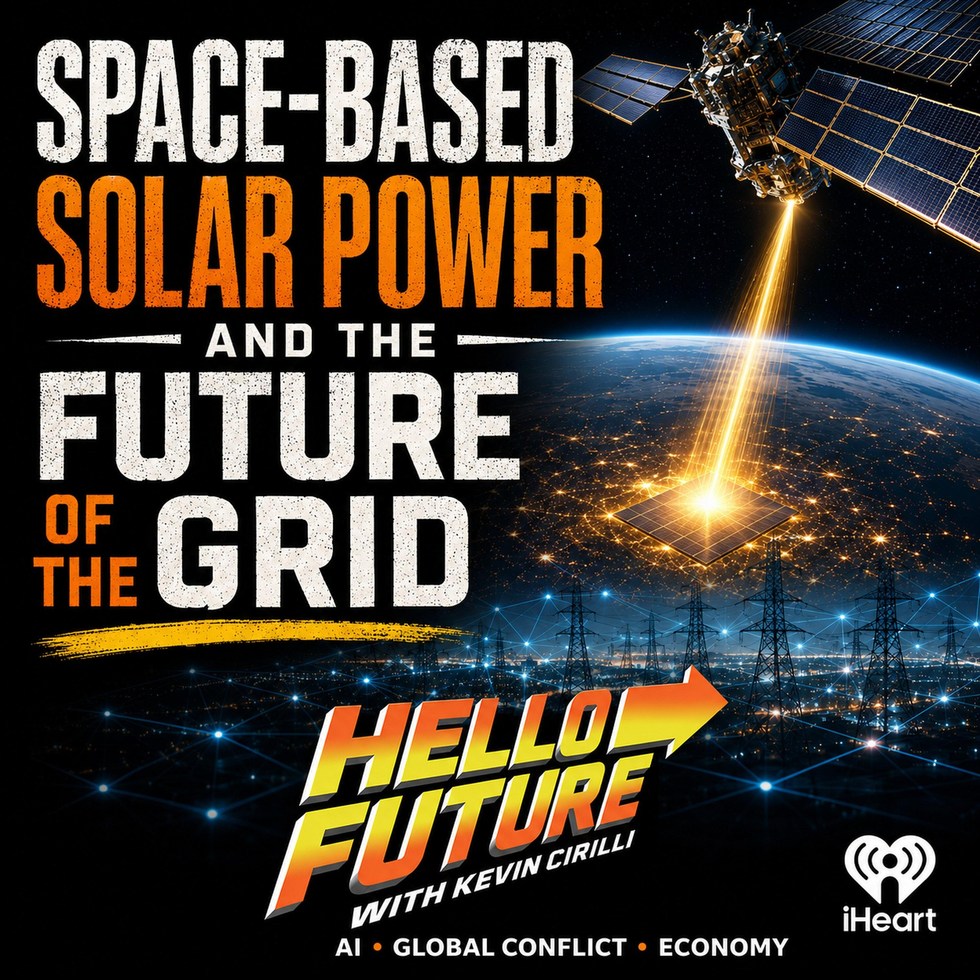
In this episode of HELLO FUTURE, host Kevin Cirilli sits down with Alex Gilbert, Principal & Field Director at Rocinante Fieldworks and Fellow at the Payne Institute for Public Policy, to explore why building solar power plants in space could be key to modernizing Earth’s energy grid.

Gilbert discusses the technical and strategic case for space-based solar power — collecting continuous energy in orbit and beaming it back to Earth — and how this frontier infrastructure could help address terrestrial energy challenges. 


Drawing on his background in nuclear innovation, energy security, and extreme-environment systems, he explains what it would take to make orbital power plants a reality and why this approach may become a critical part of the long-term solution for clean, reliable energy.

Meet The Future: https://mtf.tv/

See omnystudio.com/listener for privacy information.
Speaker 1 (00:08):
Nowadays, everybody's talking about blackouts and the grid and energy
and data centers. We don't have enough electricity. The cost
is going way up, up up up up, and I'm
just thinking to myself, why not put it in space?
Hello Future, It's me keV. This is a dispatch from
the Digital Frontier the Planet Deserves. The year is twenty
twenty six. My name is Kevin Surreally, remember you can
listen to all of the latest Hello Future episodes however
you get your podcasts and on the iHeartMedia app. And
I'm so excited to get to talk to Alex Gilbert
again because he really is one of the experts and
explaining things when it comes to outer space, but also
on regulations. I mean, he was just presenting at the
United Nations on commercial space nuclearization. Alex is someone I
really trust when it comes to help guiding and understanding
these big transformations that we're all watching. We're all inspired
as Americans to see Americans going back to the moon
and building the cislunar economy and building out infrastructure and
permanence between here and the moon and on the Moon
and ultimately beyond. He was the first person I just
talked with him last week and I said to him,
you know, Mars is feeling a little too close. Where
are we going next? And he goes, Titan, Saturn's moon Titan.
And I said to myself, are we going to land
humans on Titan in my lifetime? And he goes, yeah,
we are. By the way, if anyone's listening, send me
to Titan. I'll go, Alex, welcome back to the program.
I want to do a documentary on Titan. I want
to manifest that because I think Titan is fascinating. Would
you help me if I did that? Oh?

Speaker 2 (01:42):
Absolutely? And great to be back having to always give
a chat.

Speaker 1 (01:45):
All right, So you want to put electric power centers
in space? Right? Why should I want to do that?
And how would that work?

Speaker 2 (01:53):
Yeah? So this sounds like a crazy idea, but this
is a crazy idea that it's time has now come.
Look the United States, we're actually in one of the
better energy situations. Love. Other countries are struggling, and renewables
have been awesome in the country. But renewables have limits.
And I hate saying the phrase, but solar power doesn't
produce power when the sun doesn't shine on Earth. One,
we're looking at what's happened with SpaceX and all these
other technologies that have made that cost of getting to
space cheaper. We can now take a solar power plant,
we can put it in space where it is never
in shade, and it can produce energy, and we can
beam that energy back to or using microwaves or lasers.

Speaker 1 (02:32):
Okay, so that sounds awesome, But I have a million
questions now, and I want to start with one. How
big is a space power center? It's conjuring up images
of Star Trek and star Wars, but what does it
actually look like? And be very specific?

Speaker 2 (02:46):
Yeah, So the small ones we're looking at right now
for beaving power in space, they're going to be like
the size of a large satellite. But if we're really
talking about the holy grail here, the big energy opportunity,
we are talking about massive solar fields and space that's
spread across kilometers and kilometers just massively.

Speaker 1 (03:05):
I have American what do you mean by that? A
how big a football field? A stadium?

Speaker 2 (03:09):
Like a stadium. We can put stadiums into space that
would produce one to two gigawatts of electricity.

Speaker 1 (03:16):
Okay, so one to two gigawatts of electricity powers? What
a city a town.

Speaker 2 (03:20):
What would that power that would power a medium sized city?

Speaker 1 (03:23):
And because it's so Washington, d Yes, what are we
calling these space power centers?

Speaker 2 (03:29):
Space based solar power?

Speaker 1 (03:31):
Space based solar power?

Speaker 2 (03:34):
So can well that it's still in its early phrase
because it's a bad name. It was a horrible name
scientists and innovators. But we're seeing right now there's actually
companies that have just started raising venture backed money to
develop this in the United States and Europe. There's five
or six major companies that are doing this right now
that are hoping to have this power online.

Speaker 1 (03:53):
It's a space power grid.

Speaker 2 (03:55):
Yes, yeah, that's a better name, space power yep.

Speaker 1 (03:58):
Yeah. Okay, So we've now established you can build one
of these, you put them in space. How are we
building something in the size of a stadium in space?
Or is it like legos where you're sending up pieces
and connecting the pieces? I mean, how from an engineering standpoint,
how are we doing.

Speaker 2 (04:15):
That exactly that we call it in space assembly and
potentially manufacturing. And so the initial idea is that we'll
send up a couple of these things, we'll make them
together in space. But if we're really looking at these
very large things, these things that would be able to
remind power to cities on Earth. Those are going to
be massive, massive facilities that we will probably need astronauts
up there as maintenance workers just helping build out those facilities.
We'll probably have many deliveries. And I know you and
I were talking previously about water on the Moon. Well
there's resources on the Moon and on asteroids that we
could actually use to create the solar panels, to create
the structures that hold it together. We can actually put
build these things potentially using space resources in space with
no environmental impact on Earth, just meaning as power.

Speaker 1 (05:00):
How many years away are we from that.

Speaker 2 (05:03):
So we actually have just had the first very very
very tiny little bit of power beamed to Caltech about
a two years ago, and then we now have companies
that are doing their first demonstration missions. And right now
we're focusing just on putting a solar power plant in
space that's pretty big and beaming it in space because
that's easiest to demonstrate. But scaling this up is something that,
especially if the economics can close on getting super heavy
launch vehicles like Starship to really work by twenty forty,
we can start having the first of these big utility
scale systems and by twenty fifty this could actually be
a substantial part of power for many countries around the world.

Speaker 1 (05:38):
Okay, so if we do that, how many would we need?

Speaker 2 (05:41):
It just depends on how it works with the rest
of the energy grid. You know, I'm a big nuclear
person and relacing a nuclear renaissance in the US right now.
When we're looking at terrestrial power, the best solution is
a diversity of solutions. It's I hate to say all
of the above, but it really is all of the above,
because you get resilience by having multiple types of systems.
And so if we look at this opportunity for space
based solar power, the biggest and most important one might
be for remote areas, our island communities that otherwise don't
have good access to power. They could have one hundred
percent of their power potentially served by this very very soon,
within a decade or two.

Speaker 1 (06:16):
So is it orbiting the Earth that something the size
of Lincoln Financial Field would not be in lower Earth orbit?
Would it or would it be?

Speaker 2 (06:25):
This is the very historical idea was originally about fifty
years ago behind this, and the idea was what we
call it geosynchronous Earth orbit. Just meaning it follows the
same spot on Earth, and so it's far enough away
that it orbits at the same rotation of Earth. So
if you're looking in the sky, it's not moving, it's
staying over that same spot on Earth. It's a really
special orbit. But when we're actually looking at modern systems
of modern technology, almost any of the Earth orbits might
be applicable. We might be able to use them.

Speaker 1 (06:55):
Would I be able to see these with my eye?

Speaker 2 (06:58):
So that is I think, I think the big environmental
question here, and I think that if you look at
the some of the new ideas coming out, that is
definitely possible. And what we have seen is generally a
lot more concerns about seeing satellites and large satellites from
Earth orbits, and so that is something that I think
we could potentially see these, and we could see potentially
small rings in space around Earth. There's gonna be a
lot of questions about our people, okay with that from
a light pollution perspective, but again, it might save us
a ton on carbon emissions.

Speaker 1 (07:27):
Well, I think it's fascinating because ultimately, if you're building
something the size of a football stadium, an NFL stadium
and you're putting it in space, I would imagine that
there are going to need to be humans that are
inside of that. And now it's really starting to feel
like Star Trek. How many humans would have demanded something
like that.

Speaker 2 (07:51):
So it just depends on how many of those systems
you have. There's definitely people out there that will say
that you can just use robots, but you and I
have talked a lot about this. Robots are awesome, but
humans have a very particular use in space. We're super adaptable.
There are things that we can do that it would
take billions of dollars.

Speaker 1 (08:06):
Also, there's an economy. I mean it would be at
least a dual use system. I mean, you could turn
that into a hotel, you could turn that into space tourism. Obviously,
there's going to be other functions that this destination does.
I mean that could this potentially be a rest stop
on the way to the moon.

Speaker 2 (08:24):
So one of my favorite books that got me into
space originally was a book from the seventies. It was
like Space medic It's about a space hospital and the
entire point of the space hospital is to serve the
workforce for these space power grids. Literally, they would have
enough that you would need maintenance workers that would be
up there in space medicine. That is the type of
thing that if we actually have this go to scale,
it starts becoming a very large part of terrestrial economics.
You one hundred percent would want humans up there for
a whole bunch of blue collar or space collar type.

Speaker 1 (08:53):
Space collar jobs. We call them space collar jobs.

Speaker 2 (08:56):
Space collar jobs just first maintenance workers. But then once
you have humans, you need medics, you need all the
support services. And then if you are starting to have
a lot of things coming to and from the Moon,
all of a sudden, the entire idea of a kind
of space stations in Earth orbit becomes real.

Speaker 1 (09:12):
I think to the average eye it would look like
what a star if this was Yeah, yeah, so I
think I think realistically, you know, I wouldn't have a
problem with that. I do think that there has to
be places on Earth that had like almost like national
parks where you can protect you know, no fly zones
or no orbit zones if you want to call it that,
because I do think it is important that places on
Earth that where you protect the sky and the beauty
of that. And I do think that the comparison would
be to the National Park Service. Part of building the
future and embracing and preserving, you know, the resources and
our planet is going to require to scale and to
build off world. And if we're able to do it here,
then we would be able to quit those same systems
in Mars or I can't believe I'm going to say this,
but Mercury and Venus. Well maybe not if with the
Sun with mercury, but definitely for Venus. I mean, why
not because there's all of these different resources, and if
we're able to establish that, we don't really have to
even land humans on any of these other rocks for
last lack of a better word, we just have to
be able to essentially keep tabs on them.

Speaker 2 (10:29):
Yeah. So this specific technology, space power grids or space solar,
we can use it most anywhere in the Inner Solar System.
There's actually some good ideas a company out there called
Volta that's trying to do it for the Moon. And
so when we're talking about fermanly shadowed regions last time,
they can potentially provide power to those regions and even
though they are not directly in the Sun. Mars is
also a big opportunity there. I'm a co author and
I actually had a paper several years ago that the
first Martian export might be sending these stations back to
Earth because they might have to build those stations really
good at Mars. They might specialize and then send them
back to Earth, and they could easily do that from
an energetic perspective. Getting to a deep space, especially Jupiter
and beyond, that's certainly when you're going to have to
transition over to nuclear, but you probably have some specialized
solar type systems.

Speaker 1 (11:15):
Then right now, what is your favorite piece of our
solar system?

Speaker 2 (11:18):
Before I let you go ooh oh, that is that
is an unfair one. Right now, the one I think
about every single day is the Moon.

Speaker 1 (11:27):
Europa or Titan Europa. Okay, same, but now I feel
like because NASA's administrator, Jared Isaacman is sending the Europa
Clipper and you got the Dragonfly, but they're bullish on Titan,
it seems like, yeah.

Speaker 2 (11:41):
So personally I love all the Moon's the same tons
of ocean moons. These aren't really ocean moons, and there's
about depending on high talent and what we know, there's
probably about eight of them in the solar system. So
I love all of them. Europa is just exciting because
it is an ice ball moon. It's got massive water
oceans on it.

Speaker 1 (11:59):
Titan is really it's a giant piece of hail.

Speaker 2 (12:02):
Yeah, it's a giant piece of hail. I think we're
going to find life everywhere on the Solar.

Speaker 1 (12:07):
So that's what I think. I wrote this, I think,
and it's gonna have huge implications for biomedicine and helping
to understand if life can survive in an extreme environment.
That could help us unlock yours here. Okay, but Titan
is not just a giant ice ball.

Speaker 2 (12:23):
No, So Titan is a carbon It's a methane ice
ball effectively, So it is so cold that you have
methane lakes, and this is natural gas full natural gas rivers.
It has rivers, It has rivers of natural gas. And
then it's so cold there that water ice actually is
more like a rock. It's more like water rock than
ice because it's just so cold.

Speaker 1 (12:46):
And so yeah, but it has land.

Speaker 2 (12:47):
Yeah, Titan.

Speaker 1 (12:49):
I hate to say this because I feel like I'm
cheating on Europa. I think that Titan and Europa question
is the New Moon versus Mars question.

Speaker 2 (12:56):
Ooh, that's an interesting one to explore.

Speaker 1 (13:00):
That's my hot take because I have to tell you,
the more I go down the rabbit hole of Titan,
the more excited I get about Titan because of all
of the power things that you're talking about. When you
hear that there's a moon in Saturn, it's Saturn versus Jupiter.
Jupiter has always been one of my favorite planets because
I think it's fascinating and I've always wondered if you
were on Europa. First of all, what would the sun
look like to the human eye. Would you consider Jupiter
to be your sun or would you consider the Sun
to be the Sun? Does that make sense?

Speaker 2 (13:34):
Yeah, that's a great question. It actually might feel like
kind of both. Yes, the majority of your site comes
from the Sun, but both Saturn and Jupiter are just
so big that a lot of the light you'd see
would actually be reflected from those planets. And so depending
on which moon you're on, it could well be a
substantial portion of your energy balance on that.

Speaker 1 (13:52):
Planet, which is wild And I think what's cool to
me about Saturn is obviously it's Saturn. But if we
can crack the code of Titan, that is the Solar
systems gas station. Am I right?

Speaker 2 (14:05):
Yeah, I mean it's literally it's a ton of hydrocarbons
and stuff. And look, the one advantage I think Saturn
system has is that the Jupiter radiation environment is crazy intense.
It's really hard for spacecraft to operate close in, especially
with some of the planets that we want to go
to there. Saturn I think is also much better candidate
for having cloud cities.

Speaker 1 (14:24):
Oh that's fun.

Speaker 2 (14:26):
All right? Did I just blow your mind?

Speaker 1 (14:27):
No? No, no, okay, Because cloud cities, no one ever
talks about it because they think that that there's.

Speaker 2 (14:31):
When we could have a cloud city or a cloud
research station on Venus and about the same time that
we could have the landed station on Mars.

Speaker 1 (14:38):
So when you say a cloud city, what does that mean?

Speaker 2 (14:42):
The best way to really think about it not Saturn
and think about Venus. So Venus is very much like Earth.
It's got a similar gravity level, but the problem is
it's got a ton of.

Speaker 1 (14:51):
Atmosphere and it's hot as hell.

Speaker 2 (14:54):
Because of that atmosphere. That's actually one of the reasons
that we know about the greenhouse effect is because we
saw Venus and saw that it was all carbon dioxide atmosphere,
and it was so much hart It's actually hotterer than
mercury because of all that greenhouse effect. Wow, And so
the surface of Venus might be the like, might be
the closest place to a healthscape in our solar system.
It's crazy hot, it's super intense pressure, but there's some
altitude bands around fifty kilometers it's like thirty miles in
the air where you could actually put a station that
is just floating like a big blimp, and it would
be the right pressure, it'd be the right gravity. It
would be like you're just living up in the clouds.
You just need to wear a breather mask because it'd
be a little bit caustic to breathe. But you can
literally just have a floating research station that navigates the
clouds of Venus indefinitely and getting there and landing and
doing all that stuff. It would be a challenge, but
we can probably figure that out from an engineering perspective.

Speaker 1 (15:45):
Yeah, but you know what I want to do. We
got to start terraforming. We just got to start terraforming
the Solar system. I feel like we should just terraform Mars.
I think we should terrify. I'm a huge believer in
terraforming Mars.

Speaker 2 (15:58):
So I've got someone that you should talk to on
this show that is one of the best planetary scientists
working on that exact problem.

Speaker 1 (16:05):
Well, I would love to interview them, so stay tuned,
every one. Alex Hilbert. I genuinely enjoyed our conversations, my friend,
Alex Gilbert. It's been so much fun. I'm so excited
to be working with you and alongside and you learn.
I learn every time I talk to you. So if
folks want to find out more information about you, where
should they.

Speaker 2 (16:23):
Go My website rossinantefieldworks dot com Rossinante roc I N
A N T E.

Speaker 1 (16:31):
Why'd you name it that?

Speaker 2 (16:33):
It's after don Quixote's horse. It's got a lot of
meaning about old workhorses that are made grand by a
new adventure, which I think is right for where the
space and nuclear sectors are these days.

Speaker 1 (16:44):
That's awesome. That's a great thing. All right, guys, thanks
for listening. Be sure to check out the latest episodes
of Hello Future however you get your podcasts and of
course on the iHeartMedia app. Have a great tomorrow. Today,

More For You