Skip to content
Search

Latest Stories

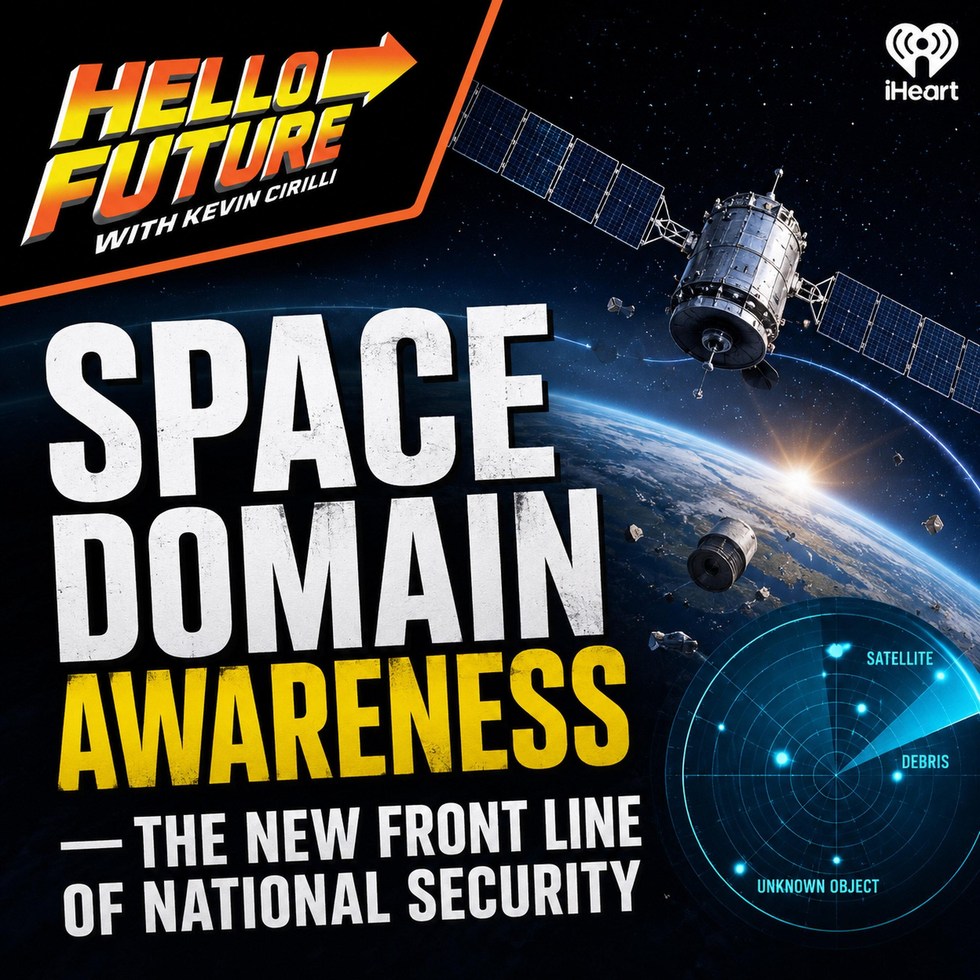
HELLO FUTURE: Space Domain Awareness — The New Front Line of National Security

HELLO FUTURE: Space Domain Awareness — The New Front Line of National Security


In this episode of HELLO FUTURE, host Kevin Cirilli speaks with Damian DiPippa, CEO of Auria, about the invisible war happening right now in Earth orbit. As thousands of new satellites, debris, and potential threats crowd low Earth orbit, Space Domain Awareness has become one of the most critical missions for the U.S. Space Force. DiPippa explains how Auria’s solutions are helping detect, track, and characterize objects in space, why SDA is the foundation of modern space operations, and what the next decade of orbital awareness looks like as commercial constellations explode.

Meet The Future: https://mtf.tv/


See omnystudio.com/listener for privacy information.

Speaker 1 (00:07):
Nowadays, most Americans are starting to realize just how interconnected
their way of life is with outer space, and all
of our technology and systems are really up there and
outer space. Hello Future, It's me keV. This is a
dispatch from the Digital Frontier. The planet is Earth. The
year is twenty twenty six. My name is Kevin SERRILLI.
You can get the Hello Future podcast however, you get
your podcasts on the iHeartMedia app, and be sure to
sign up for my newsletter over at MTF dot tv.
My guest today is someone who is really at the
forefront of helping to secure the space system domain. His
name is Damian di Pippa. He is the CEO of ARIA,
and of course he's also happens to be a Penn
State alum.

Speaker 2 (00:50):
I'm thrilled to get to talk with him.

Speaker 1 (00:52):
Damien, thank you so much for showing up to meet
the Future today, and I want to talk to you
just a little bit about what your first and foremost,
what ARIA does and what company it is. It's a
space company, but it's really at the forefront of technology
and the software systems for outer space that are needed
for the space domain.

Speaker 3 (01:11):
Right absolutely, yes, at Oriel, look We are innovators and
integrators of command and control and communications solutions for space
related systems from orbit all the way to the tactical edge,
and so that's really our niche in the marketplace, and
what we do mainly software systems, but we're also doing
hardware in the sense of digital ground stations for satcom communication,
as well as software defined radios for secure communications for
our war fighters, all the way at.

Speaker 4 (01:41):
The tip of the sphere in tactical areas well.

Speaker 1 (01:45):
What I find so interesting is that I think a
lot of folks are starting to understand the importance of
protecting the space domain. But still you get some folks
in the mainstream media and in legacy media their bosses
who really are just not educated at all. They've lost
touch with curiosity in terms of just how important this is,
and so everything from these thousands of new satellites that
are being launched. Then you've get issues related to debris
and potential threats, and then you factor in bad actors
like the Chinese Communist Party, Russia, Iran, North Korea and
other bad actors who are actually trying to hack into
our systems.

Speaker 2 (02:22):
So what is like the one.

Speaker 1 (02:24):
Problem area that ARIA really is helping to solve that
would impact everyday Americans.

Speaker 3 (02:30):
The biggest problem area we in area attack is really
the integration of fragmented systems to be able to do
the command to control and communication of these space borne
assets and also to do the communications space to space
and space to ground.

Speaker 4 (02:45):
You know, haven't been thirty five years in this industry.

Speaker 3 (02:48):
I've seen it come a long way, and you're correct,
a lot of people don't realize how pervasive space is
in our lives today and the importance of being able
to secure that infrat structure and also the continue to
improve that infrastructure from systems that you know, began twenty
years ago to the most modern systems that are going
in space even commercially.

Speaker 1 (03:09):
Today, especially as like all of these satellites are being launched,
and you know, every time you check your weather on
your phone, or you're banking with a financial system or
getting your groceries delivered to you, all of these really
modern way of life that we've created for ourselves that
we enjoy and that are important to us, it's all
connected to the space domain. And so you know what
I what I find interesting about your specific company is
that you're allowing for all of these different systems to
talk to one another. I give my dat a hard
time because he's got an Android and I have an iPhone,
and you know, you get the green bubble, so to speak.
But you know, and sometimes you try to send a
gift or a meme or something and it like it
gets all funky when you when you try to text
them back and forth.

Speaker 2 (03:55):
Basically you do that.

Speaker 1 (03:57):
Aria does that, but in outer space, because I would
imagine it'd be pretty problematic if one satellite can't talk
to Planet Earth because they're using a different system. Can
you give us an example of the type of communication
systems that you enable with your company?

Speaker 4 (04:17):
Yes, yeah, and.

Speaker 3 (04:18):
Their command and control and communication system So, for example,
we have software that actually sits on satellites that does
the orchestration of satellites with each other and themselves as
well as their payloads such as a sensor or a
communication package to be able to communicate with the Earth.
And then we also develop software that sits at the
ground stations that allow the operators to do what's called
pelemeatory tracking and control of the satellites, how the satellite
is operating, how healthy it is, and how well it's
operating in space, how it's tracking its orbit across the Earth,
and then it's control what it needs to be doing
when it needs to be sending a signal or a
signal communicating with another satellite. Those are the type of
software that we develop users can use, and we also
apply AI technology that in some cases the satellites are
able to operate on their own without a user in
the loop.

Speaker 2 (05:15):
How fast is your industry evolving?

Speaker 1 (05:18):
Because we all here there's thousands of satellites that are
being launched, and in the next decade it's going to
like be even more and it's just like a vertical
line almost in terms of the number of satellites just
between now in a couple of decades ago. But what
we don't often hear about is just the technology behind
them that's powering them and the software, which is why
I find the work that you do so fascinating and interesting,
because I would imagine that because we're living at what
I believe is the start of the fifth Industrial Revolution,
the pace of innovation to protect these assets is so fast.
I mean it's like every day I would imagine there's
some new breakthrough or algorithm from a actor that can
hack into us, So how do you stay ahead of
making sure that they're cyber secure?

Speaker 3 (06:07):
Yeah, you know, I've often said that I think in
a major conflict, a cyber attach in space is probably
a first response action that would likely happen. And so
you can't protect every single aspect of the communications chain
or the command chain for satellite systems, So you really
have to harden the most important aspects of it.

Speaker 4 (06:27):
And then you build your systems that.

Speaker 3 (06:29):
Are that are two use two terms that are called
ubiquitous and resilient. A. You put a lot up which
we're which you can see with many, particularly in low
Earth orbit now very very large constellations thousands of satellites.
That way, if you lose one or two or ten,
you've got plenty of others you can offload the work too.
And then the other is resilience and recovery. How resilient
are these systems to various effects, whether it be cyber
or mechanical or bad actors in space themselves, and how
fast can we recover.

Speaker 4 (07:01):
When something does happen.

Speaker 3 (07:02):
So you really have to design that into the system
knowing that you're not going to protect every single aspect
of the communications chain. It's just an impossibility, similar to
what we have here on Earth with our own computer systems.

Speaker 1 (07:15):
So I guess what I just learned is for hackers,
do they try to hack one satellite or if they
hack into one they get access to hundreds or thousands both?

Speaker 4 (07:26):
Yes, exactly. You know, it really depends on how they
are connected.

Speaker 3 (07:30):
And you can think of a satellite network, you know,
as far as connectivity not that much different from an
Internet connection here on Earth. You know, once you find
a way in, the whole system could be hacked.

Speaker 4 (07:41):
And so you know, we do have to do.

Speaker 3 (07:43):
Similar cyber hardening and protection in space as well.

Speaker 1 (07:46):
So are you able to, like, you know, with my
iPhone again, just to use a basic analogy, you know,
my software gets updated or as an American, I understand
refreshing my app refreshing my software to get it to
the next system.

Speaker 2 (08:00):
Do satellites work that way as well?

Speaker 4 (08:02):
Yes, in many cases we do.

Speaker 3 (08:04):
We're constantly updating satellite software both here on Earth and
what's on the satellites themselves. That's all part of the
daily space operations that you're working with your satellite systems
is modernizing your software.

Speaker 4 (08:16):
You're kind of fixed with your hardware.

Speaker 3 (08:17):
You can exactly go up into orbit and swap out
a card, but we can still transmit up new software
code and updates and harden our systems over time to
advance them with the threat.

Speaker 1 (08:29):
How long does it take for a satellite to reboot
or upgrade at software their.

Speaker 3 (08:34):
Computer systems just like any others, particularly today with commercialization
of space, A lot of the same technologies that we
would use in computer systems here we're able to use
on space systems as well.

Speaker 4 (08:45):
We may have to.

Speaker 3 (08:46):
Harden them a little bit different for the harsh environments
of space, but the timeliness of how they operate and
they get updated and are utilized seeds are similar to
what we do here on Earth.

Speaker 2 (08:57):
That's really interesting.

Speaker 1 (08:58):
And the harsh conditions is space, I would imagine make
it even a little bit more complicated. How do you
think of things like space weather and solar storms and
how does that factor into the cyber software for satellites.

Speaker 4 (09:13):
Yeah, I mean it's mostly on the hardware side.

Speaker 3 (09:15):
As you're building, as you're building and testing your systems,
you really do have to build them harden for those
types of environments. You know, you know, when you're facing
the sun the temperatures are extremely hot. As you're on
the back side of the Earth and you're not facing
the sun, the temperatures are extremely cold. You do have
to worry about things like debris and other stuff that
may impact the satellite, and how do you recover, how
do you have redundant systems. You may have to take
that into account too as you're developing your satellite systems,
and a lot of that has to do with more
of the engineering of the hardware of the satellites themselves,
and then we design the software so that you know,
we can update the software over time as we need
to accommodate emerging threats or changes in conditions, things we
might earn over time as the satellite is operating.

Speaker 2 (10:02):
If you could wave the magic wand and in twenty years,
where where are we as.

Speaker 1 (10:09):
A country in terms of how we're thinking about satellite software?
Is it now beyond Mars? What I always say is,
and I've said this in previous episodes. To me, what
I've learned because I know nothing, But what I've learned
is it's kind of like when the explorers would send
a bird out to land in order to see if
the bird came back or whatnot. Satellites to me are
like many computer birds. And if we just keep building
these flocks in these fleets of satellites, we just keep
getting further and then humans get to go because it's
like they sense the environment. So right now we're focused
on the Moon and then ultimately Mars.

Speaker 2 (10:45):
But where do we go? Even beyond that, I would.

Speaker 3 (10:48):
Say it's even more than birds going out and kind
of seeing where you are. We are going to be
dependent on satellites for various things like relays, relays of
communication between planetary bodies. So for example, now we just
we just circumnavigated the Moon again with Artemis Sphere. We're
already designs are in place and plans are in place
to put satellite constellations around the Moon and you know,
similar to you know, starlink around the Earth for communications
and internet. We're going to need those same technologies around
these other planetary bodies as we start. So we want
to go and colonize Mars, we're going to need similar
infrastructure to be able to communicate not only on that planet,
but interplanetary as well, So to be able to relay
messages and information from one planetary body to another, we
are always going to need some type of satellite systems,
some type of autonomous systems operating to be able to handle.

Speaker 4 (11:43):
That load for us well.

Speaker 1 (11:45):
Plus like with three I at lists, I mean the
ability to be able to communicate with the software.

Speaker 2 (11:49):
I mean.

Speaker 1 (11:50):
One of the things that fascinates me and kind of
got me into this was the Voyager one and Voyager two.

Speaker 2 (11:55):
I mean all of that.

Speaker 1 (11:56):
I'm like, why don't we have millions of voyagers out
there seeing what is out there?

Speaker 2 (12:00):
But we're gonna have to leave it there.

Speaker 1 (12:02):
Damien Dipipa, he is the CEO of ARIA, which is
just really at the forefront of the software for satellites.
And just thank you so much for showing up to
meet the future to break down all of these implications.

Speaker 2 (12:13):
I learned a time. Thank you so much.

More For You