Skip to content
Search

Latest Stories

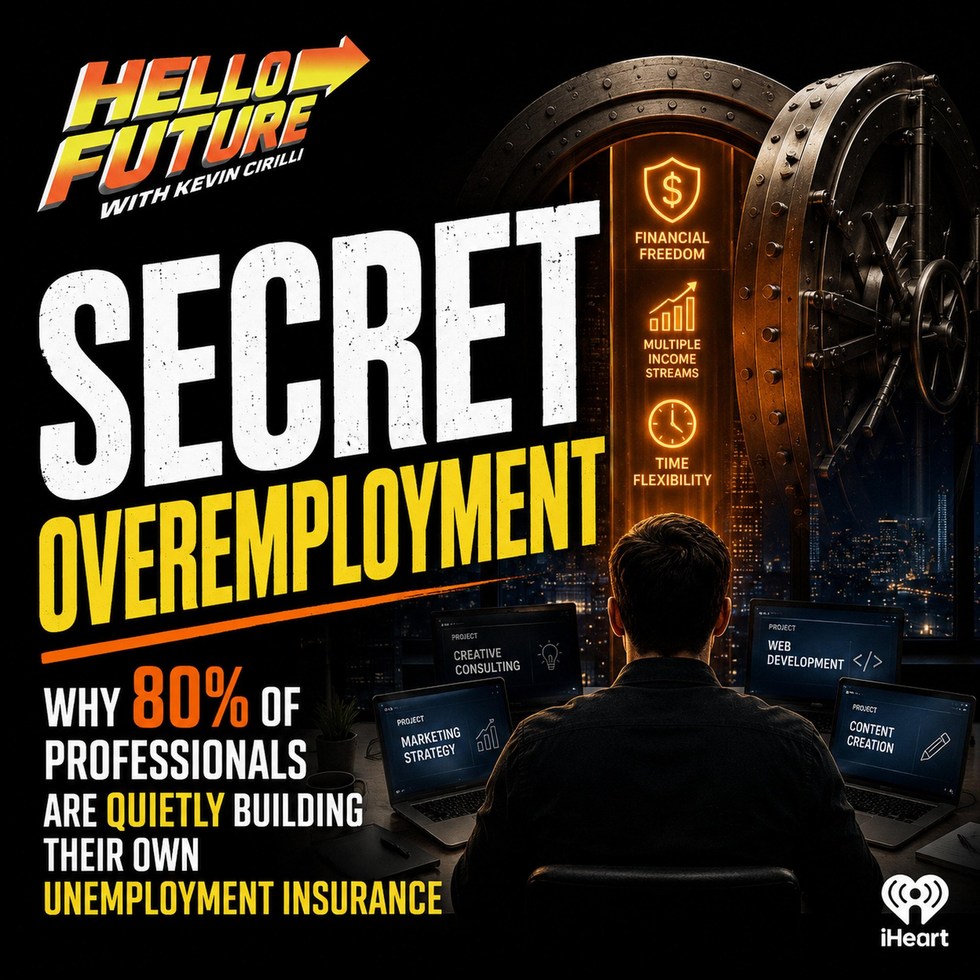
HELLO FUTURE: Secret Overemployment — Why 80% of Professionals Are Quietly Building Their Own Unemployment Insurance

HELLO FUTURE: Secret Overemployment — Why 80% of Professionals Are Quietly Building Their Own Unemployment Insurance


In this episode of HELLO FUTURE, host Kevin Cirilli speaks with Mattie Duppler, fiscal policy expert, founder of Forward Strategies, and host of The Tradeoff podcast. A former Amazon public affairs leader and Senior Fellow at the National Taxpayers Union, Mattie brings sharp insight into how economic incentives, technology, and worker behavior are reshaping the labor market.

A new Enhancv study reveals that nearly 80% of professionals now treat a second full-time job as essential “private unemployment insurance,” hedging against layoffs in an increasingly volatile economy. Surprisingly, this trend isn’t limited to remote workers — over half of multi-job holders are working mostly in-office. AI is acting as a powerful multiplier, with many completing their primary role in 30 hours or less, while still meeting or exceeding expectations across multiple jobs.


Mattie breaks down why workers are “air-gapping” their income, what this means for the traditional employer-employee contract, and whether this represents a rational response to economic uncertainty or a deeper breakdown in job security. She also explores the long-term implications for productivity, wages, fiscal policy, and how companies might need to rethink loyalty in an era where many high performers are no longer willing to bet their entire livelihood on a single employer.

This is a candid conversation about the future of work, AI’s real-world impact on daily life, and what happens when workers stop believing that one job is enough.

Meet The Future: https://mtf.tv/

See omnystudio.com/listener for privacy information.

Speaker 1 (00:07):
Nowadays, everybody's saying that with underemployment, no one really has
a job.

Speaker 2 (00:12):
Well, there's a new study that puts this on its head.

Speaker 1 (00:15):
Eighty percent of professionals are quietly building their own unemployment insurance.

Speaker 2 (00:20):
What do I mean by that? They are over employed? Yes,
this is a phrase that I've never heard before. The
over employed.

Speaker 1 (00:29):
Secret worker, people with side hustles, people who are navigating
the gig economy, but they're doing it candidly behind their
bosses backs.

Speaker 2 (00:39):
Hello Future, It's me keV.

Speaker 1 (00:40):
This is a dispatch from the Digital Frontier. The planet
is Earth. The year is twenty twenty six. My name
is Kevin Sirelli. You can listen to all of the
latest episodes of Hello Future, however you get your podcasts
and on the iHeartMedia app. My guest today is a
really good friend of mine. Her name is Maddy Dupler.
She's worked with some of the biggest companies in the
world as well, is a policy expert in Washington, DC,
but most recently with Amazon, and now she's launched her
own company called Forward Strategies, and she's got this awesome
financial podcast. So for she's essentially my go to financial expert.
Source whenever I need to understand money and how money moves.
And the podcast is called The Trade Off and you
can get it wherever you get your podcast. But Maddie,
this is your first time on showing up to meet
the future.

Speaker 2 (01:27):
So welcome to the future.

Speaker 3 (01:29):
Faith cav It's good to be here.

Speaker 1 (01:31):
And I'm curious about what you make of this idea
that all of us millennials are somehow trying to be
over employed behind everybody's back.

Speaker 3 (01:44):
I mean, I love the term over employment.

Speaker 4 (01:47):
It gives me great joy to think that that is
a new capacity, the new frontier that we're exploring in
employment data, because we're usually talking about underemployment, right we're
talking about people who aren't getting enough hours, the fact
that people aren't working as much as they want. Here's
the thing with this idea, though, about over employment. And
I think Kevin, you're going to really relate to this
since you and I are contemporaries in this sense.

Speaker 3 (02:10):
Multiple jobs is not a foreign concept to millennials.

Speaker 4 (02:15):
In fact, like this is the operating system that we
have built.

Speaker 3 (02:19):
And now I think AI is making it possible for.

Speaker 4 (02:22):
Other people to entertain the notion that like I don't
have to.

Speaker 3 (02:25):
Be a singular W two. Now.

Speaker 4 (02:29):
The framing here is that we're in an uncertain economic situation.
People want this second job as a security hedge, which
I understand, but I just don't think it is that
much like I don't think it's really a product of
AI or of like this AI scare culture.

Speaker 3 (02:51):
I think it's more a product of policy.

Speaker 4 (02:53):
And granted, when your hammer everything looks like a nail,
here's what I mean by that. Over the last eighteen
months or so, we've seen this return to office push
come like really into view right following the federal government
arguing people need to be in office. And what that
did is it started to really chip away at the
games women in particular made during COVID, Because during COVID, women,
particularly mothers with kids under five, were stuck at home
with their kids under fives. They weren't going to school,
but they started entering the labor force at higher rates
than they had before. But ever since we had this
return to office surge, those numbers have ticked down. Last year,
men entered the workforce at three times the amount that
women did. And so when I look at this, I
don't see so much, you know, a big inflection point
because of AI. I see a response, particularly from our generation,
which is now, you know, the largest working generation in
the country. I see a response to how policy continues
to treat working families, which is to say, not at all.

Speaker 2 (04:07):
Well. I think it's fascinating.

Speaker 1 (04:08):
And Maddy Dupler's my guest today and she's, as you
just heard, the reason why she's been on every financial network.
We used to go on Bloomberg together all the time,
and she's been on Fox Business, CNBC. So if you
recognize her voice, I really encourage you to go check
out her podcast, The Trade Off. This new study was
released by Enhansive and it says eighty percent of workers
surveyed agreed that a second job serves as essential financial security,
effectively acting as self funded unemployment insurance. And this is
the death of the remote myth, which is kind of
what you were just talking about. Fifty point four percent
of multi job holders are actually working mostly in the office.
And there's been this shift in demographics, so it's it's
migrated from Silicon Valley and into the broader middle class.
So folks you know, who are teachers might also have
a side with healthcare. Maybe they're doing something in the
nursing field. And to your point with this thing of
AI candidly, if you're overemployed is another word for that,
just that you're spread too thin. Because the economy just
isn't providing for middle class the way that it used to.

Speaker 2 (05:16):
And I think we all would agree on.

Speaker 1 (05:18):
That, and the latter has just been so disrupted by technology.
I'm a huge optimist about technology. We are at the
start of the fifth Industrial Revolution. That's a great thing.
But I do think there is this energy that is
uniquely American in some ways of wanting to hustle and
wanting to wanting to be a part of it. It's
like this new twist on hustle culture that we all
criticize during lockdowns and oh, we've gotta we've got to
get rid of that. And I'm sitting there and I'm like,
I don't want to. It was working really well for me.

Speaker 2 (05:45):
I loved it.

Speaker 4 (05:46):
I love you know totally, and you know, and like
that's the thing, keV, that I think is so interesting,
and that's why I think we are at a nexus
and like why the millennial generation is the one pushing
this forward, it's because of how how we entered the workforce.

Speaker 3 (06:02):
We're the first generation that we didn't get to leave
work at home.

Speaker 4 (06:04):
We're the first generation where you're checking your email a
second you wake up, you're bringing your work with you
on your commute. You don't get to unplug and leave
the office and leave work there. We've always had it
all around us. And something else that I think is interesting,
particularly in this report, is that it's not just side hustles, right,
it's people taking on basically like two different w two
jobs in order to keep that security hedge. Which you know,
that's the difference between now and say two thousand and eight,
when you and I both came to DC.

Speaker 3 (06:37):
Right, everyone we knew was working two jobs.

Speaker 4 (06:41):
If you were an eight on the hill making pennies
on the dollar, you're bartending over to Capitol Hill bars.

Speaker 1 (06:46):
I was a barista. I would go on television and
then I would get dropped off at the coffee shop
at mop floors. But that was my life in my
early twenties. But now it's like you can hide it.
I mean Business Insider, the headline millennials seek working five
jobs tech layoffs made him feel guilty. There's another article
in Fortune. It's as bosses are catching on their over
employed staff. One worker says they're making three thousand dollars
a day doing five jobs. Yahoo Finance article juggling multiple
high paying jobs as risky business. One over employment veteran says,
there's one mistake that can end it all. So I
guess Financial Times this is wild headlines survivor's guilt overwork
and AI it's so sensationalized. But I guess if you're
a manager, or you're a small business or you're a
big size business, this is.

Speaker 2 (07:35):
A cultural shift.

Speaker 1 (07:36):
How should you be wanting Because according to the data,
typically more high performers are the ones who are type
A personalities and want to be juggling all of this.
How do you lure that talent, keep that talent while
also making room for them to be able to scratch
their diversification of portfolio?

Speaker 4 (07:59):
ITCHO, I mean, and I think it's a little bit
of like a Yin yang.

Speaker 3 (08:03):
You just nailed it right.

Speaker 4 (08:04):
High performers need multifaceted stimulus, Like I you know, I'm.

Speaker 3 (08:08):
A policy nerd. I like tax policy. I also teach yoga,
you know, like I.

Speaker 4 (08:12):
Need kind of like that it out, like yeah, yeah,
this is why high performers need this external stimulus. We
know that if they're getting all of their validation from
one input, they burn out. That's one of the lessons
we learn from kind of like twenty twenty onward.

Speaker 3 (08:26):
But this is also why KPIs exist.

Speaker 4 (08:28):
Managers need to have these standards in order to evaluate
workers because workers are going to continue to seek that
external VALI validation. If it's not teaching yoga in the
off hours, it's a second W two. And I don't
think that managers can expect to monopolize worker's time the
way they have in the past. You know, it used
to be that non compete kind of protected your time.
But again, it looks like people are looking to diversify.
They're not doing the same work in this second job
or over employment arena. They are looking to have other
outlets for their productive capacity. And so if managers are
threatened by that, they need to be able to hold
up a standard that says, listen, if you're able to
produce your work, I can't complain about it.

Speaker 2 (09:14):
I find this fascinating.

Speaker 1 (09:16):
Matti Doupler, who is the head of Forward Strategies and
of course go listen to her podcast The Trade Off,
Thank you so much for showing up to meet the
future and remember folks, listen to all the latest Heello
Future episodes however you get your podcast and on the
iHeartMedia app

More For You