Skip to content
Search

Latest Stories

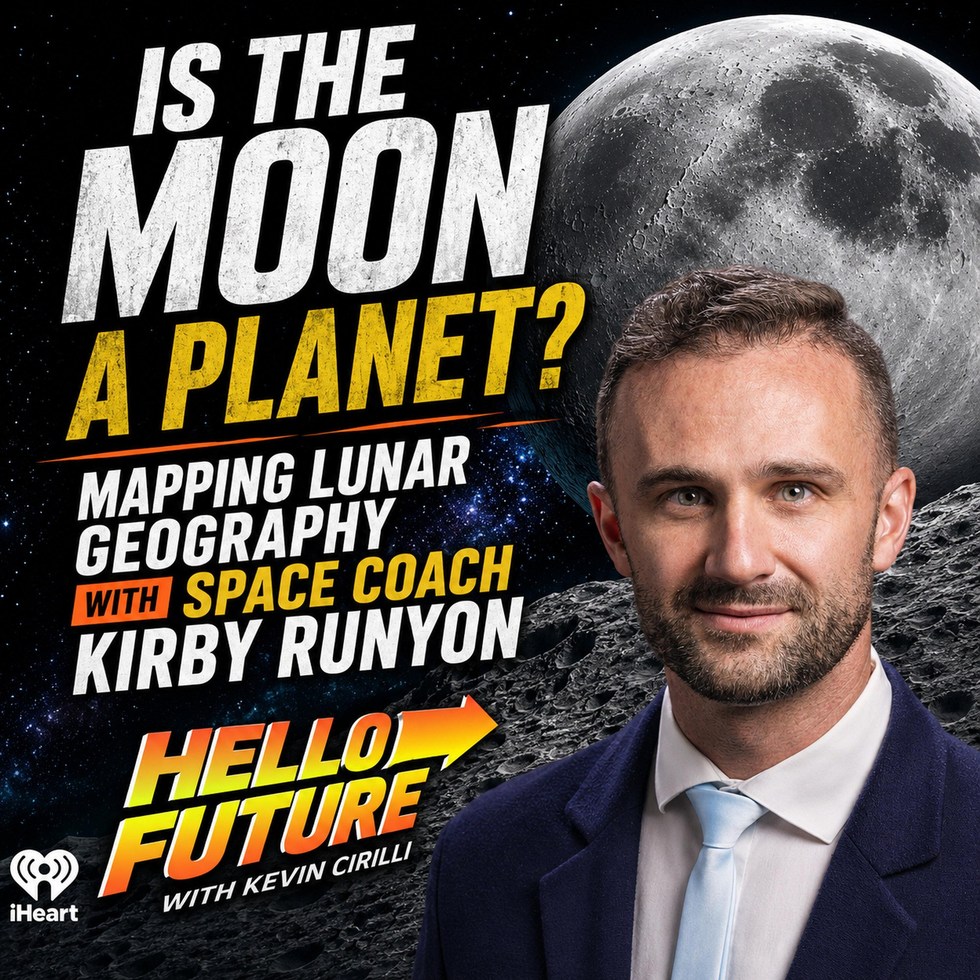
HELLO FUTURE: Is the Moon a Planet? Mapping Lunar Geography with Space Coach Kirby Runyon

HELLO FUTURE: Is the Moon a Planet? Mapping Lunar Geography with Space Coach Kirby Runyon


In this episode of HELLO FUTURE, host Kevin Cirilli sits down with his space coach, Kirby Runyon — research scientist at the Planetary Science Institute (PSI) and contributor to The Planetary Society — who is one of NASA’s leading experts mapping the Moon. Kirby breaks down the Moon’s incredible geological diversity, from massive impact basins and ancient lava plains to future landing sites for crewed missions. He explains why humans should be racing back to the Moon and playfully tackles the big question: Should we reclassify it as a planet? Packed with NASA-backed insights, this episode shows why the Moon isn’t just a destination — it’s the key to our future as a spacefaring species.

Meet The Future: https://mtf.tv/


See omnystudio.com/listener for privacy information.

Speaker 1 (00:07):
Everybody's talking about the Moon. I love I think it's
a great, great neighbor for us on planet Earth. But
is the Moon a planet? My space coach Kirby Runyon says, yes,
Hello Future, it's me keV. This is a dispatch from
the Digital Frontier. The planet is Earth. The year is
twenty twenty six. My name is Kevin Surreally. Remember you
can listen to all of the latest Hello Future episodes
on your iHeartMedia app or however you get your podcasts.
Sign up for all of the latest futurist news at
MTF dot tv. Kirby Runyan Space coach Kirby returning to
the program. Kirby, you got a lot of attention a
couple of years ago. Of course, listen to our first
episode that we did together where we talk about his career.
He's worked with NASA, he knows the Solar System inside
and out. He's a planetary geologist and research scientist. He
works with the Planetary Science Institute, knows all about the Moon, Mars, Europe,
a Triton, everything. But you got a lot of attention
a couple of years ago when you said that Pluto
is a planet still and also you believe that the
Moon is a planet.

Speaker 2 (01:13):
That's my spicy hot take.

Speaker 1 (01:14):
Well, I agree with you, coach, so why but but
I don't know why I agree with you. So let's
start with the moon. Why is the moon a planet?
And it goes back to this whole idea of throughout
society and humanity, we as humans have been very self
important in saying that it's a moon, it's not a planet,
and whatnot.

Speaker 2 (01:37):
So go yeah, so keep in mind, I'm a geologist,
I'm not an astronomer, and so I'm really most interested
in what something is on the inside, not just who
its friends are. For instances, and so, you know, the
moon is a big, rocky world. It's got enough gravity
to pull itself into a sphere, into a ball, and
that's about it. That's all it takes to be a planet.
According to many of us who use what's called the
geophysical planet definition, there's a number there's quite a number
of us professional practicing planetary geologists and planetary scientists who
don't use the quote unquote official definition from the International
Astronomical Union. We just don't find that definition to be useful,
so we just don't use it. We've got the academic
freedom to do that, And so to us, a planet
is something that is round by self gravity, regardless of
what it's orbiting. It doesn't have to orbit Earth. It
could orbit the Sun, it doesn't have to orbit anything.
If you took the Moon and magically moved it away
from Earth, I think most people would agree it'd be
a planet. So why does orbiting Earth in some people's
mind make it not a planet. And if that's the
definition for a planet, then you know there's one hundred
thirty and counting round worlds. That is stuff in space
with enough gravity to be round where Pluto is. And
further that is beyond the orbit of Neptune, place called
the Kuiper Belt. And so there are over one hundred
and thirty of these small icy planets. By the way,
I'm fine using the term dwarf planet with the provision
that we understand that dwarf planets are planets too. Jupiter's
a giant planet, saturns a giant planet, Uranus is a
giant planet, haha, And Earth is a terrestrial planet. Just
because we put an adjective in front of a noun
doesn't make it not a noun. Just because we put
dwarf in front of a planet doesn't mean it's not
a planet.

Speaker 1 (03:22):
I think it's also historically speaking, when humans in the
early astronomers, we're choosing the words for the moon, like
it almost conjures up that the Moon belongs to Earth,
you know what, Like when I think of a moon,
I think of it is like not as important as
our planet. The word choice, I think is it really
kind of gets in your head as a human if
we grew up thinking that there was a planet that
we're seeing in the sky, that almost conjures up this
notion that we could live there. So that's why I
like considering the Moon a planet, because it means that
we have a neighbor. It means that we have to
be a responsible neighbor in our Solar system. It means
something different.

Speaker 2 (04:04):
And I know you've studied this, Yeah, you know, some
people call Earth and the Moon a double planet or
a twin planet system. Our moon is a significant fraction
of the size of our planet. And if you imagine
if they had two earths orbiting each other as each
other's moons, people would have no problem agreeing that both
of those twin earths are planets. Now, just shrink one
of them a little bit smaller, a little bit small,
a little bit smaller, until it becomes the size of
the moon. Sure, it's still a planet, it's just orbiting
a bigger planet. And Pluto and its big moon, Sharon,
are a great example of this. Sharn is half the
size of the planet that it orbits, and in fact,
Pluto orbit Sharin two. They actually orbit around a point
between the two of them, and so you can't actually
say that one is just orbiting the other one. They're
really orbiting each other. Imagine a dumb bell in the
gym where one of the weights on one side was
just a little bit smaller, just said it's spinning. He
would rotate around some point in the middle. And that's
exactly what's happening with Pluto and Sharon. It's happening to
a lesser extent with Earth and the Moon. But you know,
when Galileo in like sixteen oh nine or something discovered
the four large moons around Jupiter, he didn't just call
them satellites, which is another word for moon. He called
them satellite planets. He recognized that they were places the
Jupiter system represented a miniature solar system, and that the
Galilean moons that bear his name, Io, Europa, Ganymede, and
Callisto are in fact satellite planets. They're planets going around
a bigger planet.

Speaker 1 (05:37):
That's fascinating, and specifically with the Moon, because of Artemis two,
there's so much energy behind it. You actually are one
of the geologists, specifically a scientists, yeah, who are mapping
the Moon.

Speaker 2 (05:50):
Yeah.

Speaker 1 (05:51):
And I find this really exciting because especially when we
talk about you know, what's on the Moon and the
possibility of mining the moon, or Elon Musk wants to
put a catapult on the Moon to set us further
into Mars, creating a moon station, a moon base, and
there's just so much different things. And as the mapper
of the Moon, you're looking at the different valleys, the mountains,
the creators like, the moon is a place. The Moon
isn't just this thing that we see in the sky.
It's an actual place. And because of satellites and artificial
intelligence and eventually quantum computing, we're actually getting to better
understand our neighbor. It wasn't lost on me that the
astronauts who just went further than anyone have seen things
with their human eyes that have never that humans have
never seen before that actually is going to be a
thing of the past once we're able to map the Moon.
So how are you thinking about mapping the Moon? I
now agree with you as a planet, and why is
it important? Why should people care about mapping our neighbor.

Speaker 2 (06:55):
Well, you know, one thing people might say is, well,
hasn't the Moon already been mapped? And the answer as well, yes,
but also no, it hasn't been mapped in the level
of detail that my team and I are mapping it in.
We are zooming in as far as you possibly can go.
In a lot of the images taken by the Lunar
Reconnaissance Orbiter, which is a NASA spacecraft. We're looking for
not just where we want to send future emissions, but specifically, oh,
I want to go to that rock from orbit around
the Moon. Using this robotic spacecraft, we can identify exactly
what rocks we would want to sample and collect to
be able to answer very specific questions about how the
Moon was formed, how the Moon got absolutely smacked by
asteroids hitting it, which actually then tells us about how
much Earth got whacked by asteroids early on. And we
want to understand other basic geologic questions like how do
volcanoes work on a simple planet like the Moon, And
that gives us insight into our volcanoes and to Mars's volcanoes,
into venuses volcanoes. So I'm doing geo logic mapping of
the largest and some of the oldest impact craters made
by ancient asteroid collisions from the Moon's and the Earth's
earliest history. It in part to help mission planners decide
where to send future astronauts and robots on the Moon's surface.

Speaker 1 (08:17):
What is prime real estate on the Moon?

Speaker 2 (08:19):
All right, I've got two answers for you for prime
real estate on the Moon. One of them is the
Oriental Basin and the Subherdicle where yeah, it looks like
a bull's eye, and the Artemis two astronauts were the
first people to see it with their eyes and not
just through a robotic camera. So they saw the image
that they photographed it, they described it on their twenty
twenty six flyby. That is the youngest of the really
large impact craters on the Moon, and studying it would
tell us a ton about when the Moon was hit.
There's also volcanic eruptions around there, and there's also resources
we could use. My other favorite place on the Moon
is a place on the near side. You can go
look at it with your naked eye during certain fa
the moon. It's called the Aristarkius Plateau, and it's dominated
by the crater Aristarchus, which is really bright. You can
see it as a white pinprick of light on the
moon with your naked eye. And there's a lava channel
around there. There's a lava flooding around there. It is
one of the most mineralogically rich pieces of real estate
on the moon.

Speaker 1 (09:20):
What's the one you just said.

Speaker 2 (09:22):
Aristarkis plateau. It's an old Greek.

Speaker 1 (09:25):
Name Starcus plateau. Yeah, okay, And that's got a lot
of minerals. What kind of minerals does that have?

Speaker 2 (09:34):
Yeah, it's got rare earth elements. So the stuff we're
importing from China for consumer electronics, the moon has rare
earth elements. The Moon's got thorium, which is sort of
like uranium, and we can use it in nuclear reactors
for unlimited electrical power. It's titanium. It's got literally everything
you need for civilization. There's ample silicon to make solar panels.
It's got everything you need.

Speaker 1 (10:00):
Wow, and in spades. I would imagine in spades.

Speaker 2 (10:03):
So I want to start keV. Maybe you can go
in with me on the s Starcas Mining Company. Yeah,
I would love to and have resource extraction there on
the Aerostarkist plateau. And then we can use Elon's railguns
to deliver the stuff into space without using a drop
of rocket fuel.

Speaker 1 (10:18):
Yeah, I'm happy to do that. So Elon, if you're listening,
I would gladly go to the Aerostarkis plateau. Maybe we
could open like a ski resort and go skiing or
moon dust sledding.

Speaker 2 (10:28):
You could yeah, yeah, yeah, you could totally do that, okay.

Speaker 1 (10:31):
And then the other thing, well, didn't one of the
astronauts play golf up there?

Speaker 2 (10:34):
Paula fourteen Alan Shepherd blacked a golf ball around using
a I think it was a nine iron.

Speaker 1 (10:39):
Yeah okay, So then you've got this other place.

Speaker 2 (10:42):
What's that called the Oriental basin?

Speaker 1 (10:44):
That one oriental basin? How far away is that from
the Aerostarkis Plateau.

Speaker 2 (10:49):
Oh it's a few thousand kilometers. As a Lisrow flies.

Speaker 1 (10:53):
In a theoretical world, are you going to have to
have like an airport at the Aerostarkist plat Toe and
an airport at the tale base.

Speaker 2 (11:04):
Intal basin, or a train system or a train roads. Yeah,
like a moon train.

Speaker 1 (11:09):
A moon train. And people are talking about this from
here to where, like put it in context for our
listeners who are thinking of like from New York to
where it would.

Speaker 2 (11:20):
Be like coast to coasts on in North America for sure,
like that most are the kind of distances we're talking
like New York to Los Angeles.

Speaker 1 (11:26):
Okay, So does China and Russia are they also eyeing
these two destinations for the Moon?

Speaker 2 (11:33):
I would say everyone who knows anything about the Moon
is looking at these places in addition to the South Pole,
which has ample sunlight and ice. So yes, everyone who
knows anything about the Moon, which includes Russia and China,
is looking at the especially the Aristarkist Plateau as a
mineralogically rich site.

Speaker 1 (11:48):
Okay, so we've got these three places on the Moon.
The Aristarcis Plateau, the Oriental did I say that right? Oriental?

Speaker 2 (11:54):
Pretty much? Oriental?

Speaker 1 (11:55):
Yeah, Oriental Basin, and then the South Pole, which has
a bunch of ice which we know is important for energy,
not just for drinking water, but like energy and cooling
systems and all of that stuff, the hydrogen, all of that.
How far away is the South Pole from the other
two places.

Speaker 2 (12:10):
Well, if I pulled up a map, I could tell
you exactly, but it's still going to be a few
thousand kilometers. These are like medium link distances. They're distances
you can handle, but they're not super close by each other.
There's spreadway around the Moon.

Speaker 1 (12:21):
The reason I find this fascinating is because Kirby Runyon
is demonstrating in spades. Truthfully, we've now identified places like
you've just transferred knowledge to this idiot. I'm the idiot
of there are places on the Moon, and so when
we talk about colonizing it, it's like building roads, building
a supply chain. It suddenly starts to be more real
when we think of having places on the moon. And
that's why this mapping system of the moon is so
incredibly important. So when Neil Armstrong walked on the Moon,
was he walking in one of these three places or
where was he in reship?

Speaker 2 (12:59):
Yeah, Neil and Buzz were walking in the Sea of
Tranquility in Latin, that's Mari tranquilit tatus and it's a smooth,
flat lava plane. They were walking on an ancient ancient
moon lava flow without a lot around them, and that
was intentional because that location is close to the Moon's equator.
So it was easy from a rocket propulsion perspective to
land there. And it was smooth, flat and boring, which
for landing that's what you want. That's not necessarily what
you want for scientific exploration, but smooth, flat and boring
is perfect for landing a spacecraft.

Speaker 1 (13:32):
As we do that. In relation to these three places.

Speaker 2 (13:35):
It's on the other side of the Moon. It's not
anywhere close to them. Yeah. The closest thing is the
Apollo fifteen landing site, landed amongst the mountains, the Apennine
Mountains on the Moon, where there is this lava river
called a rill Hadley Rill winding through these lava plains.
If anyone's watched Star Wars the Mandalorian, they might know
the planet Navarro is a volcanic planet and these parts
of the Moon are dominated by ancient volcanoes. And so
Apollo fifteen came in below the mountain peaks of the
Moon as it was landing. Just an incredible sight out
the window. The astronauts Dave Scott and Jim Rwin said
as they were landing, and they were just surrounded by
beautiful mountains and topographies and an ancient lava river compared
to the smooth, flat and boring place that Neil and
Buzz landed Pollo eleven.

Speaker 1 (14:22):
It's fascinating. The last thing that I wanted to just
to ask you about the Moon, which now I'm convinced,
is you're talking about mountains and hills and flat geography
of the Moon. I'm convinced it's a planet now and
I can start to see this colony is happening on there.
Where is the first place that we're likely going to
build a colony? Is that the Aristarchus Plateau?

Speaker 2 (14:44):
You know, I think we're headed towards the South Pole
for NASA's Moon base or for Artemis base camp, or
whatever you want to call it. Geologically speaking, the South
Pole is kind of boring, I gotta be honest. It
is for places on the Moon. Like, yes, I would
love it to have that on the Moon, but the
South Pole the Moon kind of boring. I would love
it if it were something like the Aristarcis Plateau. There's
a lot of other places we want to explore on
the Moon as well, but I think right now, where
the geopolitical momentum is going is the South Pole. And
what's even a bigger resource than ice that we think
is there is these peaks of near eternal light where
the sun almost never sets, and that's useful for solar power.
You can put up like a really tall tower with
solar panels on the top, and you're going to get
almost constant sunlight illumination to provide continuous electrical power for
your base. Otherwise you're stuck with the two week long
night time where you can't have solar power, followed by
a two week long daytime where you have tons of
solar power but a lot of heat. And so the
South Pole, access to really cold areas and access to
persistent sunlight is the biggest resource, more than the water ice.

Speaker 1 (15:52):
Even do you think it'll be in our lifetime when
we got these moon bases.

Speaker 2 (15:56):
I think we will see real strides towards an actual
Moon base in the twenty thirties. So hope it's also alive.

Speaker 1 (16:02):
Kirby Runyon, my space coach, convincing us all that the
Moon is a planet. I don't know, folks, We just
learned the Aerostarcus plateau, the oriental basin, the South Pole,
the sea tranquility. Sounds like we got the basis of
a moon map. That's all I gotta say. I want
a moon train. I see moon skiing and snowboarding. I
see moon hikes, I see moon golf courses. I mean, listen,
let's just americanize the Moon. Have a great tomorrow. Today

More For You