Skip to content
Search

Latest Stories

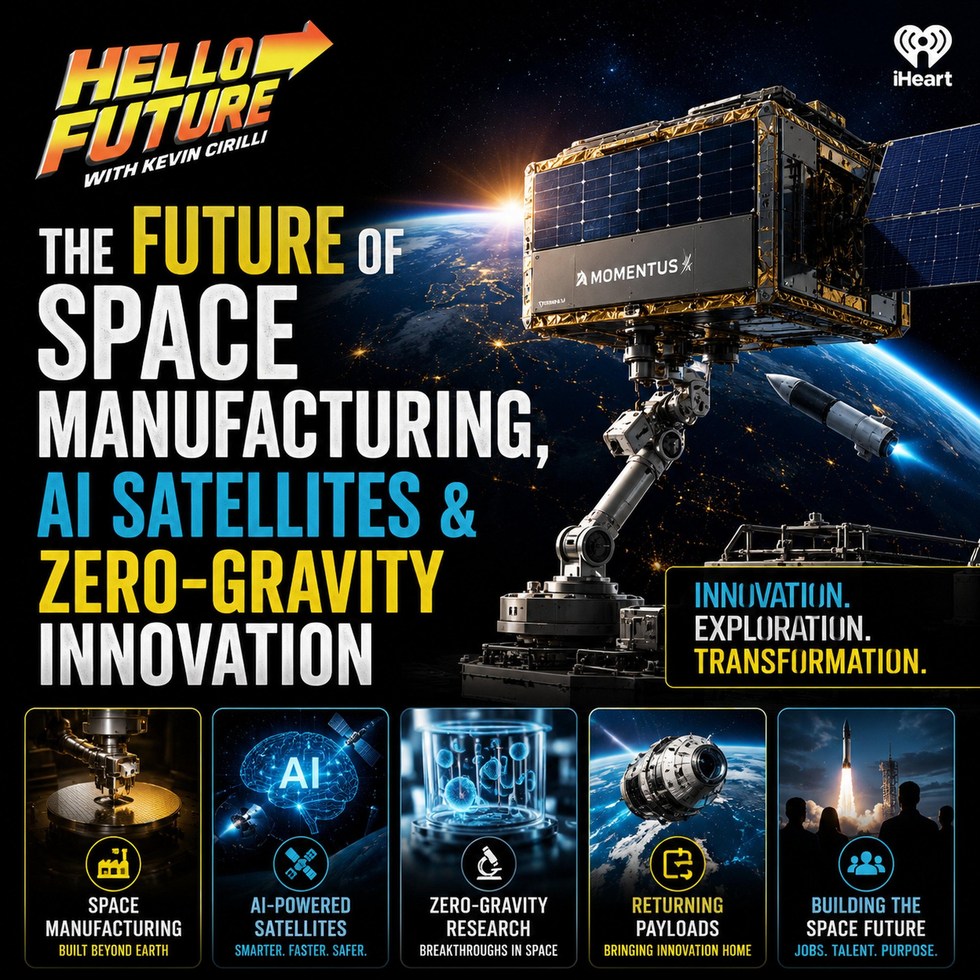
HELLO FUTURE: The Future of Space Manufacturing, AI Satellites & Zero-Gravity Innovation with Momentus CEO John Rood

HELLO FUTURE: The Future of Space Manufacturing, AI Satellites & Zero-Gravity Innovation with Momentus CEO John Rood


What if the next breakthrough in medicine, semiconductor manufacturing, and artificial intelligence doesn't happen on Earth—but in space?

In Part 2 of Kevin Cirilli's conversation with Momentus CEO John Rood, the discussion dives into the technologies that are shaping the next generation of the commercial space economy.


John explains how Momentus is building the "UPS of Space," transporting scientific payloads, AI-powered satellites, and cutting-edge research into orbit. He also reveals how zero-gravity manufacturing could transform semiconductor production, accelerate medical breakthroughs, and unlock entirely new industries.

The conversation explores DARPA and NASA missions, AI-guided satellite operations, robotic assembly in orbit, Wi-Fi in space, and the growing demand for America's next generation of space professionals.

Whether you're interested in commercial spaceflight, artificial intelligence, advanced manufacturing, or the future of innovation, this episode offers an exciting look at where technology is headed next.

Meet The Future: https://mtf.tv/

See omnystudio.com/listener for privacy information.
Speaker 1 (00:07):
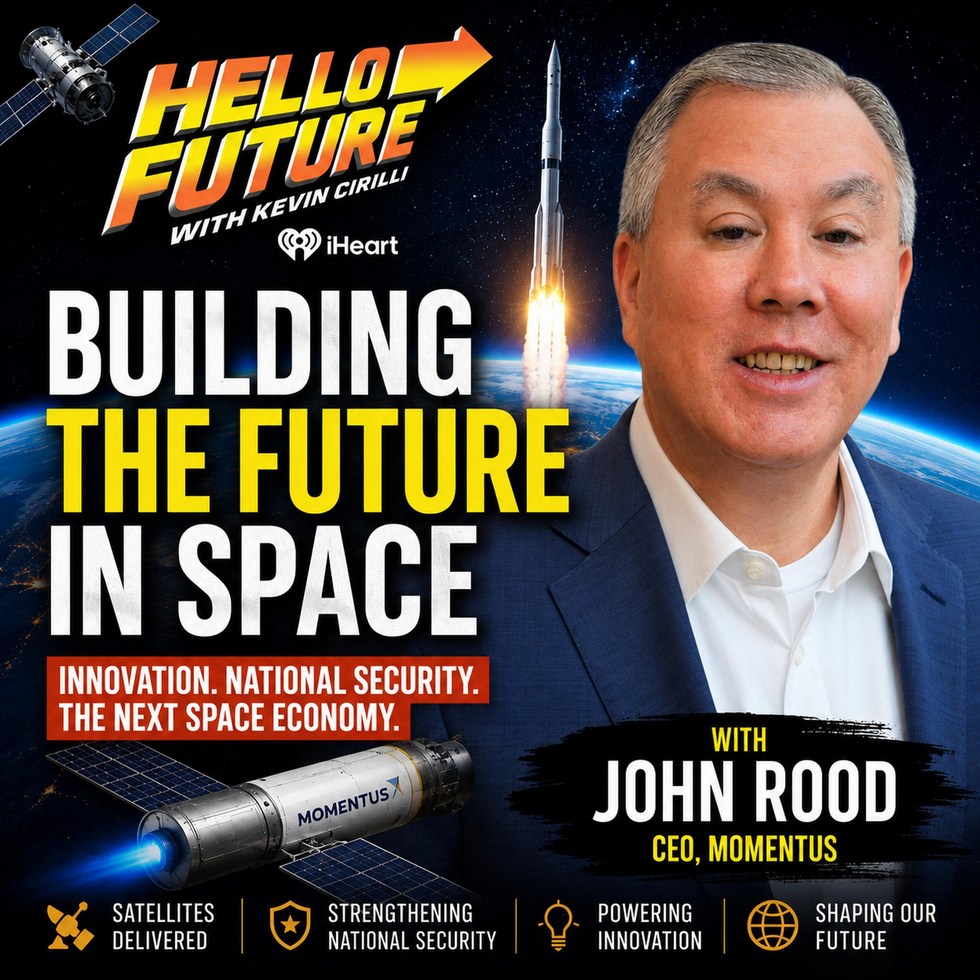
I'm thrilled to welcome back to the program the CEO
of Momentous Space. His name is John Rudd, and he
is someone who has had a fascinating career. Go back
into the archives and listen to his conversation about how
he's worked in the upper echelons of the intelligence community
and the defense community, how he's navigated working at some
major companies like Lockheed and raytheon and now he's the
CEO of Momentous Space. Hello Future, It's me keV. This
is a dispatch from the Digital Frontier the planet Desert.
The year is twenty twenty six. My name is Kevin Surreally.
Remember you can listen to all of the latest Hello
Future episodes however you get your podcast, be sure to
sign up for my newsletter at MTF dot news. That
stands for Meet the Future MTF dot News. John. All right,
so you're the ups guy of outer space. I love
this so moment this space. How big are these satellites?
By the way, are they the size of a microwave?
The size of a truck? What are we talking about?

Speaker 2 (01:07):
They're kind of the size of like a small refrigerator
or a little bigger than that, maybe a big dresser
drawer something like that. So they're about a meter and
a half by one meter roughly speaking, way about two
hundred kilograms.

Speaker 1 (01:19):
And to build one of these things, I would imagine
takes a lot of American manufacturing jobs.

Speaker 2 (01:24):
It does. We're based in San Jose, California, and it
takes a number of man hours measured in the thousands
to put together one of these satellites. Now we've done
a very modular design to make it manufacturable, so we're
largely able to integrate and test, and a lot of
that time is spent, you know, testing and validating, and
that's why our current satellites working well in space. All
of that hard work you do on Earth pays off
in space. It's kind of like the days when I
played sports, you know, all that hard work in practice
pays off during the game. That's how we put them together,
and I would say we acquire most of the components
from in the United States, but not exclusively, and then
integrate those systems at our facility in Santose, California. Typically
it takes about, you know, twenty four weeks thereabouts twenty
eight weeks to put together one. We've done them in
as little as eighteen weeks wow, and if we get
into you know, rate production, that will come down very substantially.
But you know, in our present mission, our satellite can
be a satellite and can do things like communications, missile tracking.
What we're doing now is the ups of space is
on March thirtieth, we launched attached to a SpaceX Falcon
nine rocket. We separated about five hundred and twenty kilometers
above the Earth, and since that time we're carrying ten
different payloads on the same satellite, basically that same brown
ups truck in space, carrying a variety of things that
we're going to test operate for customers like the Defense
Advanced Research Projects Agency or dark is our anchor customer. There,
they're doing a DARPAW hard demonstration of the ability to
assemble from robotically from components of trusts, simulating a two
meter diameter antenna. So our satellite that started looking like
a rectangle is going to end up looking like kind
of a tennis racket in space by the time we're
done with this big trust that's been robotically assembled under
the DARPA program.

Speaker 1 (03:22):
What are some of the payloads the experiments that maybe
we wouldn't necessarily think of that Momentous Space is involved in.

Speaker 2 (03:30):
Well, one of the ones that we want a competition
with the US Space Force called Space Maneuver Challenge, is
to do what's called rendezvous in proximity operations, Meaning we're
going to release a satellite from NASA and it's going
to go off quite some distance, and then we'll chase it,
and we'll maneuver using different sensors that we integrate together
with an AI algorithm machine learning. Basically infrared light AR
like you use on your car automotive light are you
know when you're backing up b bbbbe even tells you
how close you're getting to the curb, things of that nature. Well,
we've adapted those systems for use in space as well
as optical and we fuse all that data and so
we'll chase that Inspector satellite, will maneuver from different locations
around above, around the side, and then the roles will
reverse and that NASA satellite from Johnson Space Center is
called Inspector satellite and it will then inspect us the
Vigoride spacecraft that Momentous makes. This is a picture actually
of it in orbit right now. Wow, that's a that's
the name plate with all of the employees' names on it.
And above my head a little bit right here you
can see these are two of the infrared cameras that
will be used as part of that rendezvous proximity operations.

Speaker 1 (04:44):
He's speaking in front of a backdrop of a satellite
and and that is really cool. And so when your
satellites go up there, how long are they up there for?
Are they're up there for the forever?

Speaker 2 (04:54):
Or no, they're not. They're not there forever. We'll send
them up and on purpose, we want to orbit at
the end of the mission because we don't want to
add to all of the debris and space. In this
particular mission, we'll probably go for a year or more.
We have a sequence for each payload when we're going
to do it, and then we'll do the next one.
And so some of them we can do concurrently, and
some of them are running in the background. For example,
one of the things that we're carrying now for our
partner company where we've got a strategic partnership. They're called
soul Star is basically Wi Fi from space. So if
you're at a hotel, you're at your home right now
and you log onto the Wi Fi and you want
to communicate with your payload on our spacecraft twenty four
hours a day, just regular Wi Fi. You can do
it through their system. And part of what that will
do is it'll form a Wi Fi link between this
NASA and Spector satellite and our satellite, our UPS truck
that released it, carried it to space and released it,
and that's how they'll communicate. They'll beam back images to
Earth that way. A whole variety of things.

Speaker 1 (05:58):
I'm going to throw you a little bit of a curve,
not to trip you up, but because it's something that
really inspires me, which is medical research and outer space.
And I do not think the public has enough awareness.
And I'm a really big supporter of medical research in
space because I find it so fascinating and space is
such an incredible story to tell. But I think when
you look at quantum computing, which we're on the cusp of,
and understanding the properties of you know, zero gravity and
how different things get made and whatnot, there are just
some really innovative American companies that are I was just
at the ASCEND conference the other week and hearing Cedar
Sinai and Harvard Medical and the Cleveland Clinic. Like hearing
them speak that these these major medical institutions have space
programs now because they understand that the medical research happening
in space is so crucial. How do you see that
in the future for a company like you to be
able to conduct some of this really cutting edge research.

Speaker 2 (07:00):
I think I agree with you that there are unique
advantages that the environment in space, with zero gravity and
a variety of other traits gives you for medical research
and for medical applications that you can't do on Earth.
You know, for example, some of the things that I've
read about with the growth of human organs, a growth
of human tissue in space. One of the big challenges,
of course on Earth is as these cells are very small,
gravity causes them to be crushed. Well, in space, you
don't have that. And the ability to grow things like
that in zero gravity effectively and return them to Earth.
It's really inspiring what could be done. So at momentous
we are contributing to some of the precursor work we
haven't yet done some of these medical missions.

Speaker 1 (07:47):
I love that though, the way you just frame that
is so crucial because it is the whole industry is
about building on top of the success. That's a beautifully
framed answer about the precursor to the hope that so
many of us have fifty or seventy five years that
maybe we won't enjoy the benefits of it, but our
grandkids or our great grandkids will.

Speaker 2 (08:06):
I think some of the things that we're doing right
now on our present mission, where we're doing having the
ability to communicate and move data instantly back and forth
between space, not waiting for passes, not waiting you know,
ninety minutes or other things. That's one way, and some
of the other precursor technologies. You're going to want to
see things, you're going to want to manipulate them, You're
going to want to move that data back to Earth
where we have some onboard advanced data computing and AI
applications that we're running. But then on our next mission
that we've got under contract with NASA, we're flying a
payload cosmic is what it's called, and basically we're going
to grow semiconductor crystals in space because of zero G.
That's the purpose of the program. There's a company that
is want a NASA tech Leaks Prize. Our job is
to be the ups truck, take them to space, give
them safe and operating environment, and move the data and
other things back. But then when those semiconductor crystals are grown,
we have a return to Earth capsule and we will
return those and if you know, knock on wood all
goes well in and around Australia, that return to Earth
capsule will be recovered and the crystals brought back because
they are one of the applications that would really benefit
from zero G. That's very similar to human tissue or
medical growth or other things. And that I.

Speaker 1 (09:30):
Have like five million questions and I only have a
couple more minutes. So that's that's profound to grow semiconductor
chip crystals. That sentence right there, to do that in space?
What are the crystals because obviously, you know, we're all
familiar with the geopolitical implications of Taiwan, Taiwan straight China
and the Communist Party and TSMC and half of the
global supply of semiconductor chips coming from Taiwan, and that's
profound that we might be able to grow a piece
of chips in space is really really a big idea.

Speaker 2 (10:04):
Well, it's one of the things that a company named
Astro materials won a NASA Tech Leaps Prize because this
is what you know, they're they're trying to show that
you really can do, which is grow from from raw
materials semiconductor crystals, which is extremely difficult to do, but
there's some unique advantages that you know, at least I've
read the papers, not that I can do the work myself,
but you know, shows the advantages of being in a
zero G environment to return those to Earth. So our
job at momentous is to be the take you to
space group, operate you in space, return you safely to
Earth mission there and that that's going to take some
unique orbital fly you know, to change into a very
unique orbit to basically drop a payload off to be
recovered successfully. And so that's that's what we're charged up
to do.

Speaker 1 (10:56):
How does a satellite drop off a payload?

Speaker 2 (10:58):
Well, we've got a return to Earth capsule, which is
sort of a bulbous item that will provide a safe
reentry that NAS is providing to us. But basically, instead
of being in like a circular orbit around the Earth,
going round and around, kind of like a NASCAR car
around the track, we're going to get into a very
highly elliptical orbit to go very far from Earth and
then come very close, maybe down to his low seventy
kilometers altitude, which is not far from Earth, and then
release the capsule in the right inclination, meaning over the
right trajectory over certain places on the Earth in this
case Australia, and drop that capsule off to be recovered. Ideally,
that's the stretch goal under the program. Now, a lot
of data will be collected prior to that on orbit
about how well the crystals are growing, how the wild
material is being done, and so all of those things.
Much of the science will be accomplished prior to trying
to recover the material data. Yeah, but that last bit
is something we're stretching for and you know, really going
for it to.

Speaker 1 (12:06):
I mean, it's awesome. John Rhoads, CEO of A Mental Space,
just blowing my mind, didn't That's why I love doing
the show, as I learned something one of the smartest
people in the country on space, manufacturing and defense and
all all of this. It's it's really an honor to
be able to interview you. And the final question for
you is if someone's listening and they've got a kid,
or if they are a young person and they're starting
out their career. You know, when I was a kid,
it was like the only way you could get into
space was to try to be an astronaut. What's your
advice to someone who wants to work in the space
collar job industry? What do you look for as a CEO?
What's like the number one quality and a new employee
that you look for.

Speaker 2 (12:43):
I think you want attitude, the right attitude about learning,
about working as a team, and about applying all the
things you've learned in whether it's software development or in
your role as a mechanical engineer or aerospace engineer, whatever
you were trained to ask, or even as an accountant.
Are you going to bring that to work? You know,
we can train you how to do certain things, but
we can't train attitude. We can't train desire and development
and the desire to be part of a group that's
pushing the envelope to do ever more innovative things in
space show up, be present. I used to sometimes talk
to young people where I'd say, don't look for what
you can do that is developing yourself as much as
the job you've been given. Do it really well, not
just kind of good, but like, how about doing it
as well as you can do it, and then that
will really propel you. And then separately be pushing yourself
to learn, to learn from people around you, to bring
yourself to the stage where you're asking questions, where you're inquisitive.
And that's part of the fun part about the people
you tracked in space. They're inquisitive, they want to they're
curious about the world. They're curious about the things around them.

Speaker 1 (13:54):
Not just the world job. They're curious. We're curious about
the universe and black holes.

Speaker 2 (14:01):
Right exactly. And and that's that's that's part of you know,
what makes it fun to be in the industry and
to be around people like that.

Speaker 1 (14:09):
Awesome. Thank you so much. I hope you have a
great to day. Thanks everybody for listening. M

More For You