Skip to content
Search

Latest Stories

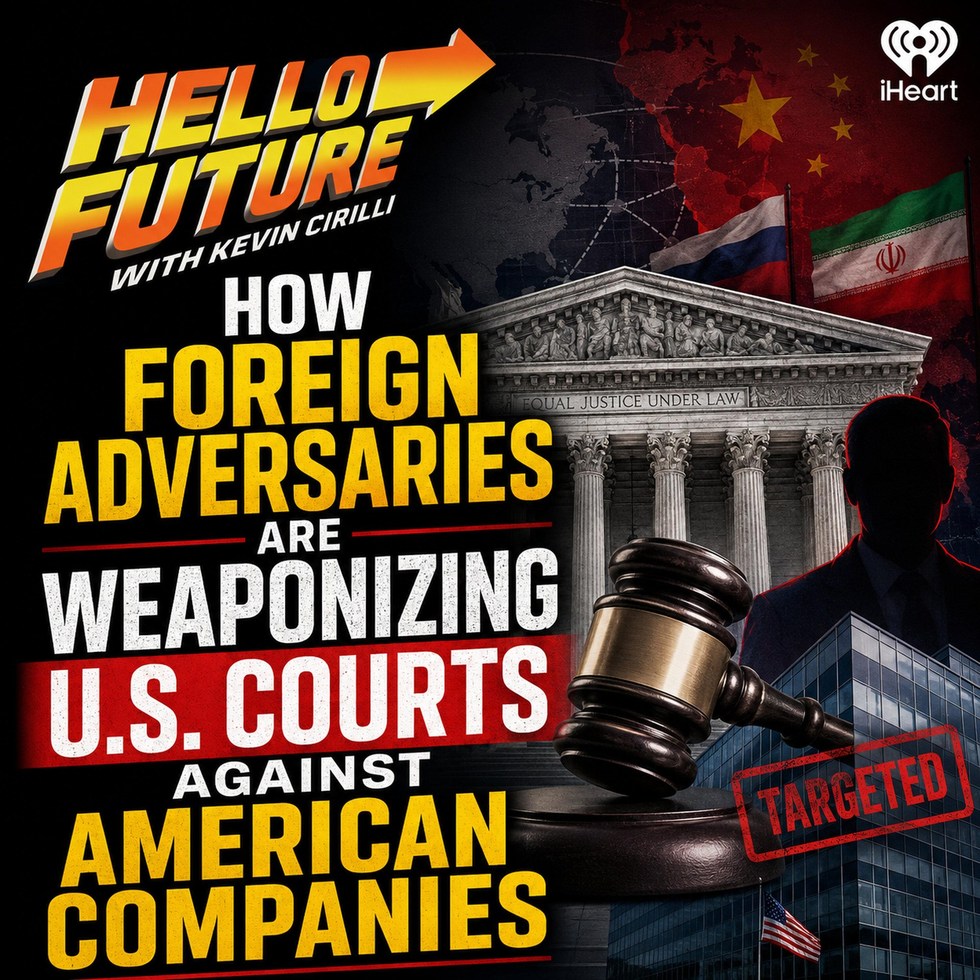
HELLO FUTURE: How Foreign Adversaries Are Weaponizing U.S. Courts Against American Companies

HELLO FUTURE: How Foreign Adversaries Are Weaponizing U.S. Courts Against American Companies


In this episode of HELLO FUTURE, host Kevin Cirilli speaks with Philip S. Goldberg, Special Counsel for the Manufacturers’ Accountability Project at the National Association of Manufacturers, about how foreign adversaries are weaponizing America’s judicial system.


Goldberg explains how foreign governments and aligned interests are increasingly using U.S. courts, litigation funding, and activist lawsuits to target American companies, undermine key industries, and advance geopolitical goals without firing a shot.


The conversation explores real-world examples of this strategy, the vulnerabilities it exploits in the U.S. legal system, and what it means for American economic security and competitiveness.

Goldberg outlines why this form of “lawfare” represents a growing national security threat and what steps policymakers and industry can take to push back.

Meet The Future: https://mtf.tv/

See omnystudio.com/listener for privacy information.

Speaker 1 (00:07):
Nowadays, it looks like our adversaries are weaponizing the very
institutions against us to benefit themselves. Hello Future, it's me keV.
This is a dispatch from the Digital Frontier. The planet
is er At. The year is twenty twenty six. My
name is Kevin Surrelli, and today I'm taking a look
at how bad actors are weaponizing the judicial court system
against America. My guest today is Phil Goldberg. He has
special counsel for the Manufacturer's Accountability Project. It's an effort
led by the Manufacturer's Center for Legal Action, which is
the National Association of Manufacturers in house legal arm and
the leading voice for manufacturers in America. Phil, I'm really
glad to have you here because as we talk in
the Supreme Court really and across the country, there's a
variety of climate change litigation that has been widely linked
to the Chinese Communist Party in many ways, and I'm
wondering if you could just start out by breaking it
down for us on how China started to do this,
and then we can get into some of the specifics.

Speaker 2 (01:10):
Well. First of all, thank you for having me. It's
a pleasure for Kevin to be with you on your show.
In terms of where the money is coming from and
how foreigners are trying to use the litigation system, I
kind of see this as two separate things. One is
there's a lot of litigation profiteering and litigation financing that's
going on by foreign entities, including China. They have been
documented episodes of this where they fund litigation against American companies.
They try to get our intellectual property, our trade secrets,
things that are turned over in discovery during the litigation,
and then they try to profit off of that. And
so that to me is one issue. The second issue,
which you also brought up, and I'm happy to talk
about either issue, by the way, but the second issue
that you brought up is the climate litigation, and that
is where we're seeing agenda driven policy being waged not
in Congress and in federal agencies where they're supposed to
be being waged, but try to achieve policy objectives through
the courts. And that is what is of greatest concern
to me and to the manufacturing community, because we understand
that there are critical issues that need to be resolved
in this country, and climate change is certainly one of them,
and that's obviously an international issue. There are proper ways
to do that. There are proper bodies of government to
do that, and that's going to congress, as, going to
EPA and federal agencies and doing things through the checks
and balances of those systems, going to the courts, and
just suing the companies who are involved in that industry
to try to get the change that you want, whether
it's a tax on carbon or certain regulatory achievements, but
trying to do that by just assigning liability to these
companies for giving us the energy that we need every
day to power our everyday lives, whether it's turning on
our lights or hitting our homes, creoling our homes, driving
our cars, all that kind of stuff. That's not what
the liability is system for. That's not what the courts
are for. And how they're trying to turn the courts
against the very companies who are trying who are selling
us the products that we need.

Speaker 1 (03:07):
Well, what I find interesting and quite alarming in many
ways is that there's a national security element to this.
And I would love if you could just kind of
walk us through some of the recent filings that have
been before the Supreme Court, which is about to make
a ruling in the future, and if you could just
give us a snapshot of some of the bypartisan national
security names that have signed on to question why this
is happening.

Speaker 2 (03:33):
There's the U Spring Court a couple months ago agreed
to hear the one that was brought by the city
and County of Boulder, and in that case, the Boulder
is doing two energy companies who are saying the two
of you are responsible for what we consider to be
our climate change damages because you're in the energy industry.
And there are similar suits like this all around the country.
There's about three dozen of them where you have local
governments sometimes state suing various energy companies. Sometimes it's two,
sometimes it's one, sometimes it's six, sometimes it's fifteen, sometimes
it's thirty to forty energy companies, depending on who the
local government wants to blame or sue for climate change
and what they believe to be their climate change damages.
And so there have been this has been going on,
well really going on for twenty years, but this wave
of it for the past nine years, and it has
become incredibly divisive and controversial around the country. You have
a lot of people lining up explained to the country
why these lawsuits not only are not legally justifiable, but
they would lead to really bad outcomes, both for the
climate and for the country. When the Supreme Court took
the Boulder case back in February, I think it was
going to announce it would take the case, It set
up a briefing schedule, and just about two three weeks ago,
a whole bunch of there were probably like thirty to
forty would we call amekus Briez're front of the court
breeze that were filed by various people and groups of
entities saying WHOA like this would be really bad? And
you had one brief that was filed by former Secretary's
of State, So you had Mike Pompeo, Jim Baker, Nikki Haley,
and National Security Advisor hr McMaster file of brief explaining
that if we are holding the companies that give us
energy liable for climate change, but this litigation doesn't reach
the state owned companies like in Saudi Arabia or Russia
or China or other places, then we're harming ourselves and
our own national energy security when we need to be
able to use our energy companies when we're up against
some hostile countries around the world, like we saw with
the Ukraine several years ago, where President Biden asked the
energy companies to step up production of oil and gas
so we can help our allies and make sure that
they're not dependent on Russian oil. And the same thing
with the current situation in Iran. So if we're hampering
and hindering our own ability to do that, that's a
national security problem, and that's what they said. There also
is a brief that was filed by General Myers, who
was a Chairman of the Joint Cheess of Staff, and
a retired Admiral Michael Mullen, who were senior military officers
serving under both Republican and Democratic administrations. They expressed the
same types of concerns that the military relies on these
companies to provide them with the energy that they need
to engage in the efforts that they need to engage
in to protect this country.

Speaker 1 (06:29):
These are some of the biggest national security names that
has served in Republican and Democratic administrations, and they're essentially
sounding the warning bell, raising the alarm. This is not
a case about whether climate change exists, and I think
what has happened so much in the legacy media in
many ways has wrongfully oversimplified these issues, because this is
not a case about whether climate change exists. You just
heard from Phil, folks that climate change is a real
issue that we need to address. But this is not
a case that decides that. This is how bad actors
are weaponizing the court systems against our very own national
security interests. And when you have men and women who
have served at the highest echelons of the military to
protect and defend our country, to protect and defend our
right to protest, including by the way, to protest against
climate change, when you have these individuals filing these types
of proceedings, this is somewhat rare, right Phil, I mean,
this isn't something that they do all the time.

Speaker 2 (07:30):
No, this is You're right, this is very rare. I
have not seen this kind of lineup of voices file
with the Supreme Court to provide this kind of context
for this litigation, saying if you allow this type of
litigation to go through, it's going to hurt us, but
it's also going to hurt the climate. In the fight
against climate there was an article that came out in
The New York Times a couple of years ago that
explained that if American companies, like the ones that are
being sued and the ones that serve us and whether
you're in American companies start reducing their production, it's not
going to reduce the demand for energy. It is going
to just shift who provides that energy, and it's going
to be the state owned companies again in Saudi Arabia
or Russi Aa, China and other countries where they don't
care about the climate, they don't care about environmental security
or what's good for the earth. And they said that
our reliance on OPEC would go from where it was
at the time, which was I think they said it
was fifty five percent up to seventy five percent. OPEK
would dominate the international oil market oil guess market. So,
if you care about the climate and you care about
doing something about climate change, this is the wrong solution
because we're not doing something internationally, we're not doing something
that's going to actually make a difference. We're going to
create a penalty on Americans, and we're going to offshore
the production of energy to companies that don't care about
the climate as opposed to our companies that we hold accountable.
There's so many different layers to this litigation, and a
lot of this is what's been before the court. This
is bad for national security, this is bad for the climate,
this is bad for international relations. There's a brief talking
about that. It's also going to be a regressive tax
on the people who can least support it, because if
you make energy companies pay all this money in the
United States, it's going to make them charge Americans more,
which is why one of the advocates for the litigation
has called this an indirect carbon tax on the American people.
You look at all these different layers, there's really no
argument as to why this is justifiable, like why this
is good for the country, and why this is justifiable legally.
Once you peel back the onion on all these layers,
you see it's bad in every different way.

Speaker 1 (09:44):
And it's really interesting to have Mike Pompeo, James Baker,
Nikki Haley hr McMaster, some of the top lawyers in
the nation, and they write in this brief, quote, the
Constitution vests power over foreign affairs exclusively in the federal government.
I mean, this is really the central thesis of their argument.
And they write, quote, in defending our national Charter and
urging its ratification. The founders made clear that on issues
related to foreign powers, our nation must be united and
speak with one voice. Really interesting stuff when you have
foreign governments trying to rewrite our ability as a country
to provide energy for ourselves that's directly impacting our national security.
Do you think that the Court's going to rule in
your favor or how do you think they're going to rule?

Speaker 2 (10:37):
Yeah, you know, I've learned long ago never to try
to predict what the Supreme Court is going to do.

Speaker 1 (10:44):
The same every time any court for that matter.

Speaker 2 (10:47):
There's also a lot of nuance in how they could
rule here, the procedural ways or substance of ways. The
last time they had one of these cases was in
twenty eleven called American Electric Power versus Kinnetic You had
a bunch of states that were suing utility companies for
generating electricity, for causing climate change, and seeking injunctive relief
against Everybody thought that the court was going to rule
on political question. You know, these are political questions for legislatures,
these are not liability issues for courts. And it came
up with a very nuanced ruling on that the Congress
had displaced the ability to bring these kinds of cases
when they gave that authority to the EPA. So that
was a very narrow ruling that frankly has then spawned
a lot of the current litigation because what the people
behind this litigation did is they took that case and said, Okay,
you know Spreame, course we can't do that, then how
do we use the courts to try to advance our
political agenda? And so they met in La Jolla, California
soon after that case in twenty twelve, and you know,
they basically said, even if you want to get a
company or an industry out of existence, you're better off
just suing them for damage, just to make it look
like it's a normal tourt case. And so they did.
They repackaged these lawsuits. Instead of bringing them under federal law,
they brought them under state law. Instead of asking for
injunctive elie, they're asking for damages. Instead of suing the utilities,
they're suing the producers of the energy. They just try
to move the deck chairs around to make it look
different from what AEP from what the court said the
ep But the end of the day, it's the exact
same and you've had several courts now from the US
Court Appeals for the Second Circuit in response to one
of these cases from New York City back in twenty
twenty one, you had the Maryland Supreme Court just a
couple of months ago say this is the same as
aap just because they try to change the combination and
permutations of how litigation can be brought, it makes no difference.
The courts in the Supreme Court in aep said these
are not just dishable cases, these are policy matters. It
then Congress has delegated that authority to the EPA and
that should apply in these cases too. And so you've
got now the Maryland Supreme Court on one side, and
the US Court Appeals from the Second Circuit with it.
And then you've got Colorados Court in the Hawaii Supreme
Court but on the other side saying no, no, we
think our local government should be able to see these
energy combinations for climate change. And so now we're going
to see what the Supreme Court says. Hopefully they see
that they can't a duct the issues, that they actually
address them and then be do it in a way
that's actually it's useful and more comprehensive than trying to
just pick a narrow lane where we're going to spend
the next fifteen years litigating yet another combination of permutation
of how these cases can be brought until it goes
back up to the Supreme Court. It'd be good if
they could just kind of set the broad rules of
the road and then everybody can work within that.

Speaker 1 (13:33):
It is really interesting, I think so often. My big
takeaway is just again, all climate change, climate lawsuits and whatnot,
they're not all about whether or not climate change exists, folks.
I mean they're not. And I think that's really the
point that we got to hammer home because no one
here is debating that climate change exists. No one on
this show is but the way in which Chinese Communist
Party and other foreign governments have entered the back door
to try to weaponize the institutions that we hold dear
against ourselves, or that we can't provide energy to our allies,
that we can't provide energy to ourselves, that we can't
grow a robust middle class. That's the problem. That is
the problem. And I'm going to tell you something, folks.
The solution is not to let the CCP funnel backpedal
money to the Supreme Court. Thanks for showing up to
meet the future. Have a great tomorrow today, and be
sure to check out all the latest episodes of Hello
Future wherever you get your podcasts and on the iHeartMedia app.

More For You