Skip to content
Search

Latest Stories

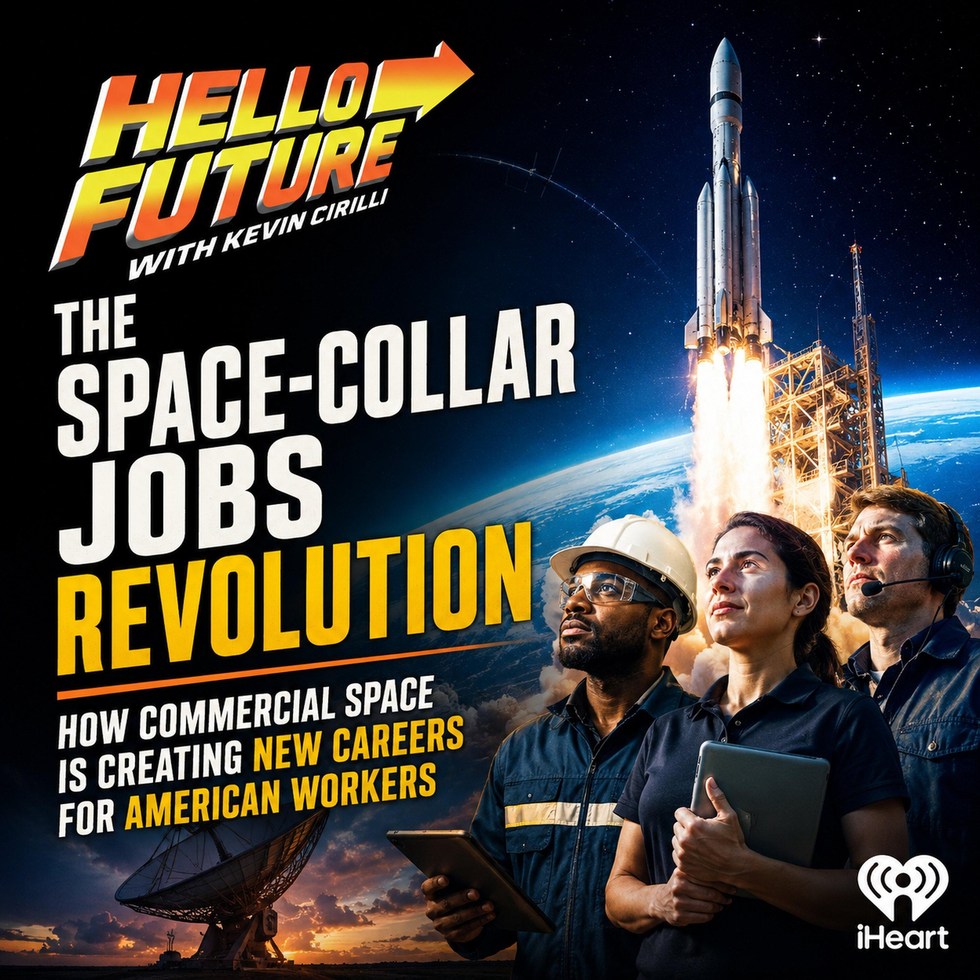
HELLO FUTURE: The Space-Collar Jobs Revolution — How Commercial Space Is Creating New Careers for American Workers

HELLO FUTURE: The Space-Collar Jobs Revolution — How Commercial Space Is Creating New Careers for American Workers


In this episode of HELLO FUTURE, host Kevin Cirilli continues the conversation with Max Haot, CEO of Vast, shifting focus from the hardware in orbit to the jobs being created here on Earth.
As Vast builds real flight hardware today — with Haven-1 already in integration — Haot discusses the surge in “space-collar” jobs in manufacturing, welding, integration, testing, and beyond. With the broader space economy projected to be worth trillions in the coming decade, the discussion explores what this growth actually means for American workers outside the traditional astronaut and rocket-scientist roles. Haot shares how Vast is approaching workforce development and training, the surprising and overlooked job categories emerging in the industry (including designers behind Vast’s new space suits), and why the demand for these roles has changed dramatically in just the last 12–18 months. This forward-looking conversation highlights how commercial space is becoming a powerful engine for high-skill, high-wage job creation across America.

Meet The Future: https://mtf.tv/


See omnystudio.com/listener for privacy information.
Speaker 1 (00:07):
The question that I get asked everywhere I go, really,
whenever I'm talking about Hello Future, is where should folks
be looking for bright spots in the economy? And my
answer is always the same, Look up to the stars
at night, look up at the moon. The economy and
space is where all of the futurism exists in our economy.
Hello Future, It's me keV. This is a dispatch from
the Digital Frontier. The planet is Earth. The year is
twenty twenty six. My name is Kevin Serilli. I'm the
founder of MTF dot TV and the host of Hello Future,
which you can get on your iHeartMedia app. Returning to
the program, one of my favorite guests, Max Hout. He
is the CEO of VAST, which is building space stations
for inevitably when the International Space Station crashes back down
to Earth in the ocean somewhere burns in the sky
over they're however, they're gonna get rid of it. I
don't have an astrophysics disagree. I just interviewed them. He's
building the future economy and that's a very big job,
so I guess talk to us. In our previous episodes, Max,
we talk about the policy behind this and all of
the science behind it. We've gotten your background, but you're
a job creator. Talk to me about how your company
employees all of the people that it takes to make
all of this hardware, all of these docking things. I mean,
you're talking to welders, engineers, astronauts. Tell us about the
future economy of all these jobs.

Speaker 2 (01:39):
Based systems are you know, really complicated and multi discipline.
You know, if you create a satellite as a company,
you need so many type of engineering discipline to be represented.
And you know, obviously the most obvious one or electronic mechanical,
you know, software, but there are many more and many
more subtleties to all of these that you need to
work together to create a space system. Talk about human
space system. Then it goes to another level, right, we
have flight surgeons, we have people doing training, we have
astronaut advisors, we have people that are making food systems
for us.

Speaker 3 (02:14):
You know, the number of discipline that you need.

Speaker 2 (02:16):
To succeed at building a quod space system or space
station is you know, kind of the top most complex
version of a space system.

Speaker 3 (02:24):
And so that you know that means that.

Speaker 2 (02:25):
In each of these team for each of these discipline
you need, you know, not just one person. Sometimes you
need ten, sometimes you need two. But if you aggregate
it all, you easily get to the size of ass
which is today you know, a thousand employee, most of
them in engineering and manufacturing technicians basically, but they also
cannot operate and build a product in the design they
need to do without many more support functions, you know,
from supply chain to marketing to it to security, to
finance and so on, as you find in other businesses.
So incredibly luck to have the chance to lead this
team and to see them, you know, the work they
do every day to build the world's first commercial space station,
which will also be America's next space station, heven one,
and we are doing it right here in a vertical
integrated way. So it means that instead of asking vendors
to build a lot of our systems and peace, we
get raw material that comes in, whether it's our primary structure,
which is the most visible part of the whole that
you see of a space station. We get row sheets
of aluminium coming in and then what comes out is
an actual fully formed space station and everybody that was
involved in that process is right here. And then after
that you have all of the subsystem that get bolted
inside and outside, and all of this was also created here,
and it doesn't stop there, the software, the guidance and
control and navigation and so on.

Speaker 1 (03:49):
I call them space color jobs. I think they are
jobs of the future that have arrived today. And I
can't think of a cooler, more exciting mission to be
a part of if you're a young person, and to
build literally, folks, the next frontier. I mean, it's straight
out of a sci fi movie. So what I find fascinating, Max,
is how you're thinking about workforce development and training. Because
there is no workforce onboarding for the space industry. You're
the you and folks in your industry are the pioneering that.
How are you thinking about new onboarding and rethinking how
you recruit for these space collar jobs, which are primarily
blue collar jobs what they would be called in the past,
but for welders, for technicians and whatnot. Because they're good
paying jobs too.

Speaker 3 (04:40):
I mean, we're luk at that.

Speaker 2 (04:41):
In the LA area, where you know we are in
Long Beach, in the in the Greater Los Angeles area,
there's an incredible amount of multi generational talent. Whether we
all talking about programmers, machinists, welder technician. The experience that
he's here and that has been grown over a few
decades or gener is just incredible. We are nurturing that obviously,
we are attracting that talent and are lucky for them
to join us and help build the mission. You know,
in terms of more on the engineering side, the key
tool is really our internship, right, and you're really building
your next generation of engineers on a five year timeline
or something like that.

Speaker 3 (05:21):
Three to four years.

Speaker 2 (05:23):
The interns of today are engineering leader in the next
five years.

Speaker 3 (05:27):
So this is a constant flux. Every year.

Speaker 2 (05:29):
We have a really large body of interns, mostly in
engineering disciplines that come from amazing college all around the country.
Very competitive. We get tens of thousands of applications.

Speaker 3 (05:42):
Wow.

Speaker 2 (05:42):
The people that applies, obviously are extremely passionate about our
mission and about space and about finding a career where
they can have an impact and build space infrastructure, right,
not PowerPoint, not design, not things that will stay on
the ground, things that will actually fly. You can actually
hear them make some space station in the background. Here.

Speaker 3 (06:03):
I have two quick.

Speaker 1 (06:04):
Questions for you. That's fascinating. Tens of thousands of folks
applying annually just for a vast internship. That shows you
just how the next generation is really understanding that space
is the future. You guys just came out with this,
which I found fascinating and it's a great illustration just
quickly of space jobs that you wouldn't even think of
as space jobs. The vast astronaut flight suit the design
for the next era of human spaceflight. I mean you
can go online and see it. Their web team deserves
a huge shot up. They just got a Webby Award vasted.
But specifically the space suit is designed for astronauts. Even fashion,
it's actually really important what you wear in a space station.
But that's another space collar job for designers.

Speaker 2 (06:44):
Yeah, I mean we have a whole department of soft
goods departments. You know, it's anything from making the bags
to our gomment that I'll use inside in many other
aspect of the space mission. So this is an incredible
part of it to know. Now, the other piece is
that design is to be really part of a commercial
space station. So if you think about government products, usually
there has been no design element to it.

Speaker 3 (07:09):
And if you look at the International.

Speaker 2 (07:10):
Space Station, that's a key demonstration of that. But if
you look at every single commercial product in your life,
from a car to a house, to a piece of
furniture to a computer, I mean, every single thing you
can buy is always a mix between design, function, price
economics and so on. And so this is happening to
commercial space station. And so you can see we've you know,
art space station or designed for professional astronaut. They are
not luxury hotel for tourists. But yet we believe it
should be well designed. It should provide a place where
people can can resk and function better. One would be
more productive in a well designed office than in the
corner of a train station or something like that. So
that that applies to professional environment to use design. And
you're talking about the suit the exact same thing, right.
It's primarily a safety garment and a functional garment so
that you can have your tools and you can operate
in micro gravity and not catch any corner. And so
there's a whole set of requirements that you need for
garment for suits that are that are well suited for
micro gravity. But we should also make sure it looks
good and so and not at the compromise of the functions.
So it's a pleasure to definitely have to be one
of the first company in the world, and we expect
to be the first to have it in space, to
push this boundary and really bring designed to human space flight.

Speaker 1 (08:31):
It's cool. The Vast spacesuit is cool. Final question for you,
what for all the folks who are listening who are
trying to break into the space industry, maybe they're one
of the tens of thousands of folks who have applied
for your internships. CEO of Vast max out, what is
one thing that a job applicant can do to stand
out in an interview that you wish you would have
known when you were just starting out your career.

Speaker 2 (08:58):
That's a hard question, but you know, first I would
say that every single person that ended up receiving an offer,
advice and working is really really passionate about the mission
to extend humanity into space and obviously passionate about space.
And so you know, usually people you know for any position,
right from an assistant to somebody in marketing to obviously
people in engineering. No one arrives here randomly, right, It's
never just another job. So for this type of career,
you have to be passionate, and not just passionate from
a you know, science fiction kind of point of view,
but you have to know the industry. What are the players,
what are the companies, what are the programs that are
going on now, whether it's at NASA in the private.

Speaker 3 (09:41):
Sector, the launch speakers so.

Speaker 2 (09:43):
So generally be really educated as to the context that
we that we live in, and you know, space Twitter
or space X, I guess you could call it now
you know, is a great resource, but I would say
that that's the basic, No, the context that we live in.
As much as you can, that's just an a small piece, right,
it's a detail. The key is really talent and skill
and knowledge and really being the.

Speaker 3 (10:06):
Best at what you do. That's what gets our attention.

Speaker 1 (10:09):
Basically, awesome, Max Out, thanks so much for walking us
through the economy of the future and space collar jobs.
And maybe one day I'll get to go to space
in a vast space station as.

Speaker 2 (10:21):
Soon as soon as we can, and I hope before
that you come and visit us here and check check
the factory.

Speaker 3 (10:26):
And I can show you around.

Speaker 1 (10:27):
So definitely, yes, yes, absolutely, yes, all right, thank you
to you and your team.

Speaker 3 (10:32):
Have a great one.

More For You