Skip to content
Search

Latest Stories

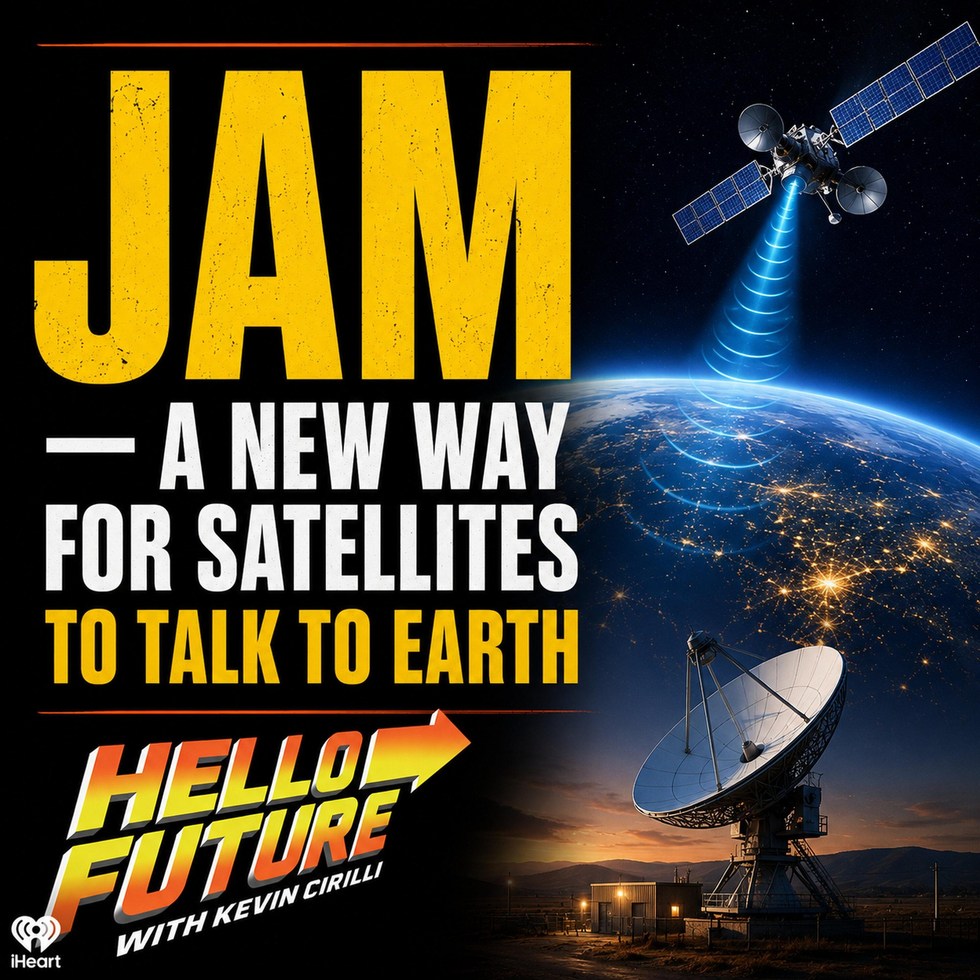
HELLO FUTURE: JAM — A New Way for Satellites to Talk to Earth

HELLO FUTURE: JAM — A New Way for Satellites to Talk to Earth


In this episode of HELLO FUTURE, host Kevin Cirilli talks with Damian DiPippa, the CEO of Auria.
Auria just won a big new contract with the U.S. Space Force. The project is called JAM, which stands for Joint Antenna Marketplace.

Satellites are like robots high up in space. They need to talk to big antennas on the ground to get messages and send back pictures and information. Right now, this can be slow and hard to schedule.
JAM is like a smart online store in the cloud. It quickly connects the people running satellites with antennas all over the world. This makes talking to satellites much faster, easier, and more reliable.
Damian explains why this matters now — there are thousands of new satellites in space, and we need a better way to stay connected.


JAM helps America keep its satellites working safely and smartly. This is one of the coolest new ideas happening in space right now! It turns regular antennas into a fast, flexible team that helps our satellites do their important jobs.

Meet The Future: https://mtf.tv/

See omnystudio.com/listener for privacy information.

Speaker 1 (00:07):
Have you ever heard of the Joint Antenna Marketplace. It's
a jam. It's a real jam, joint antenna marketplace. These
satellites are actually talking to one another, and the US
Space Force is very, very interested in how America's satellites
and our ally satellites are able to talk to one another.
They do it in part with this joint Antenna marketplace.
Hello Future, It's me keV. This is a dispatch from
the Digital Frontier. The planet is Earth, the year is
twenty twenty six. My name is Kevin's really listen to
Hello Future, however you get your podcasts and on the
iHeartMedia app. I'm so excited to welcome back to the
program Damian Dipipa. He's the CEO of ARIA and they
just got this big new contract with the US Space
Force for the project called JAM again, this joint Antenna marketplace.
I don't know too much about it, Damien, so I'm
really excited that you're gonna help explain it to me
and to our audience. So, first of all, I know
it's a big deal. Congrats, but what does it mean?

Speaker 2 (01:08):
Yeah, the joint intent and marketplace essentially is a great
example of coexistence and collaboration between US government space systems
and commercial space systems. So in this case, we have
what's called the US Government Satellite Control Network, which control
which space operators for the government control satellites, you know,
how they operate in space. And the more and more
satellites we have, the more that network is tasked. So
the US government wanted to be able to reach out
to commercial antenna providers to be able to utilize their
antennas within the satellite Control network to also control and
command space vehicles. And so we've been developing kind of
the middleware, the central engine, through a secure cloud environment
that connects these commercial antenna providers to the US government
space operation centers to be able to command satellites and
so kind of as an antenna as a service capability.

Speaker 1 (02:04):
So I find this interesting. It kind of sounds like
the app store and the infrastructure, but the apps in
this analogy would be satellites. And so if different private
space companies are sending up all these satellites, the digital
infrastructure around it needs to be supported and secure. Is
that sort of right?

Speaker 2 (02:23):
Or think of it from this aspect as how you
communicate like the ground system antennas that then communicate with
the satellites.

Speaker 3 (02:31):
This is what the government wants to access, so they.

Speaker 2 (02:33):
Can have constant communication with satellites all over the world
without the US government having to build a thousand antennas
and use their own network to run them all.

Speaker 1 (02:44):
So how many antennas are we going to need?

Speaker 2 (02:46):
Well, it all depends on how many satellites you have too.
I mean, every satellite needs to communicate either to an
antenna or a ground station.

Speaker 3 (02:54):
And as we go more in the future, you.

Speaker 2 (02:56):
Know, every iPhone could be an antenna kind to satellites
for direct to satellite you know communication.

Speaker 1 (03:04):
That's fascinating to me because I think we talk a
lot about data centers right now. But is there a
world where there's an antenna shortage or no?

Speaker 2 (03:13):
Oh no, I don't think there'll ever be a world
where there's an antenna shortage. If anything, I see the
technology continue to move into the future where tech, the
antenna technology ory is smaller, is more ubiquitous, more available
across the board. I mean even today, like I said,
future generations of your cell phone are going to be
basically satellite phones. Now that takes us to a whole
new technology over what we're doing with cell it with
cellular networks today, because now we're actually talking about do
we really need cellular networks with satellite capability able to
now do all of that director your phone? And so
as we improve speeds and times and data capacity in space,
that's just going to make this a bit capability just
more everyone to even the average user today.

Speaker 1 (04:02):
Should we be thinking about putting antennas on the moon
in Mars.

Speaker 2 (04:06):
Well, we already are, right, I mean, as we've talked
previously with Artemis having already gone around the Moon, and now.

Speaker 3 (04:14):
We're talking about a moon base.

Speaker 2 (04:15):
There are already plans of putting you know, constellations of
satellites around the Moon to be able to do this communication,
in which case you'll need the antennas to be able
to communicate as well.

Speaker 1 (04:26):
So if you're a young person and I mean I'm
hearing you talk and I'm just thinking to myself, I'm like,
this is where the jobs are, folks. I mean, this
is such a bright spot in the economy because I mean,
how many satellites are up in space right.

Speaker 3 (04:39):
Now, thousands, tens of thousands.

Speaker 1 (04:41):
Tens of thousands, and now you're talking about doing it
around the moon. And Mars, and I would imagine it's
going to take a lot of jobs. So if you're
a young person and you're thinking about cyber first of all,
how did you get to where you are? And what
would you what advice would you give to people who
are are looking to break in into the space I
call them space collar jobs. This space industry.

Speaker 3 (05:05):
You know, well I.

Speaker 2 (05:06):
Started as an aerospace engineer and satellite architect, you know,
thirty five years ago. Well, this was still emerging, and
you know at that point in time you kind of
had to get a degree in that area and work
and focus in that area.

Speaker 3 (05:16):
The nice thing about the space.

Speaker 2 (05:18):
Economy today is you don't actually have to be a
space expert to work in the space economy today. I mean,
we have a perfect example at Oria where we took
our space operators that understand the space environment and we
paired them up with ui UX game developers and we
created applications and tools in order to train the next
generation of space operators and to do mission planning for
space that used you know, modern day graphics that everybody
is used to. And so our software developers who actually
developed that really.

Speaker 3 (05:52):
Had no space background.

Speaker 2 (05:53):
We just paired them up with the space experts and
then they were able to develop these tools.

Speaker 3 (05:58):
And so that's just one.

Speaker 2 (05:59):
Example of how well you don't actually have to have
a space background to work in the future space economy
because these skills will be so transferable to applications that
we need in space as well.

Speaker 1 (06:10):
Talk a little bit about your company and the types
of jobs that you support that you have and the
type of fields that it touches, just to that point
which you just explained.

Speaker 2 (06:20):
You know, we are innovators and integrators of command and
control and communications solutions from orbit to what we call
the tactical edge all the way to the warfighter for
mostly space related operations, and so we have a lot
of software developers and systems engineers that we hire.

Speaker 3 (06:35):
We also do have space experts.

Speaker 2 (06:37):
We have people that understand AI and develop AI algorithms
that we apply into space. And then we actually have
some people that understand hardware design of chipsets and how
to develop alternating waveforms for communicating with space assets from.

Speaker 3 (06:53):
The ground in a secure way.

Speaker 2 (06:56):
Skills in software development, in engineering, in spacecraft orbital mechanics,
and in payload operations for like satellite systems and collection
systems you know, radar from space, imagery from space. These
are the types of experts we hire and employ.

Speaker 1 (07:13):
An area awesome, and it's kind of sounds like making
video games, like you're coding video games, but for real
life satellite systems.

Speaker 2 (07:20):
In some cases and in other cases we're actually putting,
you know, assembling you know, chipsets and building radios that
are going in the hands of war fighters out in
the field to communicate securely.

Speaker 1 (07:31):
I mean, it really is the jobs of the future.
That's what I just find so interesting about this is
it's really the jobs of the future. We're celebrating two
hundred and fifty years young. I like to say, we're
a young country. You're helping to build the next two
hundred and fifty years. Where does Damian to pipup orient
America's presence toward going Like most people that I interview
in this industry, they understand that we're creating a presence
on the Moon. They understand that that's to ultimately get
to Mars. They understand I think arguably setting up bases
in order for mining and for energy. I love Planet Earth.
I mean I'm an Earthling, you know, God bless, but
the resources on our planet our finite. But if you
start to look at the you know, carbon three for example,
on the Moon, or we haven't even mapped our own
solar system, which is wild to me. And satellites get
to map the Solar System and get to see all
of the resources that you know. I'm not pushing my
religion on anybody. I believe in God that I believe
God gave us in our Solar system, you know what
I mean. That's what I envision is America really being
able to expand freedom further and further into the Solar
System so that we can make life better for humans
here on planet Earth. That's kind of what motivates me.
But how do you think about it as CEO of
a company that does the software for these satellites, which
candidly there's going to be millions of them. I believe
in our lifetime in our Solar system.

Speaker 2 (08:58):
The future is really limitless as far as that goes,
particularly with the commercialization of space, and now there are
probably more commercial applications from space than there are government
and military applications from space today, and so they will
always have the need to send communication, to send data,
to command their systems. They'll need more integration. More and more,
these systems are lasting longer, so newer systems will have
to communicate with older systems that integration and will continue
to help integrate that fragmentation, which will always exist over
time because new technologies will continue to outpace you know,
anything we could really think of as we go forward.
I like to say, the law of alchemy says we
don't even know today what that new innovation will be
ten years from now. That'll just change our lives. And
so given the distances of space, there will be a
need for commanding, communication, and controlling of these assets.

Speaker 3 (09:54):
And you know, our role is really to tie that
all together.

Speaker 2 (09:56):
For our customers, both on the commercial side and the
government side and the military side, and then also the
kind of coexistence and collaboration of the two together.

Speaker 1 (10:05):
David the pip A CEO of ARIA, I really appreciate
you showing up to meet the future and thank you
so much.

Speaker 3 (10:11):
Great talking to you.

Speaker 1 (10:12):
Thanks

More For You