Skip to content
Search

Latest Stories

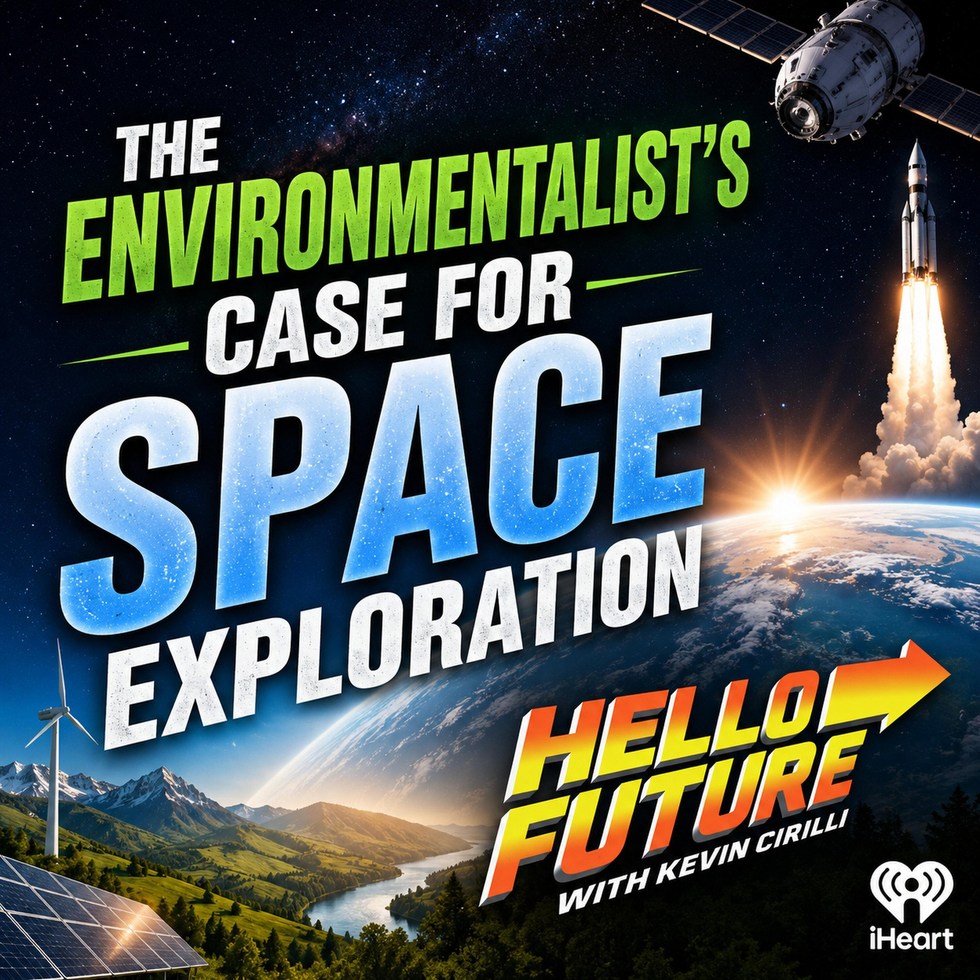
HELLO FUTURE: The Environmentalist’s Case for Space Exploration

HELLO FUTURE: The Environmentalist’s Case for Space Exploration


In this episode of HELLO FUTURE, host Kevin Cirilli speaks with Mary Guenther, Head of Space Policy at the Progressive Policy Institute and co-author of the new report Space for Progress, Earth for Keeps. Mary makes the pragmatic progressive case that the explosion in space activity shouldn't be viewed as an environmental threat — it’s a powerful tools for protecting the planet.

The conversation explores how NASA, NOAA, and commercial satellites generate terabytes of free data every day that power conservation, wildfire response, precision agriculture, drought monitoring, and disaster management. From the SWOT satellite measuring water levels in the Everglades with centimeter accuracy to the FireSat partnership (Earth Fire Alliance, Muon Space, Google, and EDF) that will detect 5×5 meter wildfires every 20 minutes, Mary shows how space tech is democratizing environmental intelligence for nonprofits, local governments, farmers, and everyday Americans.


She also addresses the real questions around rocket emissions, satellite reentries, and atmospheric impacts — but argues the smart path forward isn’t a binary fight over more regulation. It’s more science, sustained funding for NASA Earth Science and NOAA, smarter public-private partnerships, and industry-led innovation on cleaner fuels and materials. If you care about the environment and the future, this conversation reframes how space exploration serves Earth.

Meet The Future: https://mtf.tv/

See omnystudio.com/listener for privacy information.

Speaker 1 (00:06):
You know, one of the reasons that I am so
passionate about space exploration and thinking through space is because
I believe that here on planet Earth, our resources are finite.
It's really a supply and demand problem. We only have
so many resources on this planet. But outer space is infinite,
and there are infinite resources in outer space. So why
are we only sucking dry planet Earth? If we care
about protecting the environment, which I do, If we are
environmentalists and want to make sure that we don't contribute
to climate change, why not explore our very own solar system.
Ultimately other galaxies far far away. Hello Future, It's me keV.
This is a dispatch from the Digital Frontier. The planet
is Earth. The year is twenty twenty six. My name
is Kevin's Really. You can get all of the latest
Hello Future episodes on your iHeartMedia app. You can also
get them wherever you get your podcast. Be sure to
check out my website MTF dot tv for all of
the latest futurism news. My guest today is someone who
I'm thrilled to welcome back to the program. Her name
is Mary Gunther. She's the head of space policy for
the Progressive Policy Institute which is located here in Washington,
d C, where I'm broadcasting from. And she's also the
co author of this awesome new report that PPI put
out called Space for Progress, Earth for Keeps, and she's
making a very pragmatic case that the explosion in space
activity should not be viewed as an environmental threat. It's
actually going to protect our planet. I love this, Mary,
Thank you so much for coming back on the show
to talk about your report. The reason I love this
is because I think that really lately, especially there's been
this false narrative in the press, even in legacy media press,
that space is somehow just a billionaire personality contest, folks
blasting off rockets and starships and space toys for whatever reason,
that we've sort of lost the plot a little bit
that actually exploring the Moon and mining Mars and mining asteroids,
growing resources in outer space, medical health and space, all
of that is to make our lives better here on
planet Earth and to protect our planet. So why did
you want to do this report and what did you
find in it?

Speaker 2 (02:23):
Thank you so much for having me. So Space gives
and space takes is the simplest way to put it.
And we know a lot more about the give side today,
but if you look at what we can see from space,
the World Economic Forum is estimated that fifty percent of
all essential climate variables can only be viewed from space.
That means that the information you're getting about the water
content from space has enabled massive amounts of drought monitoring
and drought response within you know, a particularly vulnerable community,
some of which we're not able to monitor prior to SWAT,
which is a mission that is from both NASA and
the French Space Age caness. It also means that we
have new tools to detect wildfires so that firefighters have
better information to enable them to respond to and ultimately
contain those to minimize property damage to communities here on Earth.
It's really incredible all of the information we get about
our Earth from space, and it's so important to protect
that and ensure we expand access and use new technologies
like AI to expand the environmental insights and the goodness
we get. On the other side, there are these open
scientific questions about the potential impacts that space activities have
on the atmosphere. We need to understand them because much
of the nasin science that has been done is on
old fuels and old materials that are not as commonly
used today. So the projections and the models are not
necessarily comporting with current activities. Until we understand what kind
of environmental impacts there are, there's really not much we
can do to mitigate it, which is concerning.

Speaker 1 (04:00):
Mary Gunther is my guest today. She's head a space
policy for the Progressive Policy Institute PPI out of Washington, DC.
She co authored this great new report called Space for
Progress Earth for Keeps an Integrated Framework for Space and
the Environment. She wrote it with Susie Perez Quinn, who's
formerly with NASA. Great great report. Can't recommend it enough
and if you go to MCF dot tv, I'll make
sure to link to it on our when we push
out the episode in the US alone. The report found
satellite launches have surged more than six hundred percent over
the past decade, and their pace is only expected to
accelerate as the race to deploy data centers into orbit
heats up. I talk about this, I report on this.
This is something that I'm really passionate about. I do
believe that we should be putting data centers up in space.
It is probably one of the best illustrations that people
right now can understand about how if we put them
in space, we're not negatively impacting the environment. You write
what happens in space now touches almost every aspect of
modern life, from agriculture to national securities and navigation to
internet access, space technology, and earth science. I think that
that's stat that you just gave us, Mary, fifty percent
of all of the information that we need in civilization
to track can only be viewed from space as staggering.
I mean, in many ways this is an equality issue
because underserved communities are parts of the world. They deserve
to have information about their water that you pointed out,
or significant weather threats of climate change. So space is
vital for that. You talked about fuel and whatnot. But
even as we think more long term and you talked
about some of these unanswered environmental questions, you know, I
think one of the things that people have questions about
is the impact of all these launches on the atmosphere
and on pollution. So, from like a kindergarten level, why
should folks be optimistic about why exploring more into space
can actually help protect our environment.

Speaker 2 (06:18):
That's a perfect question in that, of course, there likely
are some environmental impacts from rocket launch, and we should
in fact seek to understand them better because there's a
variety of fuels use at the same time, though, if
we aren't launching these satellites up to space, they tell
us about wildfire risk, about water conditions that are helping
farmers every day grow more efficiently to ensure that more
of the world's population is fed, while we're going to
be losing out on a ton of this atmospheric information
that can improve our lives down on Earth in a
very direct and tangible way. I know folks always want
to know is a hurricane coming? Is my home? And danger?
These are really basic safety questions, And so while we
think about how we understand potential space pollution, we also
cannot lose sight of the fact that the progress and
the information we get in the environmental context alone, not
to mention the national security implications and the economic implications,
mean that we can't stop progress while we answer these
questions those tuning to beyond parallel tracks.

Speaker 1 (07:22):
And I think to your point, it's only in the
last couple of decades, folks, that we've been able to
monitor if a hurricane's coming, and that is something that
I don't think anyone living in Florida or in the
Gulf that they want to know if that hurricane's coming.
They deserve to know. So these basic, basic things that
we candidly, I think, sometimes take for granted. We're only
invented because of space exploration period. I love your report
for a lot of reasons. But this chart where you
specifically talk about the different levels of the atmosphere and
the different layers of the Earth's atmosphere, and you're not
hearing things. You are hearing a dog bark. That's my dog,
Theo making his debut on Hello Future. Apparently there might
be a guest at the door, but there is not,
so we'll keep going. But the thermosphere, which is where
the International Space Station is, it is only two hundred
and fifty miles above us, which is a fraction of
how the width of America from New York to California.
So we're not even necessarily talking about long, large distances
before we get into our space, which means at the
Earth's atmosphere is really like a piece of paper. That's
how we have to think of it. But there are
these different layers to it. And what Mary's advocating for
is making sure that there is enough scientific research so
that we fully understand these different piece of paper layers
of our atmosphere so that we don't screw it up right.

Speaker 2 (08:53):
That's exactly it. At the end of the day, there
is not this kind of distinct separation between space and Earth.
It's gradiations, it's shades of gray, so to speak. And
so understanding what the impacts of space activity are is
going to be critical at various levels of the atmosphere,
in large part because the space industry is made up
of people who love Earth. We've seen them when they've
learned new things about material science, been willing to change
up how they conduct their operations, how they build, to
ensure that they are conducting operations safely. So as we're
having this environmental conversation, part of the reason we're doing
this report is let's see industry as a partner. Let's
work with industry together to first understand the science, but
then what are these responses, How can we respond to
them in partnership before we start thinking about a binary
choice about regulation or about cracking down, because today we
aren't seeing an industry that is blatantly thumbing their nose
at environmental concerns within the atmosphere. We're seeing an industry
that it'd be interested in learning more about the Earth
so actively supports missions that learn more about our Earth.
And therefore we should be giving them the information that
they need to understand so that they can make responsible choices.

Speaker 1 (10:12):
And it's especially as science with satellites get better at
re entering into earth aluminum, for example, aluminum oxide particles,
because I think the average person is familiar with in
their mind conjuring up an image of when a satellite
comes back down to Earth, it burns up in the sky.
That makes sense to people. It's crashing down and it disintegrates.
I think is people understand that, but it doesn't really disintegrate,
you know if you I mean it disintegrates in the
sense that it's not going to like it will burn up.
But when it burns up, chemicals are released. And at
a very simple level, and I'm a translator for kindergarteners,
that's what I like to say. Mary's trying to push
for understanding the impact that when the soundatellite burns up,
when it's re entering, what effect those chemicals have on
the atmosphere. And she's advocating for more studying and research
of that specific field so that it can guide policymakers
who and I don't believe that either party really has
a clear in the United States, let alone worldwide has
a clear enough, Like this isn't really a part of
an issue yet because no one's really thinking about it.
So Mary's ahead of the curve in thinking about it.
But we've got a six hundred percent increase in satellites
going up to space just in the last decade. That's
only going to continue to increase. It just means, like,
what effect is it going to have? These are the
type of questions that we did that just no one's
talking about. So I commend you for doing that. What
is something really cool, probably that won't happen in our lifetime,
that makes you really optimistic and hopeful and excited about
space as a means of protecting our planet.

Speaker 2 (11:59):
I'm so excited for our ability to mine both the
asteroid and the Moon. I mean, our potential to create
rocket fuel from the water ice on the Moon, and
you know obviously the corresponding savings of fuel here on Earth.
It blows my mind. It would be incredible to be
able to get there, and I know that we're taking
steps every day with the ard Miss program.

Speaker 1 (12:21):
I agree. I think when I was a kid, you know,
and we would watch Magic School Bus when we had
a substitute teacher, like that was a big thing. Oh
is there is there water on the Moon? And is
there water on Mars? But the reason we thought about
it was because in my head it was like, oh,
I could drink water on the Moon. But actually, in reality,
it's for energy production and that's incredible. I hope that
one of your next studies touches on that, because I
think that that's really really cool. We're going to have
to have you back on. Thank you so much for
showing up to meet the future and just thinking through
all of these really important issues. And again, folks, check
out her study that she wrote with Teuzy fors Quinn.
I'll put it up on MTF dot TV and thanks.
Have a great tomorrow today

More For You