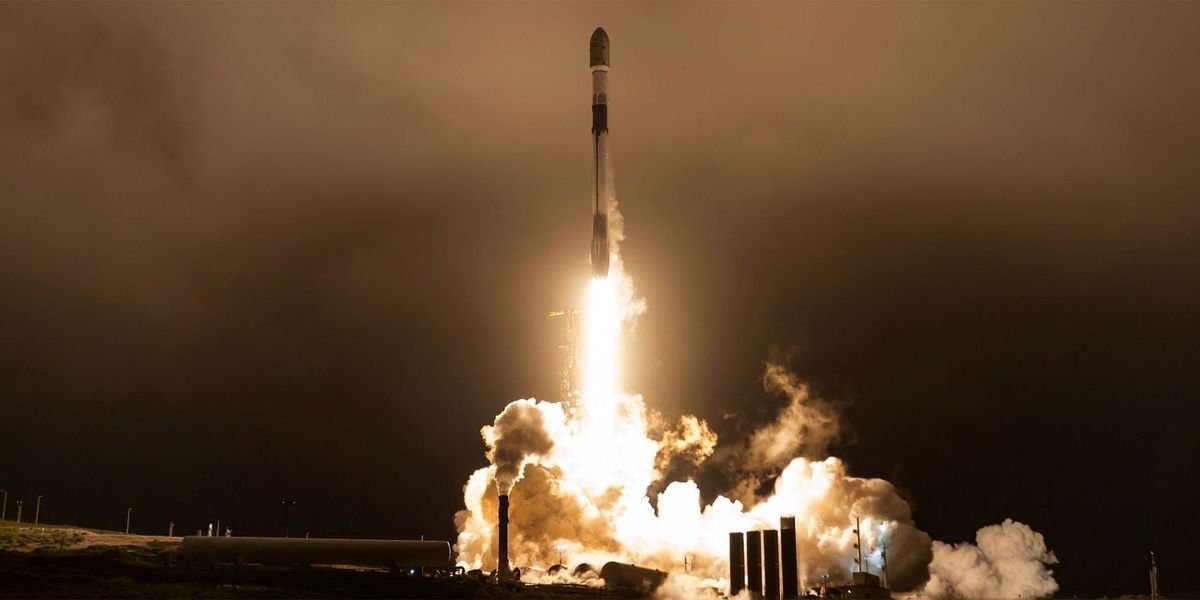
SIGN OF THE TIMES: SpaceX launches 29 Starlink satellites from Florida just hours after Blue Origin rocket explosion, via Space.com.
Welcome to SPACE <GO> -- my weekly tip-sheet on all things space industry from the Space Coast, to the Capitol Corridor, to Wall Street. Subscribe below. Back to the future...
BLUE ORIGIN JUST HAD A BIG PROBLEM — AND IT COULD HURT THE WHOLE SPACE STOCKS: Blue Origin’s big new rocket blew up during a test on the launch pad. The blast damaged the launch site so badly that it could take more than a year to fix. This means Blue Origin won’t be able to launch rockets for a long time, which is bad news for the company and its customers.
--> WHY THIS MATTERS FOR INVESTORS: Blue Origin was supposed to start launching a lot of rockets this year for big customers like Amazon. Now those plans are pushed back, and the company has no other place to launch from right now. This gives SpaceX even more control over big rocket launches, which could make SpaceX stock look stronger while Blue Origin and companies that were counting on them may face delays.
Source: Ars Technica (H/T James Carafano)
BLUE ORIGIN BLAST HITS SPACE STOCKS — “LAUNCH RISK” GOES PUBLIC. Blue Origin’s New Glenn rocket exploded during a pre-launch test, triggering a sharp sell-off in public space stocks. As more companies go public and retail investors pile in, launch risk is now a live valuation factor — not just an engineering one.
--> LAUNCH RISK HITS VALUATIONS: ASTS, RKLB, LUNR and other space names dropped sharply on Friday. What was once largely a private-sector issue is now immediate market feedback. SpaceX’s recent successful Starlink launches stood in contrast, underscoring the premium investors are placing on proven reliability.
--> COMMUNICATIONS GAP: The space industry now needs stronger, more credible voices on-air and in Washington. As setbacks become public events that move stocks, clear communication on timelines, safety, and risk is no longer optional. Innovation has long outpaced policymakers. That window is closing. High-profile incidents involving listed companies will force clearer rules on safety, licensing, and oversight — much like the airline industry faced for decades.
--> BOTTOM LINE: The space sector is maturing into a public market. Execution, transparency, and communication now carry immediate financial consequences.
Sources: Business Insider CNBC Yahoo Finance Space.com
SPACE FORCE AIMS TO BACK MORE START-UPS — HERE’S THE PLAYBOOK: At the State of the Space Industrial Base conference in New Mexico last week, Col. Tim Trimailo, director of the Space Force’s Commercial Space Office (COMSO), laid out practical guidance for startups looking to win defense business.
--> START WITH THE ‘WHY.' Trimailo stressed that founders must lead with the warfighter problem and the operational capability their technology delivers. “We buy capability, we don’t buy widgets,” he said. Too many pitches jump straight into technical details without clearly explaining the military outcome or “so what.”
--> KEY RULES FOR DEFENSE STARTUPS: Successful companies are transparent about setbacks (the ecosystem is small), provide enough technical detail to build credibility without revealing everything, and take time to understand real budget and requirements processes. There are “very, very few, if any, secret pots of funding.” Persistent, ongoing engagement beats one-off meetings.
--> THE DUAL-USE EDGE: The strongest path combines commercial traction with government support. Trimailo wants to see companies use programs like SBIR to attract private capital, then leverage that momentum for follow-on funding such as TACFI or STRATFI. He warned against letting government work pull startups too far from their commercial roots.
--> MEET THE FUTURE: The Space Force is actively trying to bring agile commercial players into its ecosystem, but winning requires speaking the language of capability, outcomes, and procurement reality. Trimailo’s advice is less about shortcuts and more about building the relationships and credibility that actually close contracts in a competitive, capital-intensive sector.
Source: SpaceNews
EXCLUSIVE: PROGRESSIVES LOOK TO SPACE FOR CLIMATE WINS — NOT FIGHTS. A new Progressive Policy Institute report and discussion make the case for framing space activity as a tool for climate resilience and middle-class jobs rather than a threat to Earth, as I exclusively report on HELLO FUTURE with Kevin Cirilli for iHeart Media.
--> THE PRAGMATIC CASE: Space-based data already delivers measurable environmental wins — from FireSat’s rapid wildfire detection to SWOT’s precise water monitoring and precision agriculture tools. Advocates argue that 50% of essential climate variables come from space and that the industry should be positioned as climate infrastructure, not a problem to regulate in isolation.
--> THE EQUITY AND JOBS ANGLE: The messaging emphasizes benefits for underserved communities and the Global South through better data and economic opportunity. The goal is to avoid binary fights between space progress and planetary protection, instead pushing for more science on emissions, sustained NASA/NOAA funding, and public-private collaboration.
--> MEET THE FUTURE: As space becomes more visible and commercial, progressives are testing a more constructive frame — one that ties orbital capability to terrestrial climate goals and job creation rather than treating the two as competing priorities.
Source: mtf.tv
RETAIL INVESTORS ARE ALREADY CHASING SPACEX VIA ETFS — THE HYPE IS HERE: Space-themed ETFs are seeing explosive retail inflows as investors look for ways to get exposure to SpaceX ahead of its expected blockbuster IPO.
--> THE ETF GOLD RUSH: Tema’s NASA ETF has ballooned to more than $2.6 billion in assets in roughly two months. Other vehicles, including Baron’s First Principles and ERShares Private-Public Crossover, also hold SpaceX shares. The sector is being positioned as the next major theme after AI, with six new space ETFs launched in the past three months alone.
--> WHAT’S IN THE FUNDS: SpaceX represents about 7.5% of the NASA ETF. These products give retail investors easy access to a company that was previously difficult to own before an IPO. Some funds are more concentrated in pure space plays, while others mix in broader defense or industrial names.
--> THE RISKS: CNBC's Krysta Escobar flags high volatility in the space sector, citing recent setbacks like the Blue Origin explosion. Many of these ETFs carry higher fees than traditional passive funds, and holdings can shift quickly once SpaceX goes public. Not all space ETFs are created equal in terms of concentration and quality.
Source: CNBC
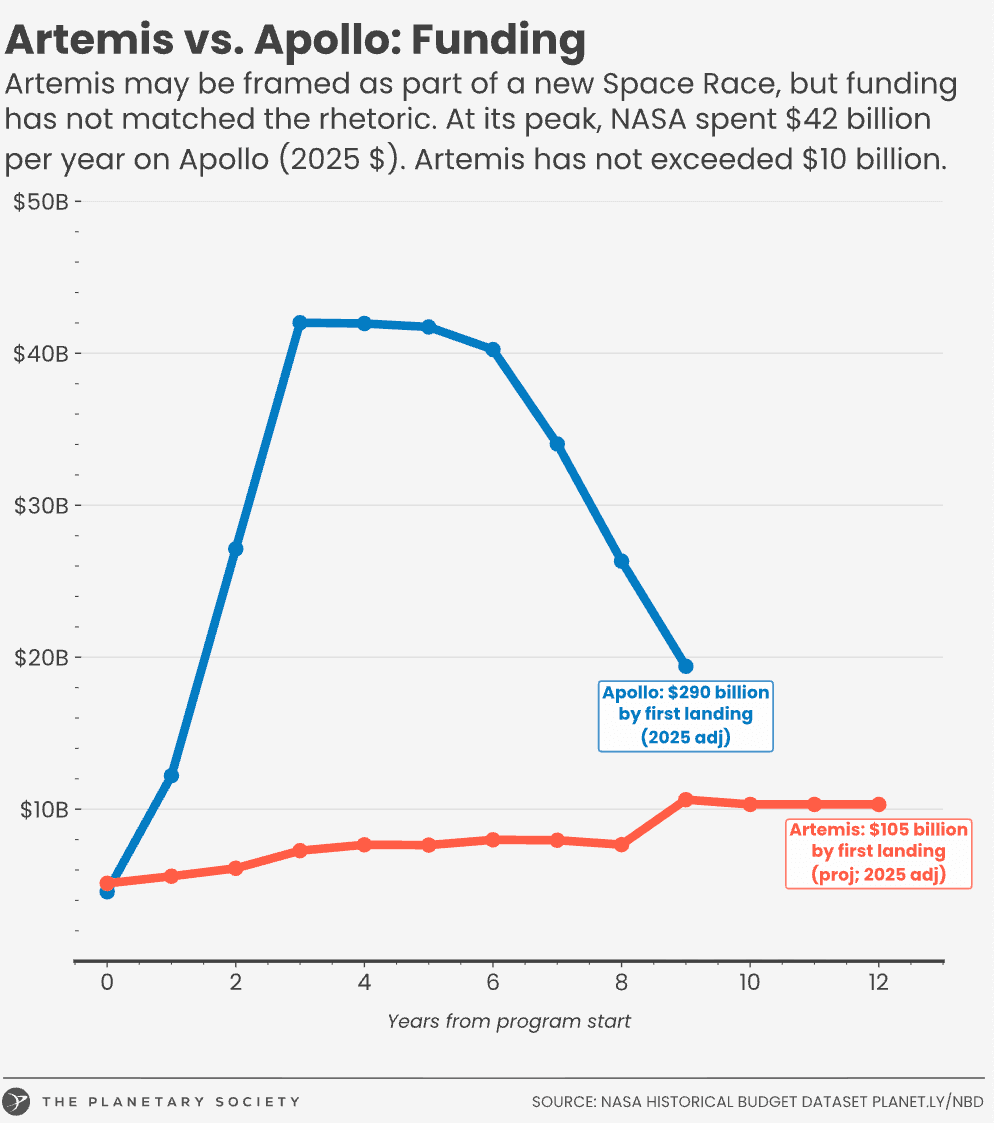
ARTEMIS VS. APOLLO: THE NUMBERS TELL A DIFFERENT STORY: NASA’s Artemis program is often compared to Apollo, but the scale, pace, and approach are fundamentally different. Three key charts highlight how today’s lunar effort operates under tighter budgets, longer timelines, and different workforce realities.
--> BUDGET REALITY: Artemis is projected to cost roughly $105 billion by the time astronauts return to the Moon in 2028. That figure is significantly lower than Apollo’s inflation-adjusted spend of around $290–300 billion through its first landing. Annual funding for Artemis also averages far below Apollo’s peak yearly outlays, reflecting a more constrained fiscal environment.
--> TIMELINE AND SCOPE: Apollo moved with extreme urgency, launching 21 robotic lunar missions in just seven years to prepare for crewed landings. Artemis is taking a slower, more commercial approach focused on sustainable presence rather than a rapid sprint. The first crewed landing is now targeted for 2028, more than a decade after the program’s formal start.
--> WORKFORCE AND EXECUTION: During Apollo, NASA’s civil servant workforce nearly tripled in just a few years to meet aggressive deadlines. Artemis is operating with a shrinking workforce and reported morale challenges, including a 20% reduction in civil servants in 2025. This smaller team is being asked to manage a more complex, long-term program that relies heavily on commercial partners. Artemis is not Apollo 2.0. It is a slower, leaner, and more commercially dependent effort operating in a very different political and budgetary reality.
Source: The Planetary Society
 Source: The Planetary Society